
AI for Retail: Improving In-Store Operations With Vision, Forecasting and Assistants
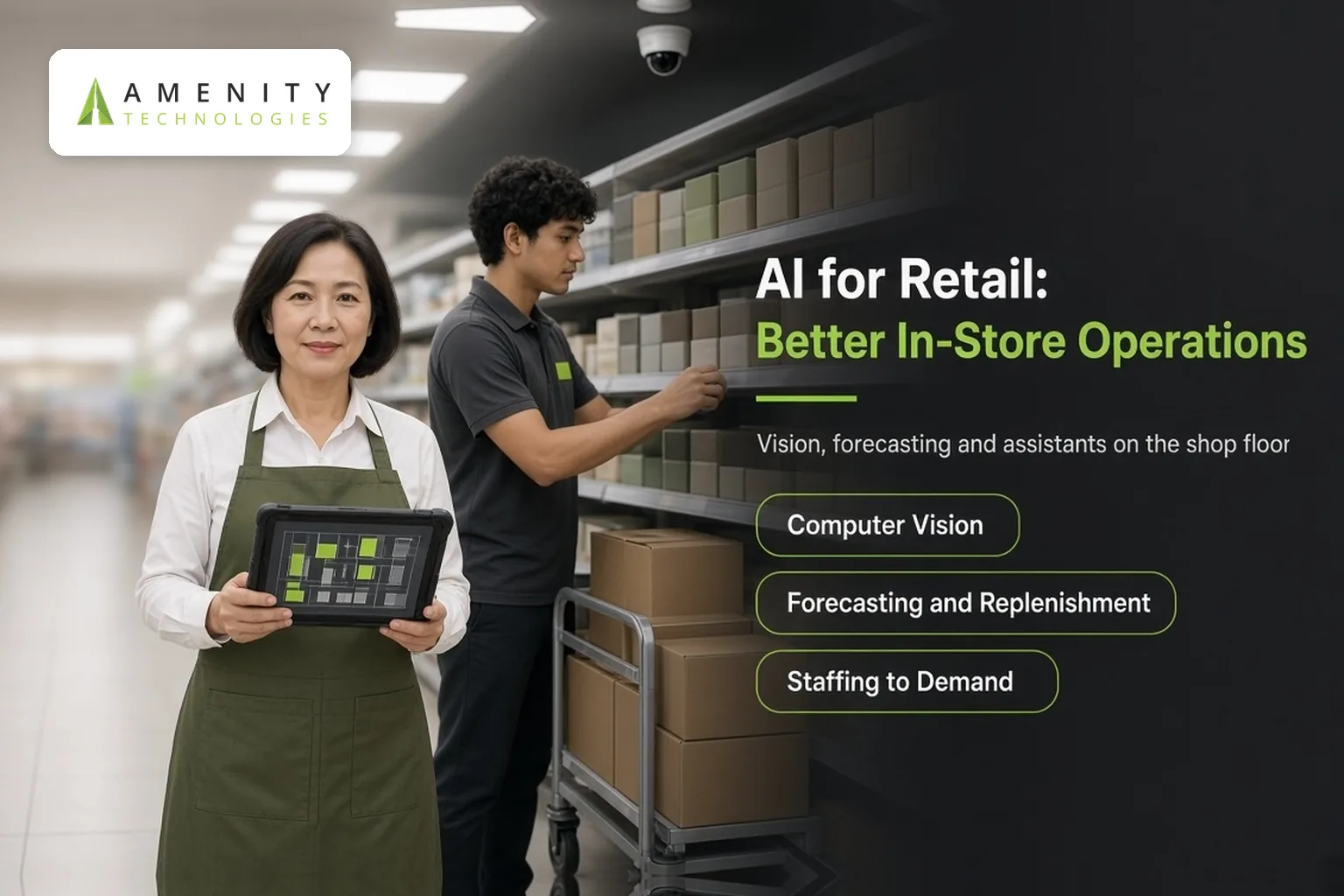
Physical stores face pressure from online competition, rising costs and staff shortages. Yet stores still hold a big advantage: customers can see, touch and buy immediately. AI helps retailers protect that advantage by keeping shelves full, staffing the right hours and answering questions quickly. This guide covers in-store AI for retail. For online stores, see AI for e-commerce operations.
In-Store Use Cases
| Area | AI application | Benefit |
|---|---|---|
| Shelf availability | Cameras detect empty or misplaced shelves | Fewer lost sales |
| Planogram compliance | Check displays match the plan | Consistent store layouts |
| Footfall and dwell | Count visitors and track busy zones | Better layout and staffing |
| Queue monitoring | Detect long queues and alert staff | Shorter waits |
| Demand forecasting | Predict sales by store and product | Better replenishment |
| Staff scheduling | Match shifts to predicted traffic | Lower costs, better service |
| Store assistants | Chat or kiosk answers about stock and products | Faster help for shoppers |
Computer Vision on the Shop Floor
Cameras combined with computer vision and object detection can spot empty shelves, misplaced products and long queues, then alert staff. Systems can be designed to analyse products and areas rather than identify individuals. Read where computer vision delivers value.
Forecasting and Replenishment
Machine learning forecasts demand by store, product and day, using sales history, seasonality, promotions, weather and local events. Better forecasts mean fewer stock-outs and less waste, especially for perishable goods. See machine learning development.
Staffing to Demand
Footfall data and forecasts help managers schedule more staff at busy times and fewer during quiet periods, improving service without raising costs.
Helping Shoppers and Staff
- Shoppers: kiosk or WhatsApp assistants answer stock, size and price questions and support click-and-collect.
- Staff: a knowledge assistant answers product, policy and process questions instantly.
See omnichannel chatbots and personalised recommendation engines.
Privacy and Trust
- Inform shoppers where cameras and analytics are used, as local rules require.
- Prefer anonymous counting and product-focused analysis.
- Use facial recognition only where lawful, necessary and transparent.
- Follow applicable data protection laws.
Infrastructure Choices
Video analytics can run on edge devices in stores to reduce bandwidth and keep raw footage local, sending only alerts and summaries to the cloud. Our team works with edge hardware for these deployments. See AI deployment services.
Getting Started
- Pick one measurable problem, such as stock-outs in a key category.
- Pilot in a few stores with clear before-and-after metrics.
- Train store teams to act on alerts.
- Scale to more stores and use cases.
Measuring Success
- On-shelf availability for key products
- Sales lift in categories with fewer stock-outs
- Queue length and wait times
- Labour hours versus footfall
- Waste on perishable products
Common Pitfalls
- Alerts that nobody is assigned to act on
- Camera placement that misses key shelves
- Ignoring store staff feedback during the pilot
How Amenity Approaches Retail AI Projects
- Visit stores and map operational pain points
- Choose one measurable problem and baseline it
- Design camera, data and alert workflows with store teams
- Pilot in a few stores
- Scale with central dashboards and store-level actions
Store teams are involved from the start, because they are the ones who act on AI insights every day.
Key Takeaways
- Computer vision keeps shelves full and queues short.
- Forecasting improves replenishment and staffing.
- Privacy-friendly designs build shopper trust.
- Pilot in a few stores before scaling.
Retailers that combine store data with online data gain a complete view of customers and stock, making every channel smarter. The physical store becomes a source of insight as well as sales.
About Amenity Technologies
Amenity Technologies is a GenAI and AI development company based in Ahmedabad, India, with a team of 50+ AI specialists. We build chatbots, voice bots, RAG systems, AI agents, computer vision and custom AI software for clients worldwide. See our awards and achievements.
Related Reading
- AI for e-commerce back-office operations
- AI for manufacturing: visual quality inspection guide
- AI for customer service: metrics and the hybrid support model
Frequently Asked Questions
How is AI used in physical retail stores?
For shelf and planogram monitoring, footfall and queue analytics, demand forecasting, staff scheduling and shopper or staff assistants.
Can AI detect empty shelves?
Yes. Computer vision with in-store cameras can detect empty or misplaced shelves and alert staff to restock.
Does retail AI need facial recognition?
Usually not. Many use cases work with anonymous counting and product-focused analysis. Facial recognition should only be used where lawful, necessary and transparent.
How does AI help with retail staffing?
Footfall data and demand forecasts help managers match shifts to busy and quiet periods.
Where should a retailer start with AI?
With one measurable problem, such as stock-outs in a key category, piloted in a few stores before scaling.
Bring AI to Your Stores
Talk to our AI team about your use case, or explore our case studies.