
AI for Manufacturing: A Practical Guide to AI Visual Quality Inspection
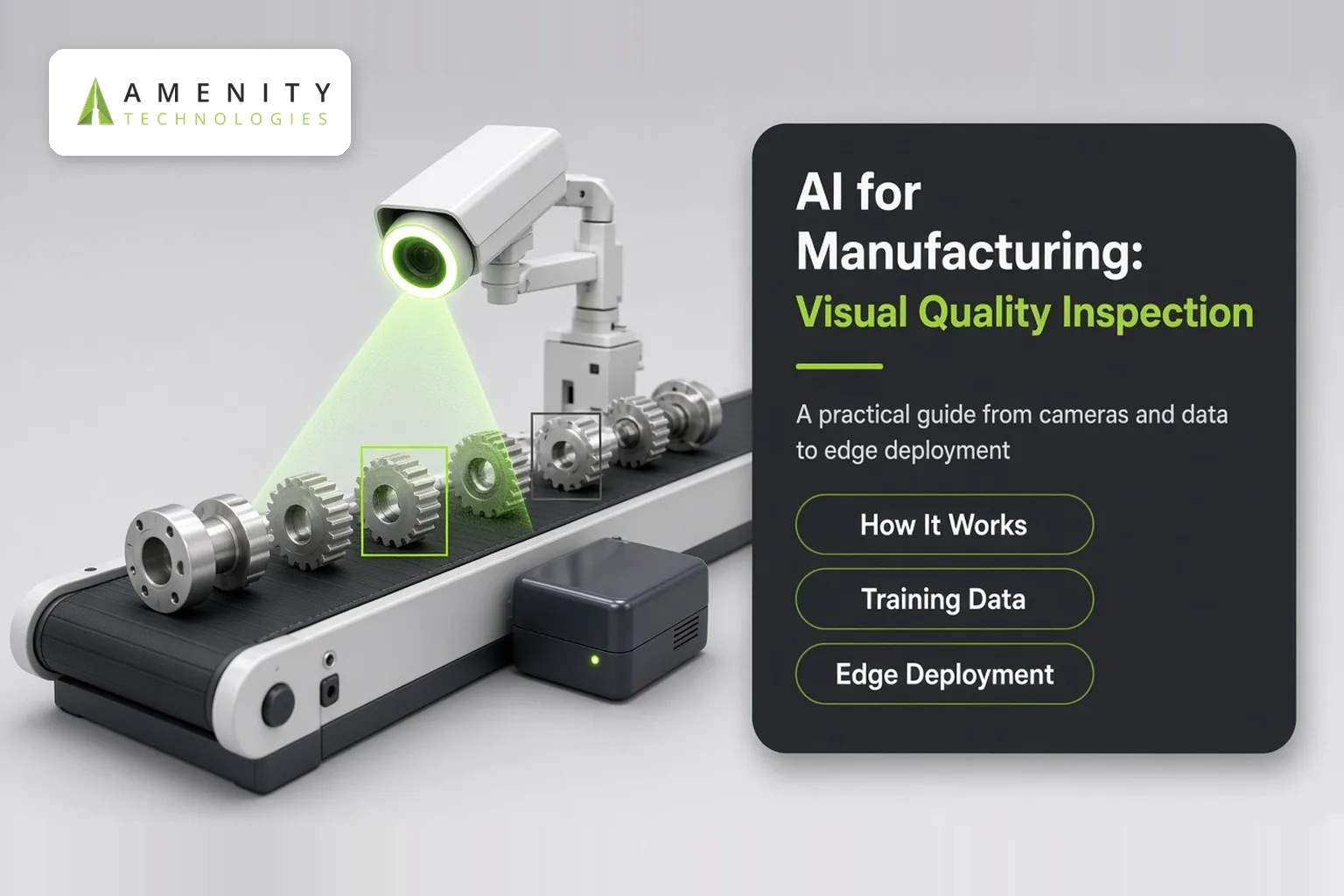
Quality inspection is one of the clearest wins for AI in manufacturing. Human inspectors get tired, standards drift between shifts and some defects are too small or fast to catch reliably. AI visual inspection checks every part, every time, and records the evidence. This guide explains how it works and how to start. Our broader 7 AI automation use cases in manufacturing covers other opportunities. See AI for manufacturing.
What AI Visual Inspection Detects
- Surface defects: scratches, dents, cracks, stains, porosity
- Assembly errors: missing, misaligned or wrong components
- Dimensional issues within camera resolution limits
- Label, print and packaging errors
- Colour and finish inconsistencies
How It Works
- Image capture: industrial cameras photograph parts on the line.
- Analysis: computer vision models classify parts or locate defects using object detection.
- Decision: parts are passed, rejected or sent for manual review.
- Action: a signal triggers a reject mechanism or alerts an operator.
- Records: images and results are stored for traceability.
Getting the Hardware Right
Image quality decides model quality. Consistent lighting, the right camera resolution and frame rate, stable positioning and protection from dust and vibration matter as much as the model.
Training Data
- Collect images of good parts and of each defect type.
- Label defects consistently with your quality team.
- Include variations: lighting, batches, materials and orientations.
- For rare defects, consider anomaly detection trained mostly on good parts, or carefully used synthetic data. See synthetic data for training.
Accuracy and Trade-Offs
| Error type | Impact |
|---|---|
| Missed defect (false negative) | Bad parts reach customers |
| False reject (false positive) | Good parts scrapped or re-inspected |
Agree acceptable rates with quality and production teams. Many plants start with AI flagging parts for human review before moving to automatic rejection.
Edge Deployment
Inspection often needs decisions within milliseconds, without depending on internet connectivity. Models typically run on edge devices beside the line. See AI deployment services and MLOps consulting for keeping models updated.
Measuring ROI
- Defects escaping to customers
- Scrap and rework costs
- Inspection labour hours
- Customer complaints and returns
- Traceability for audits
A Pilot Plan
- Pick one product and the most costly defect types.
- Set up cameras and lighting at one station.
- Collect and label images over a few weeks of production.
- Run the model in shadow mode alongside inspectors.
- Compare results, tune, then go live with human review.
Read our manufacturing AI implementation guide and, for broader industrial uses, AI for industrial operations.
Common Pitfalls
- Collecting images under different lighting from what the line will use
- Defect labels that differ between inspectors
- No plan to retrain when products, materials or suppliers change
- Ignoring how operators will respond to alerts
How Amenity Approaches Visual Inspection Projects
- Study the product, defects and current inspection process
- Design camera and lighting setups with your engineers
- Collect and label images with your quality team
- Train and test models in shadow mode
- Deploy on edge devices with monitoring and retraining
Quality, production and maintenance teams all sign off before automatic rejection goes live.
Key Takeaways
- Image quality and consistent labelling decide accuracy.
- Run models in shadow mode before automatic rejection.
- Edge deployment gives fast, reliable decisions on the line.
- Measure escaped defects, scrap and labour saved.
Start with one station and one product, prove the result, and scale with confidence across lines and plants.
About Amenity Technologies
Amenity Technologies is a GenAI and AI development company based in Ahmedabad, India, with a team of 50+ AI specialists. We build chatbots, voice bots, RAG systems, AI agents, computer vision and custom AI software for clients worldwide. See our awards and achievements.
Related Reading
- AI for industrial operations: maintenance, energy and safety
- Ai in manufacturing 7 real automation use cases
- AI for industries: how to find the right use cases
Frequently Asked Questions
What is AI visual inspection in manufacturing?
It uses cameras and computer vision models to check parts for defects, assembly errors and label issues on the production line, with results recorded for traceability.
How much training data does AI inspection need?
It depends on the product and defects. You need labelled images of good parts and each defect type across normal variations; anomaly detection can help when defects are rare.
Does AI inspection run in the cloud or on site?
Usually on edge devices beside the line, for fast decisions without depending on internet connectivity.
Can AI inspection replace human inspectors?
Many plants start with AI flagging parts for human review, then automate rejection once accuracy is proven, with people handling exceptions.
How do you measure AI inspection ROI?
Track escaped defects, scrap and rework costs, inspection labour, customer complaints and audit traceability.
Start an AI Inspection Pilot
Talk to our AI team about your use case, or explore our case studies.