
AI for E-commerce: Automating the Back Office, Not Just the Storefront
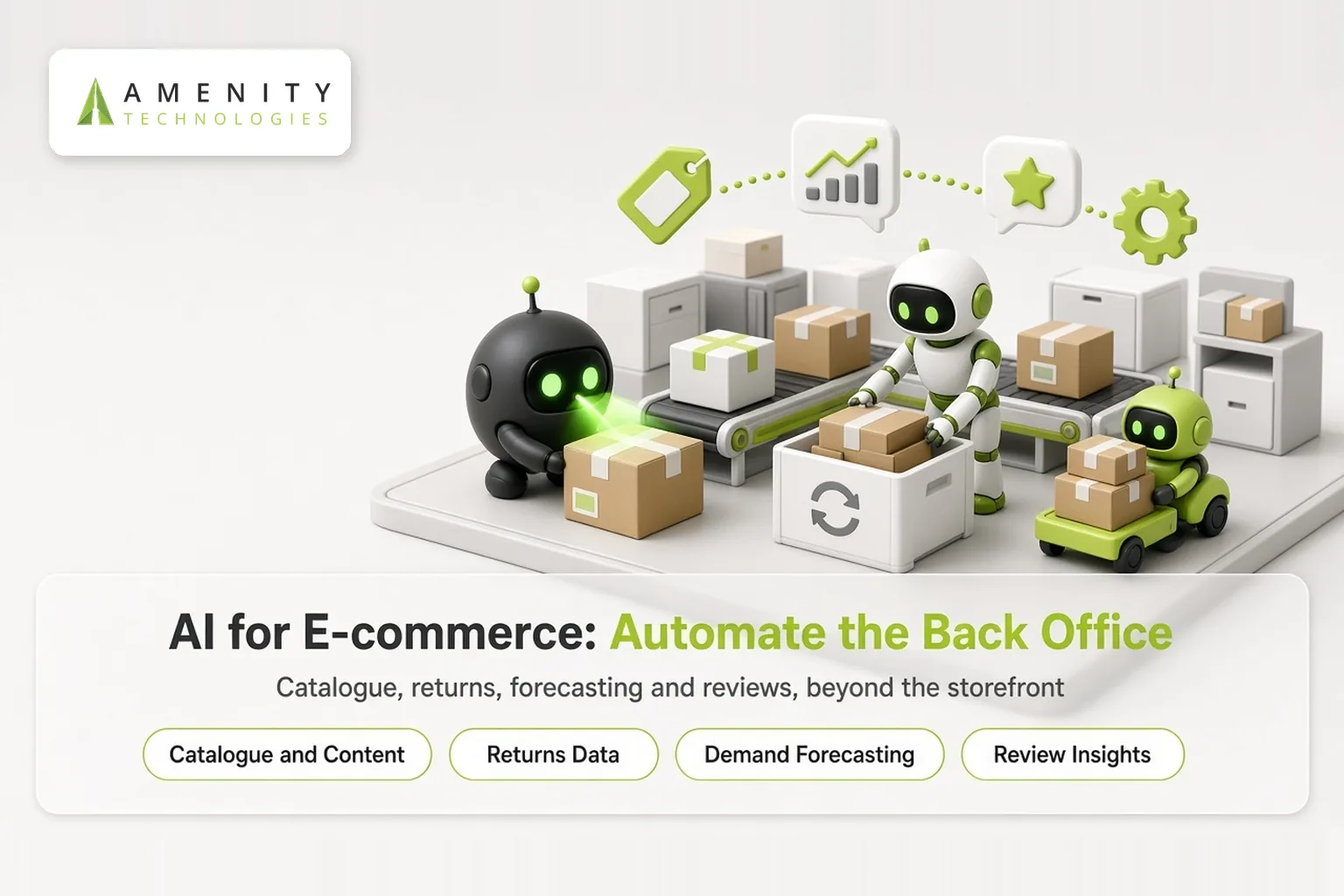
Most talk about AI in e-commerce focuses on the storefront: shopping assistants, recommendations and support bots. Those matter, and we cover them in how AI chatbots increase e-commerce sales. But much of the cost and friction in online retail sits behind the scenes, in catalogues, content, returns, stock and exceptions. This guide covers AI for e-commerce operations.
Back-Office Use Cases
| Area | AI application | Benefit |
|---|---|---|
| Catalogue enrichment | Extract attributes from supplier data and images | Complete, searchable listings |
| Product content | Draft descriptions, titles and translations for review | Faster launches, consistent tone |
| Image tagging | Detect colour, pattern and category from photos | Better filters and search |
| Returns | Classify return reasons and route cases | Lower handling cost, product insights |
| Demand forecasting | Predict sales by product and region | Less stock-out and overstock |
| Review analysis | Summarise themes from reviews | Product and listing improvements |
| Order exceptions | Flag delayed, failed or suspicious orders | Faster resolution |
Catalogue and Content at Scale
Marketplaces and large stores handle thousands of SKUs from many suppliers, with inconsistent data. AI can standardise attributes, fill gaps from product images using image analytics, and draft descriptions in your brand voice. Always keep a human review step for accuracy and compliance.
Returns as a Data Source
Return reasons in free text are hard to analyse manually. NLP can classify them into sizing, quality, damage or expectation issues, revealing which products or listings need fixing. See NLP model development.
Forecasting Demand
Machine learning models use sales history, seasonality, promotions and external signals to forecast demand, supporting purchasing and warehouse planning. See machine learning development.
Review and Sentiment Insights
Summarising reviews by theme shows what customers love and dislike at scale. Read our sentiment analysis guide.
Connecting Front and Back Office
Back-office AI improves front-office AI. Rich attributes make product discovery bots more accurate, and clean order data makes support bots more helpful. See e-commerce chatbot solutions.
Automating Workflows
Many back-office tasks span systems: marketplace, inventory, logistics and accounting. AI workflow automation and AI agents can move information between them and flag exceptions for staff.
Where to Start
- Pick the area with the most manual effort, often catalogue content or returns.
- Measure today's time and error rates.
- Pilot AI on one category or channel.
- Scale once quality is proven.
For a complete view, read our complete guide to AI for e-commerce.
Example: Fixing a High-Return Product
An online fashion store sees high returns on one jacket. AI classifies return comments and finds most say "runs small". Review analysis confirms the pattern. The team updates the size guide and product description, and returns fall. Without AI, the pattern would have taken weeks of manual reading to spot.
Common Pitfalls
- Publishing AI-written content without review
- Forecasting without cleaning historical data first
- Tools that do not connect to the platforms you already use
How Amenity Approaches E-commerce AI Projects
- Audit catalogue, returns and order processes for manual effort
- Pick one high-effort area and baseline it
- Build and integrate the AI workflow with your platforms
- Pilot on one category or channel
- Scale and connect insights to the storefront
Back-office improvements often pay for themselves quickly because they remove daily manual work.
Key Takeaways
- Back-office AI reduces cost and improves the storefront experience.
- Catalogue content and returns are common quick wins.
- Keep human review for published content.
A strong back office makes every customer-facing AI tool work better, from search and recommendations to support.
About Amenity Technologies
Amenity Technologies is a GenAI and AI development company based in Ahmedabad, India, with a team of 50+ AI specialists. We build chatbots, voice bots, RAG systems, AI agents, computer vision and custom AI software for clients worldwide. See our awards and achievements.
Related Reading
- AI for retail stores: in-store operations
- How ai chatbots help ecommerce businesses increase sales
- AI for customer service: metrics and the hybrid support model
Frequently Asked Questions
How can AI help e-commerce operations?
By enriching catalogues, drafting product content, tagging images, classifying returns, forecasting demand, summarising reviews and flagging order exceptions.
Can AI write product descriptions?
Yes. AI can draft descriptions, titles and translations in your brand voice, but a human should review them for accuracy and compliance.
How does AI help with returns?
NLP classifies return reasons from free text, reducing handling time and revealing products or listings that need improvement.
Can AI forecast e-commerce demand?
Machine learning models can forecast demand using sales history, seasonality and promotions to support purchasing and warehouse planning.
Where should an online store start with back-office AI?
Start where manual effort is highest, often catalogue content or returns, and pilot on one category before scaling.
Automate Your E-commerce Operations
Talk to our AI team about your use case, or explore our case studies.