
AI for Industries: A Practical Framework for Finding the Right Use Cases
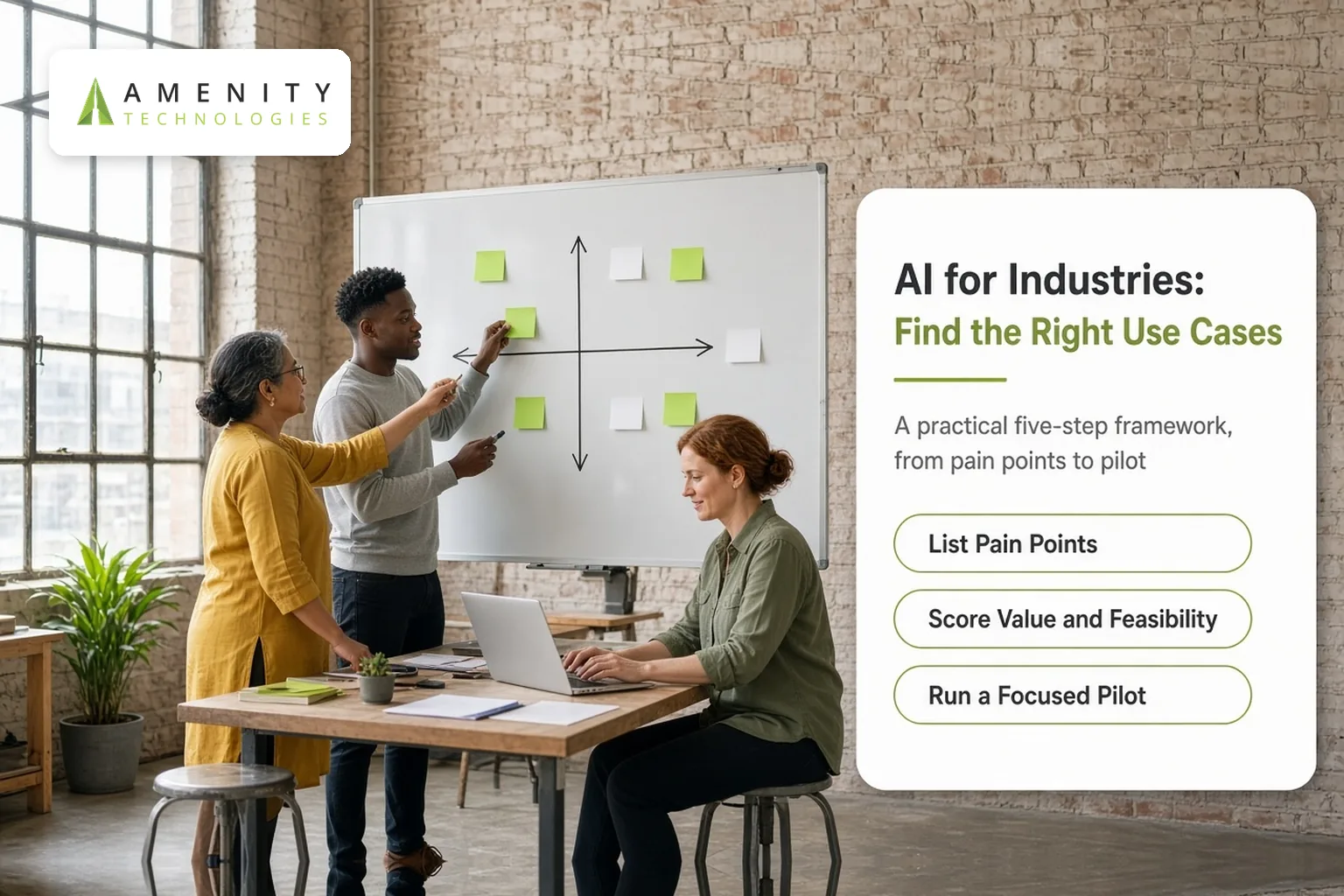
Every industry is being told that AI will transform it. Yet most organisations struggle with a simpler question: where should we start? The best AI projects are rarely the most impressive ones. They solve a frequent, costly problem with data the business already has. This framework helps any industry find those opportunities. Explore our sector work on the AI for industries page.
Step 1: List Pain Points, Not Technologies
Ask each team where time is lost, errors happen, customers wait or decisions rely on guesswork. Typical answers: answering the same questions, reading documents, scheduling, inspecting, forecasting and following up.
Step 2: Match Pain Points to AI Capabilities
| Pain point | AI capability |
|---|---|
| Repetitive questions | Chatbots and voice bots |
| Reading forms and documents | Document processing and OCR |
| Visual checks and monitoring | Computer vision |
| Forecasting and predictions | Machine learning |
| Multi-step manual workflows | Workflow automation and AI agents |
| Finding internal knowledge | RAG systems |
Step 3: Score Value and Feasibility
| Value questions | Feasibility questions |
|---|---|
| How often does the problem occur? | Is the data available and accessible? |
| What does it cost today? | Is the data good enough quality? |
| Does it affect customers or revenue? | Can it integrate with current systems? |
| Is there a clear success metric? | Are risk and compliance manageable? |
Plot use cases on a simple grid. Start with high value and high feasibility.
Step 4: Check Data Readiness
- Where does the data live, and who owns it?
- Is it labelled or structured enough for the task?
- Are there privacy or regulatory restrictions?
- How will new data keep flowing after launch?
Step 5: Run a Focused Pilot
Pick one use case, define one success metric, and build an AI MVP or proof of concept with real users. Read what a proof of concept should prove and our 90 days to production case study.
Industry Starting Points
- Healthcare and wellness: front desk, intake and documentation. See healthcare and wellness.
- Banking, finance and insurance: customer service, document checks, claims. See banking, finance and insurance.
- Retail and e-commerce: product discovery, support, forecasting. See retail and e-commerce.
- Manufacturing: visual inspection and maintenance. See manufacturing and industrial.
- Education: admissions and student support. See education.
- Travel and hospitality: bookings and guest service. See travel and hospitality.
- Real estate, legal, sports and fitness: see real estate, legal and sports and fitness.
Common Mistakes
- Starting with the most complex use case
- Underestimating data preparation
- No business owner for the outcome
- Measuring model accuracy instead of business results
Our AI strategy consulting team runs this framework in workshops.
A Simple Scoring Example
| Use case | Value (1–5) | Feasibility (1–5) | Priority |
|---|---|---|---|
| Customer FAQ chatbot | 4 | 5 | Start now |
| Invoice data extraction | 4 | 4 | Next |
| Demand forecasting | 5 | 2 | Fix data first |
| Fully autonomous operations | 5 | 1 | Later |
Scoring with business and technical leaders together keeps priorities realistic and shared.
How Amenity Approaches Industry AI Projects
- Run a discovery workshop with business and IT leaders
- Score use cases for value and feasibility
- Assess data readiness for the top candidates
- Build a proof of concept for the leading use case
- Plan the path to production and scale
Most engagements move from workshop to working prototype within weeks.
Key Takeaways
- Start from business pain points, not technology.
- Score use cases on value and feasibility together.
- Check data readiness early and prove value with a focused pilot.
About Amenity Technologies
Amenity Technologies is a GenAI and AI development company based in Ahmedabad, India, with a team of 50+ AI specialists. We build chatbots, voice bots, RAG systems, AI agents, computer vision and custom AI software for clients worldwide. See our awards and achievements.
Related Reading
- AI for enterprise: building an AI operating model
- AI for healthcare: a privacy and compliance checklist
- AI for manufacturing: visual quality inspection guide
Frequently Asked Questions
How do I find AI use cases for my industry?
List pain points by team, match them to AI capabilities, score each for value and feasibility, check data readiness and start with a focused pilot.
What makes a good first AI project?
A frequent, costly problem with available data, a clear success metric and manageable risk.
Why is data readiness important?
AI depends on accessible, good-quality data that can keep flowing after launch, within privacy and regulatory limits.
Should I start with a proof of concept?
Yes. A focused proof of concept or MVP with real users shows whether a use case delivers value before larger investment.
Which industries does Amenity Technologies serve?
Healthcare and wellness, banking, finance, insurance, retail, e-commerce, manufacturing, education, travel and hospitality, real estate, legal, sports and fitness, customer service and enterprise.
Find Your Best AI Use Case
Talk to our AI team about your use case, or explore our case studies.