
AI Chatbot PoC: What a Proof of Concept Should Prove
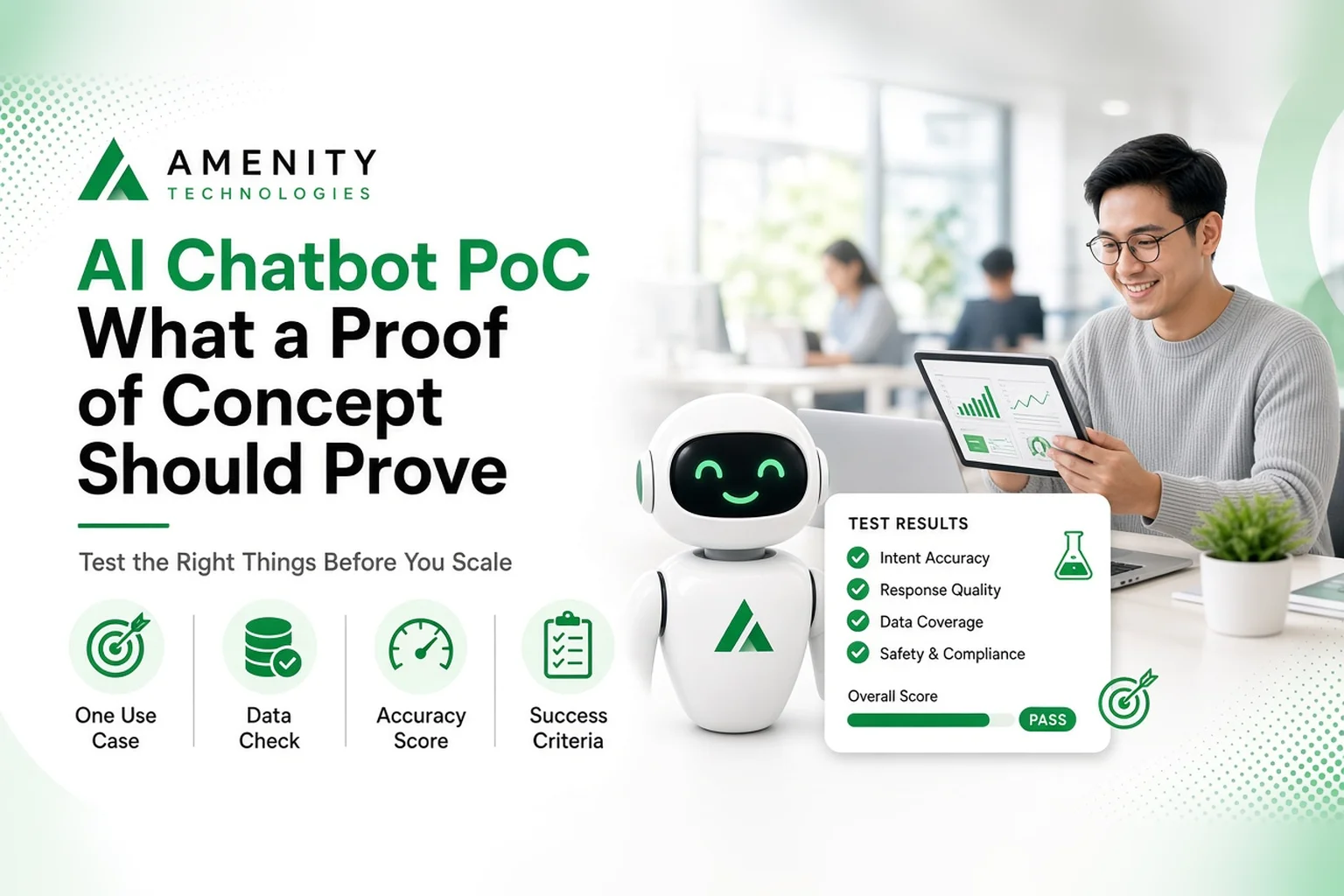
A chatbot demo is easy to like. Someone types a well-chosen question, the bot replies smoothly, and the room is convinced. The demo leaves out everything that happens afterwards: the badly worded question, the document that contradicts another, the conversation that needs a person. An AI chatbot PoC exists to test those situations while the cost of being wrong is still small.
A proof of concept is a limited build designed to answer a few specific questions before a larger commitment is made. It is not a smaller version of the final product. A well-run one leaves you with evidence about the use case, the data, the accuracy you can expect, and the handoff to your team. What follows covers each of those, in the order that tends to prevent rework.
Choose One Use Case
Trying to cover support, sales and internal queries in a single PoC spreads the effort thin and makes the results hard to read. Pick one flow instead, preferably one that is asked often and has answers your team can confirm.
A few questions help narrow it down. Who asks this question, and through which channel? What does a correct answer look like? Who answers it today, and where do they find the information? If your own team cannot agree on the correct answer, a chatbot will not settle the matter.
The use case also shapes the type of chatbot. Amenity's chatbot solutions page describes rule-based bots, which follow predefined decision trees for structured queries, and AI-powered bots, which use natural language processing and machine learning to interpret context and intent. If your flow is predictable, a PoC can show whether the simpler option is enough.
For specialized requirements, you can explore sector-specific frameworks such as banking chatbot solutions or healthcare solutions.
Check the Data
A chatbot can only answer from what it has been given, so look at the source material before any build begins. That usually means help articles, policy documents, product information and past support conversations.
Four checks are worth making:
- Currency: Does the content describe how things work today?
- Consistency: Do any two documents give different answers to the same question?
- Coverage: Does it address the questions customers actually ask?
- Access: Can the material be shared with the build team, and is any of it restricted?
Gaps found here are far cheaper to fix than gaps found after launch. Amenity describes the second stage of its process, Prototype & Validate, as a focused proof of concept that validates the model, data and user experience before you scale. Data sits in that list alongside the model for a reason.
Measure Accuracy
"It seemed to answer well" is an impression, not a result. Decide how accuracy will be judged before testing starts.
Build a test set from real customer questions rather than questions invented by the project team. Include straightforward ones, ambiguous ones, ones outside the bot's scope, and a few designed to push it off course. Then grade each answer: correct, partly correct, incorrect, or correctly declined.
The last category deserves attention. A bot that recognises it cannot answer and passes the customer to a person is doing its job. A bot that answers with confidence and gets it wrong creates a different problem. Reviewers should be people who know the right answers, such as support leads or subject specialists, since a technical reviewer may judge how fluent a reply sounds while a specialist will judge whether it is correct.
Test the Handoff
Every chatbot will meet conversations it should not finish, so the PoC should confirm that the exit works.
Amenity lists real-time human handover among its chatbot features, in which the chat passes to your team with full context so the customer does not have to repeat anything. Whatever tool you use, test the same points. What triggers a transfer: a direct request, repeated misunderstanding, a particular topic? What does the agent see when the conversation arrives? What happens outside working hours? Who takes ownership once the chat moves?
A handoff that loses context or leaves the customer waiting without explanation undermines whatever the bot did well beforehand.
Set Success Criteria
Without criteria agreed in advance, the review turns into a debate about whether the results were good enough.
Agree Thresholds First
Write down what you will measure and the level that counts as a pass. Sensible measures include the share of test questions answered correctly, how often conversations reach a person, and how often the bot declines appropriately. The levels depend on your business. An internal assistant and a customer-facing bot carry different risks, so the thresholds should differ. Set them before you see results, so the numbers do not drift to fit the outcome.
Define What Failure Means
Name the findings that would pause or end the project. Perhaps the source content is too thin to support the use case, or accuracy falls short in one category of question. A PoC that cannot fail is not testing anything. Learning "not yet" at this stage costs far less than learning it after a full build.
What Happens Next
A PoC usually ends in one of three places.
Proceed
The criteria are met, and the work moves into chatbot MVP development: a first working release for real users, with a wider scope and the integrations the PoC left out.
Adjust
Some criteria were met and others were not. Content gaps, an unclear scope or a handoff rule that needs rework are common reasons. Correct them and retest against the same question set.
Stop
The use case does not hold up, or the data cannot support it. That is a valid outcome. You have spent a small amount to avoid a large one.
In every case, keep a record of the test set, the scores, the failure patterns and the open questions. It becomes the brief for the next phase.
If you are considering a chatbot and want to scope a proof of concept, contact the Amenity team to discuss your use case.
Frequently Asked Questions
How is a PoC different from an MVP?
A PoC tests whether the idea works, with a limited scope. An MVP is the first usable release for real users. The PoC results inform whether and how to build the MVP.
What data do we need to start?
Begin with the content your team already uses to answer the target questions, such as help documents, policies and FAQs. The PoC will show whether it is enough.
What if the PoC misses the success criteria?
You should look at where it fell short. Content, scope, or handoff issues can often be corrected and retested. If the use case itself does not hold up, stopping is a sound result.