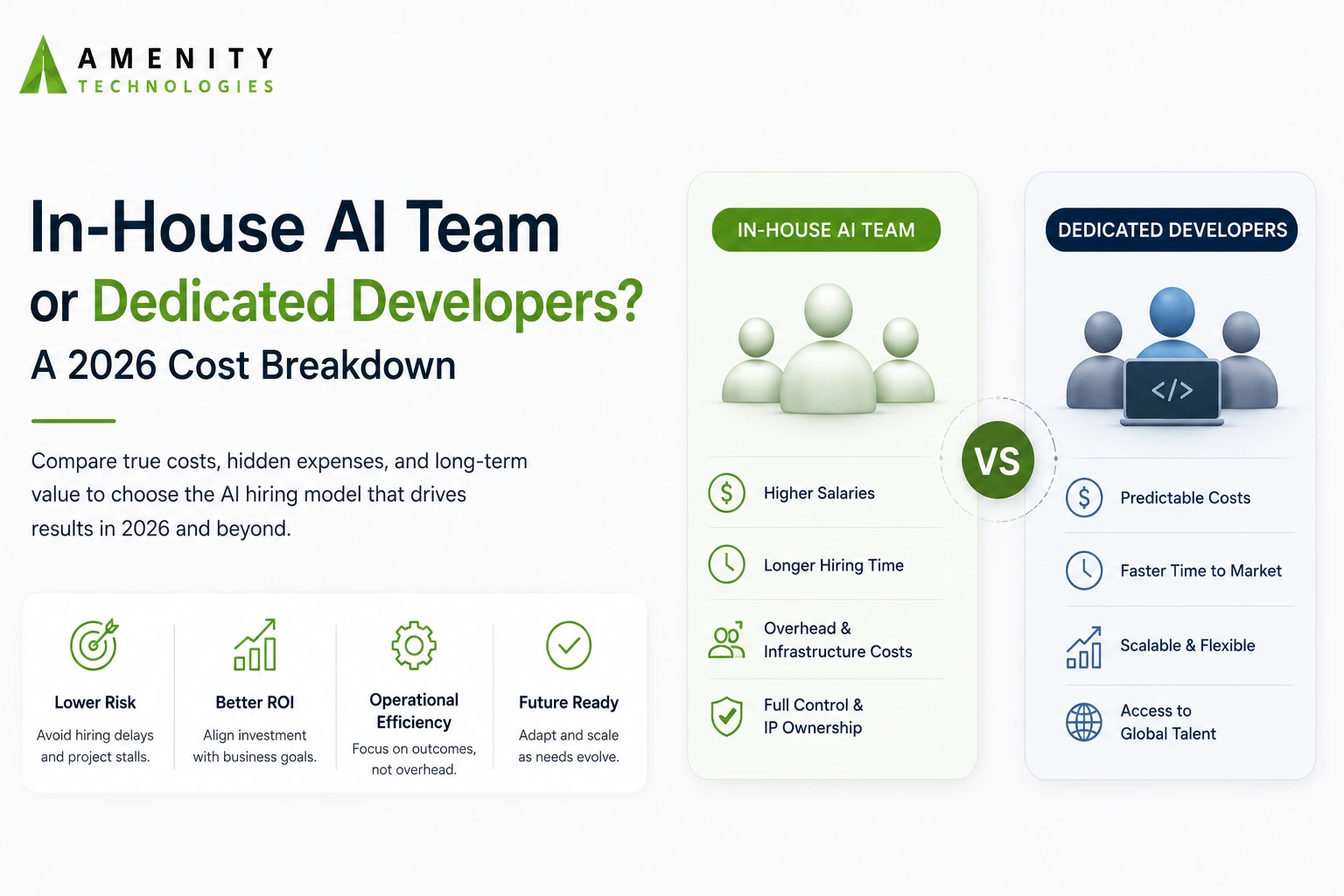
In-House AI Team or Dedicated Developers? A 2026 Cost Breakdown
Few technology decisions create as much debate inside leadership teams as the hiring model behind AI initiatives.
One group pushes for internal ownership. Another argues for external specialists who can accelerate delivery without increasing headcount. Both approaches can work, but they carry very different financial and operational implications.
The discussion is no longer limited to development costs alone. Recruitment timelines, retention challenges, infrastructure overhead, project risk, and long-term scalability all influence the outcome. When evaluating an in-house AI team vs hiring dedicated developers, the most important question is often not which model is cheaper today, but which one creates the strongest business outcome over the next several years.
Why AI Talent Costs Look Different in 2026
The hiring market looks very different than it did a few years ago.
Experienced AI engineers remain difficult to recruit, while demand for machine learning, data engineering, and AI product expertise continues to grow. Filling a role is one challenge. Building a team with the right mix of skills is another.
AI projects are also becoming more specialized. A recommendation engine, a document processing platform, and a computer vision system rarely require the same expertise. The conversation inside many companies has shifted from “Who should we hire?” to “What type of team does this project actually need?” The answer is often different for every AI initiative.
The Actual Cost of Building an In-House AI Team
Many AI hiring plans look straightforward at the beginning. A budget is approved. A few roles are identified. Recruitment begins. But, the picture usually changes once development gets underway.
An engineer hired to build models ends up spending time cleaning data. Product decisions begin competing with technical priorities. Infrastructure questions appear that nobody considered during the hiring process. Before long, the discussion shifts from filling positions to building a team that can actually deliver.
That’s why the cost of building an AI team is rarely limited to salaries alone. AI staffing costs often grow through hiring delays, onboarding time, management attention, internal coordination, software licenses, and the practical realities of getting a new team working effectively together.
Understanding Dedicated Development Team Cost
Not every company wants to spend months building an AI function from scratch. Some projects have fixed delivery timelines. Others require skills that may only be needed for a specific phase of development. In those situations, leadership teams often look beyond traditional hiring.
The dedicated development team cost is usually structured differently from internal recruitment. Instead of managing sourcing, onboarding, retention, and long-term workforce planning, companies gain access to an established team with relevant technical experience already in place.
That doesn’t automatically make one model cheaper than the other. It does change where the investment goes and how quickly a project can move from planning into active development.
Side-by-Side AI Development Team Comparison
The discussion often changes once hiring actually begins.
Finding one strong AI engineer is difficult enough. Building an entire team around that person is a different challenge altogether. Some companies are comfortable making that investment because AI is expected to become a long-term internal capability. Others are focused on delivering a specific product, solving a defined problem, or launching within a fixed timeline.
That is where an AI development team comparison becomes useful. The decision is rarely about choosing the cheaper option. It is usually about deciding where complexity should live, inside the business or with an external delivery partner.
Direct Costs
Salaries and long-term employment commitments remain the largest expense for internal teams.
Hidden Costs
Hiring timelines, vacant positions, and project delays can quietly affect budgets.
Operational Ownership
Internal teams keep decision-making and technical knowledge closer to the business.
Resource Flexibility
Dedicated teams can expand or contract more easily as project needs change.
The Hidden Costs Businesses Often Miss
The original hiring plan rarely survives untouched. A role expected to take four weeks to fill stays open for three months. A project pauses because one specialist is overloaded. New hires spend their first few weeks learning internal systems while delivery deadlines continue moving closer.
None of those situations look dramatic in isolation. Yet they show up repeatedly in AI projects. The challenge is that delays usually never appear as a separate line item in a budget. They surface through missed release dates, longer development cycles, and teams waiting on skills that are not yet in place. Those costs are harder to measure, which is exactly why they are easy to underestimate during planning.
Scalability and Resource Planning
Project plans may usually look stable on paper, but in reality, things can be very different.
An AI initiative that starts with data preparation can suddenly require model specialists. A team focused on experimentation may find itself dealing with deployment challenges a few months later. Priorities shift. Technical requirements change. Deadlines stay exactly where they are.
That creates pressure when key skills are missing and hiring cannot keep pace with delivery expectations.
Part of the appeal of AI development outsourcing comes from that uncertainty. Additional expertise can be brought in when requirements change rather than waiting for another recruitment cycle to run its course.
Which AI Development Model Creates More Business Value in 2026?
The answer often becomes clear only after the project is underway.
Some companies spend months assembling internal teams for initiatives that need immediate execution. Others move too quickly with external partners and later realize the capability should have been developed internally.
That is why discussions around in-house AI teams vs hiring dedicated developers rarely come down to hourly rates or salary comparisons alone in 2026.
ROI is usually tied to timing, project scope, and long-term plans. A short-term initiative with highly specialized requirements may justify one approach. A core product expected to evolve for years may point in a different direction. The strongest outcomes tend to come from aligning the hiring model with the business objective rather than the budget alone.
When an In-House Team Makes Strategic Sense
Some projects eventually become part of the business itself. The roadmap keeps growing. New features are added every quarter. Internal systems begin depending on the models being built. What started as a project slowly becomes a long-term capability.
At that point, keeping knowledge inside the company often becomes more important than accelerating the next release.
Teams working on proprietary data, core products, or highly specialized workflows frequently reach this stage. The discussion is no longer about filling a few technical roles. It becomes a question of ownership, continuity, and retaining expertise that will still be needed years from now.
When to Hire Dedicated AI Developers
Not every AI initiative justifies building a department around it. A product launch may be approaching. A proof of concept needs validation before larger investment decisions are made. A company may require expertise that simply does not exist internally today.
Those situations often lead to a different conversation.
Instead of asking how quickly new employees can be recruited, teams start looking at how quickly work can begin. That is usually the point where businesses decide to hire dedicated AI developers with experience in similar projects rather than spending months assembling new capabilities from the ground up.
The goal is not to avoid internal hiring forever. It is to match the delivery model to the immediate requirement in front of the business.
Making the Right AI Hiring Decision for 2026
Most teams don’t struggle because they chose the wrong hiring model. They struggle because the model they chose doesn’t match the project in front of them.
A long-term AI product has different staffing needs than a six-month implementation. A proof of concept requires a different level of investment than a platform expected to support the business for years. Those differences matter.
If you’re weighing the costs and trade-offs yourself, a conversation with Amenity Technologies can help bring clarity to the decision. Sometimes the fastest way forward isn’t hiring more people, it’s understanding what the project actually needs.
FAQs
Q.1. How many AI specialists does a business actually need to get started?
A: Often fewer than expected. The right team structure depends on the project scope, data availability, and delivery timeline.
Q.2. When does building an internal AI team make financial sense?
A: Usually when AI is expected to become a long-term capability that supports core products or operations.
Q.3. How can businesses determine which hiring model is the right fit?
A: The answer usually depends on project duration, business goals, internal expertise, and expected long-term ownership.