




Education is rarely hindered by a lack of content. There are lectures, books, online modules; more material than most students can fully consume. The true bottleneck is scalable support.
Here, we’re not talking about the kind that exists on paper, but the support that’s available when a student needs it. A doubt at night. A missed concept during class. A small confusion that grows because it wasn’t resolved in time.
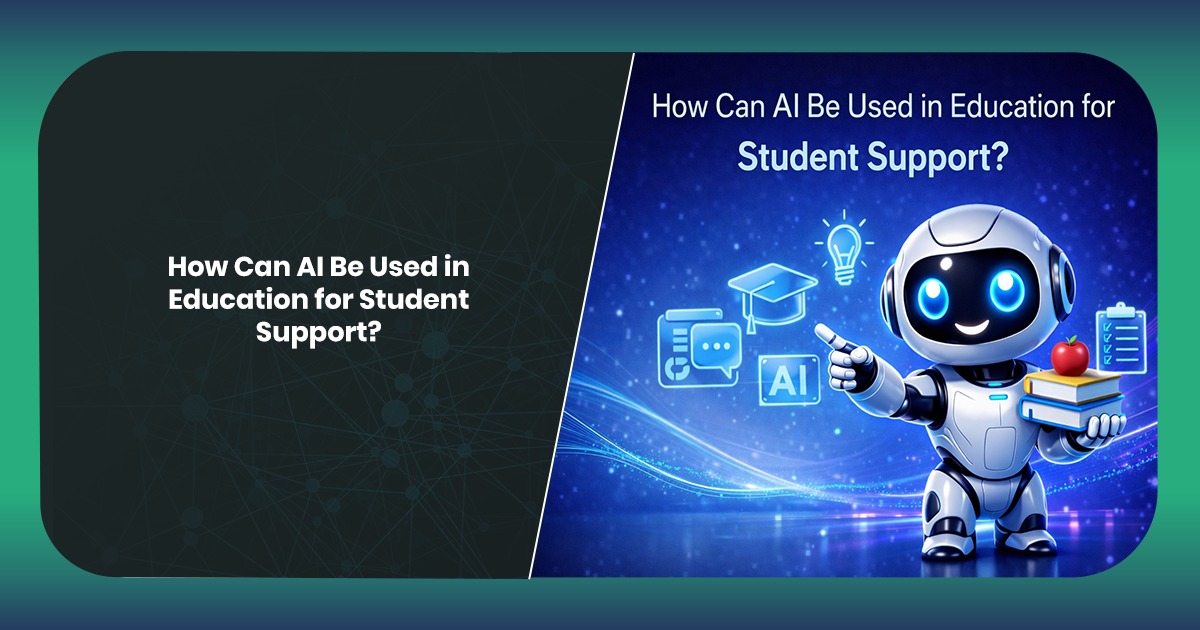
That’s where things usually slow down. AI is starting to show up in that exact gap; not to change how subjects are taught, but to make sure students don’t stay stuck longer than they need to. That’s where the question, “how can AI be used in education?” comes into the picture.
In this post, we’ll dive deep into the topic and find out how we can leverage AI in education, especially for student support.
Where Student Support Quietly Fails
Most institutions already offer support systems through help desks, email queries, and discussion forums. Even after this much effort from institutions, students hesitate. It’s not because support isn’t there, but because there’s no immediate resolution available.
A delayed response often leads to cognitive disengagement. A missed clarification becomes a weak foundation. Over time, these small gaps start piling up.
This isn’t a technological problem. It’s a timing problem.
That’s also why conversations around artificial intelligence in education have shifted in recent years; not toward replacing teaching, but toward improving how quickly students receive support when they need it.
How Does AI Help Students in Education?
Educational institutions often assume that conversational agents are meant to replace teaching; but that’s not where AI helps students the most.
AI works best as the first layer of support, helping students move forward without unnecessary delays. When a student asks something simple:
– “What does this concept mean?”
– “Can you explain this step?”
Instead of waiting, students get an instant response. It may not always be perfect or highly detailed, but it’s enough to keep the learning process moving smoothly.
And that’s where AI makes a difference. It reduces interruptions.
Once the basics are clear, deeper understanding can still be built with the help of teachers.
Why Timing Matters More Than Depth
In conventional setups, depth is prioritized. Detailed explanations. Structured sessions. Full coverage.
But quite often, students don’t need depth immediately, they just need direction. It could be:
- A quick clarification.
- A simple example.
- A nudge to continue.
Here, AI chatbots for education are suited well in those moments. They don’t need to provide the best explanation. Simply training them enough to provide answers will be good enough.
This shift from perfection to timely responses changes how support is experienced.
Learning Starts to Feel Less Interrupted
One thing that often goes unnoticed is how frequently students pause. Not because they’re done; but because they’re stuck.
A missing explanation. A confusing instruction. A step that doesn’t make sense. Without immediate support, momentum breaks.
AI reduces that pause.
Instead of stopping, students continue. Maybe slower, maybe with partial clarity; but they don’t completely disengage.
That continuity matters more than it seems. Because once learning flow breaks, getting back into it is harder than solving the original doubt.
Administrative Queries Are the Silent Distraction
Not all student questions are academic.
A large portion is administrative:
- Deadlines
- Schedules
- Submission formats
- Course details
For these tasks, teaching isn’t required. There is a need for clarity only. And yet, they often take time. Students send emails. Wait for replies. And then follow up.
This whole process adds friction where it doesn’t need to exist.
But, introducing automated chat assistants, this layer can be easily handled. Not because the system is advanced; but the questions are predictable.
Removing that friction doesn’t improve learning directly; but it removes distractions around it.
Personalization: In a Practical Sense
Personalized learning sounds ambitious. In reality, it often comes down to small adjustments.
Some students revisit the same concept multiple times. Others move ahead quickly. Some need examples. Others prefer summaries.
AI systems don’t fully customize the learning phase; but they start noticing patterns.
If a student repeatedly struggles with a topic, the system can offer additional explanations. If progress is faster, it can suggest the next step.
This isn’t deep personalization. It’s a subtle alignment. And that’s usually enough to make learning feel more responsive.
Feedback Without the Usual Delay
Feedback is one of the most valuable parts of learning; and also one of the slowest.
Assignments get submitted. Reviews take time. Responses come later.
By then, the context is gone. AI solutions for education industry change that timeline slightly. It doesn’t replace detailed evaluation, but provide immediate signals:
- What looks correct
- What might need revision
- Where something seems off
Even basic feedback, if delivered early, can be helpful. Because it keeps students connected to the work while they’re still engaged with it.
Where AI Can Create Problems If Used Wrongly
There’s always a chance to push useful tools too far. AI is no exception here.
If students start depending on automated chat assistants for every answer, learning becomes passive. Instead of thinking through problems, they start looking for shortcuts. This may affect their learning capabilities.
That’s one part of the story. The other part demonstrates accuracy.
AI doesn’t always respond perfectly. Sometimes explanations are incomplete. Sometimes context is missed. If there’s no oversight, small misunderstandings can go unnoticed.
And then there’s the human element.
Some support needs empathy. Encouragement. Context beyond data. AI doesn’t replace that. It only supports around it.
Adoption Is About Fit, Not Just Technology
Introducing AI into education isn’t technically complicated. What truly matters is how well it fits into the learning experience.
If it sits outside the learning process, it gets ignored. If it’s forced into every interaction, it creates resistance.
This becomes even more relevant when looking at how AI in higher education is being introduced in the systems. The systems that work best aren’t necessarily the most advanced; they’re the ones that align naturally with how students already engage with learning platforms.
The balance lies somewhere in between. AI should be present, but not overwhelming. It should be helpful, but not intrusive.
Students should feel that support is there when they need it, not something they’re required to use. That’s when adoption starts to happen naturally.
Starting Small Works Better Than Doing Everything
One common mistake that you might make without noticing is trying to apply AI everywhere at once. Pedagogical support. Admin queries. Feedback. Engagement. All at once.
This rarely works. A better approach is narrower.
Prioritize automation for high-friction touchpoints.
– Where questions repeat.
– Where responses don’t need deep interpretation.
Let that layer work first. Then expand. This makes the system easier to manage; and easier to trust.
Final Thoughts: Support That Doesn’t Feel Delayed
AI in education doesn’t change what students learn. It changes how quickly they can move forward. That’s the difference.
Instead of waiting, they continue. Instead of pausing, they progress.
Not because everything is solved; but because the gap between confusion and clarity becomes smaller.
And in learning, that gap matters more than most things.
If you’re looking to bring down delays in student support and create more responsive learning experiences, Amenity Technologies can help you design AI solutions through our AI development for edtech companies that fit seamlessly into your education systems.
FAQs
Q.1. How is AI actually supporting students without replacing teachers?
A: In most cases, AI doesn’t jump into the teaching part. The AI agents just support the gaps around it. Students still depend on educators for depth, context, and guidance. What AI does is reduce delays. It answers quick questions, clarifies basic doubts, and keeps students moving when immediate help isn’t available.
Q.2. How is AI in higher education being implemented differently?
A: In higher education, the focus is often broader. It includes not just queries from students, but also academic guidance, research support, and administrative efficiency. The key difference is scale. The systems need to handle more users, more complexity, and more varied interactions.
Q.3. How do we know if AI is actually improving student support?A: The signs are usually subtle. You can find out that students stop following up repeatedly. Queries get resolved faster. There’s less waiting involved. Support teams spend less time on routine questions. If interactions feel smoother overall, the system is working well for your institution.