
Benefits of AI in Education: A Quick Guide for Students & Teachers
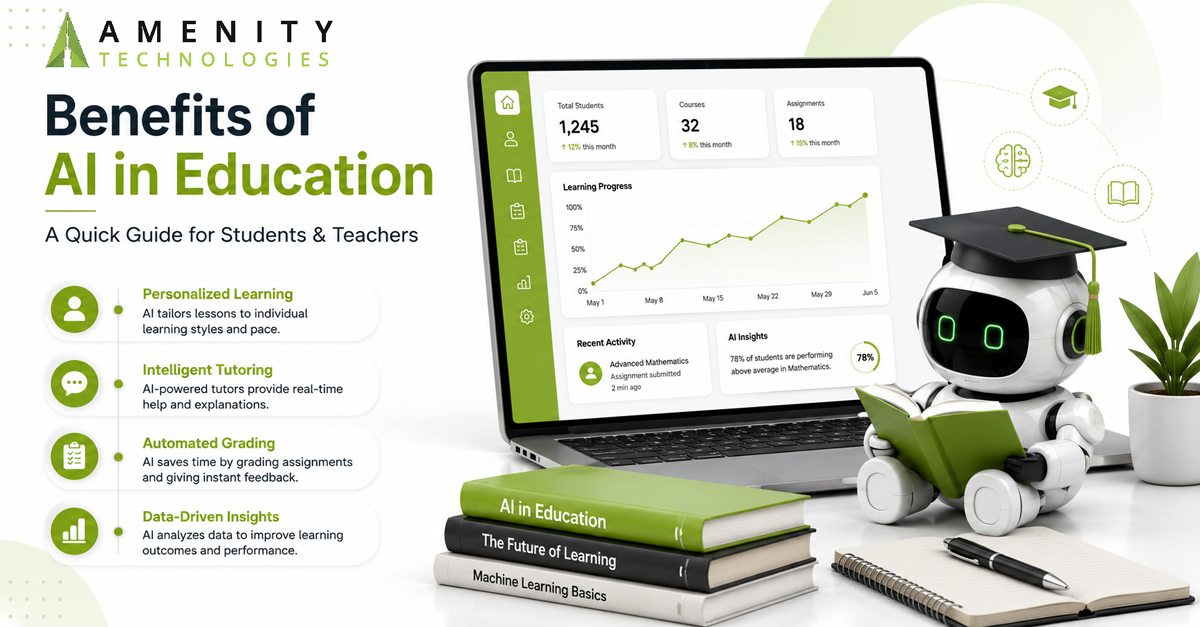
When people talk about AI in education, the focus usually shifts straight to what it can do: automation, personalization, and faster systems.
But the actual benefits don’t show up all at once. They appear in smaller ways.
A student gets an answer without waiting. A teacher spends less time on repetitive tasks. An administrative process that used to take hours starts taking minutes.
Individually, these don’t seem transformative. But together, they change how learning feels, less delayed, more responsive, and easier to move through. That’s where the real value begins.
In this post, we’ll explore some key benefits of AI in education to understand its importance and get clarity on the strategic viability of digital assistants.
Benefits of Implementing AI Solutions
What are the benefits of using AI in education? Below are some key advantages to consider:
1. Learning Becomes Less Dependent on Timing
One of the most noticeable benefits of AI solutions is not about content; it’s about access.
Students don’t always need help during class hours. Inquiries often arise outside of synchronous hours. Sometimes much later.
In traditional setups, that creates a pause. The student either waits or moves forward without clarity. AI-driven digital assistants mitigate these latencies effectively.
Instead of depending on support availability, students will have access to immediate assistance; whether it’s a quick explanation or direction toward the right material.
It doesn’t replace teaching. But it removes the delay between confusion and progress. And that delay is often where learning slows down the most.
2. Students Stay in the Flow More Easily
There’s a moment in learning that’s easy to overlook.
The point where a student gets stuck. They don’t feel completely lost. They are just unsure enough to stop. Here,that pause turns into disengagement without proper support.
AI-backed virtual assistants help reduce how often that happens.
When a student can resolve a doubt quickly, they don’t step away. They continue.
It’s not about making learning easier. It’s about making it uninterrupted. And over time, continuity matters more than intensity.
3. Teachers Spend Less Time Repeating the Same Things
A large part of teaching involves repetition.
Answering the same types of questions. Clarifying similar doubts across different students. Explaining instructions multiple times. It’s necessary; but also a time-consuming process.
Modern AI development for education platforms takes some of that load.
Not by removing interaction, but by handling the first layer of it. Basic clarifications, common queries, standard instructions.
This creates space. Teachers have enough time to focus on:
- Deeper explanations
- Complex discussions
- Individual student attention
The role doesn’t change. But how time is used does.
4. Administrative Work Becomes Less Visible
Not all friction in education is academic. A lot of it sits in administrative processes:
- Finding schedules
- Understanding deadlines
- Navigating course structures
These tasks are simple, but they take time; and often interrupt the learning process.
AI reduces that overhead. Instead of searching or waiting for responses, students can get quick answers to these questions.
The benefit isn’t dramatic. It is consistent.
And consistency in small interactions improves the overall experience more than occasional large improvements.
5. Personalization Starts to Feel Practical
Personalized learning has always been discussed as an ideal choice.
In reality, it’s been difficult to maintain personalized learning at scale.
Although virtual assistants don’t tailor responses deeply, they bring things closer. Instead of treating all students the same, systems can begin to adjust based on behavior.
For example, if a student revisits a topic repeatedly, more support can be offered. If progress is quite faster, the system will guide them forward.
These are small adjustments. But they make learning feel less rigid. Not fully customized, but less generic.
6. Feedback Happens Closer to the Work
Feedback is one of the most valuable parts of learning. It’s also one of the most delayed. By the time students receive it, they’ve usually moved on. The connection between effort and response weakens.
With advanced AI agents, it doesn’t replace detailed evaluation, but it can provide immediate signals:
- Whether something is on track
- Where improvements are needed
- What to revisit
Even simple feedback, when delivered early, keeps students engaged with their own work. That timing makes a difference.
7. Support Scales Without Feeling Overwhelming
As institutions grow, support systems tend to stretch. There will be more students, more queries, and more pressure on existing teams.
Without AI, scaling support usually means adding more people. But, with AI, part of that pressure is absorbed.
Routine queries are handled automatically. Basic guidance is always available. The system doesn’t slow down during peak periods.
This doesn’t eliminate the need for human support. But it changes how support is distributed. And that makes scaling more manageable.
8. Students Feel Less Hesitant to Ask Questions
This is one of the less obvious benefits. Students don’t always ask questions.
- Sometimes because they’re unsure.
- Sometimes because they don’t want to interrupt.
- Sometimes because the process feels slow.
AI changes that behavior slightly.
When asking becomes easier, and responses are immediate, hesitation reduces. Students interact more. Not because they’re encouraged to; but because the barrier is lower. That increased interaction often leads to better clarity over time.
Why Consistency Matters More Than Speed
Speed is often highlighted as the main advantage. But consistency is just as important.
Every student gets:
- The same level of access
- The same response availability
- The same baseline support
This removes variability. Students are not dependent on timing, location, or availability to get basic help. That consistency creates a more stable learning experience. And stability, over time, improves outcomes.
What Institutions Should Focus On First
For institutions adopting AI, the benefits don’t come from doing everything at once.
They come from starting in the right place. The most effective starting points are usually:
- Repetitive student queries
- Administrative bottlenecks
- Areas where delays are common
When you succeed in addressing these operational inefficiencies, the impact will be clearly visible.
From there, systems can expand; gradually and intentionally. Trying to apply AI everywhere at once often leads to confusion. Focused AI chatbot for education websites implementation works better.
Final Thoughts: Small Improvements That Add Up
AI in education doesn’t introduce one major change. It introduces many small ones.
– Faster responses.
– Less waiting.
– Better access to support.
Individually, these feel minor. But together, they reshape how students experience learning.
– It becomes smoother.
– More continuous.
– Less interrupted.
And that’s where the real benefit lies. Not in what AI replaces, but in what it removes along the way.
If you’re exploring how to implement AI effectively in your education systems, working with the right technology partner makes a measurable difference. At Amenity Technologies, we design AI-driven solutions that align with real learning environments, not just technical possibilities. From student support automation to intelligent learning systems, our approach focuses on what actually works in practice.
FAQs
Q.1. Does AI-driven virtual support bots actually improve learning outcomes or just automate tasks?
A: AI-driven virtual support bots improve outcomes when they reduce delays and keep students engaged. Automation is just the surface, continuity in learning is where the real impact shows.
Q.2. What is the biggest advantage of using AI in education today?
A: One of the most highlighted advantages is that it removes waiting time. Students can move forward without being stuck, which makes learning more consistent and less frustrating.
Q.3. Where does AI make the most immediate difference in education?A: In high-frequency interactions such as basic doubts, admin queries, and quick clarifications. That’s where delays used to exist the most.