
 ALL ARTICLES
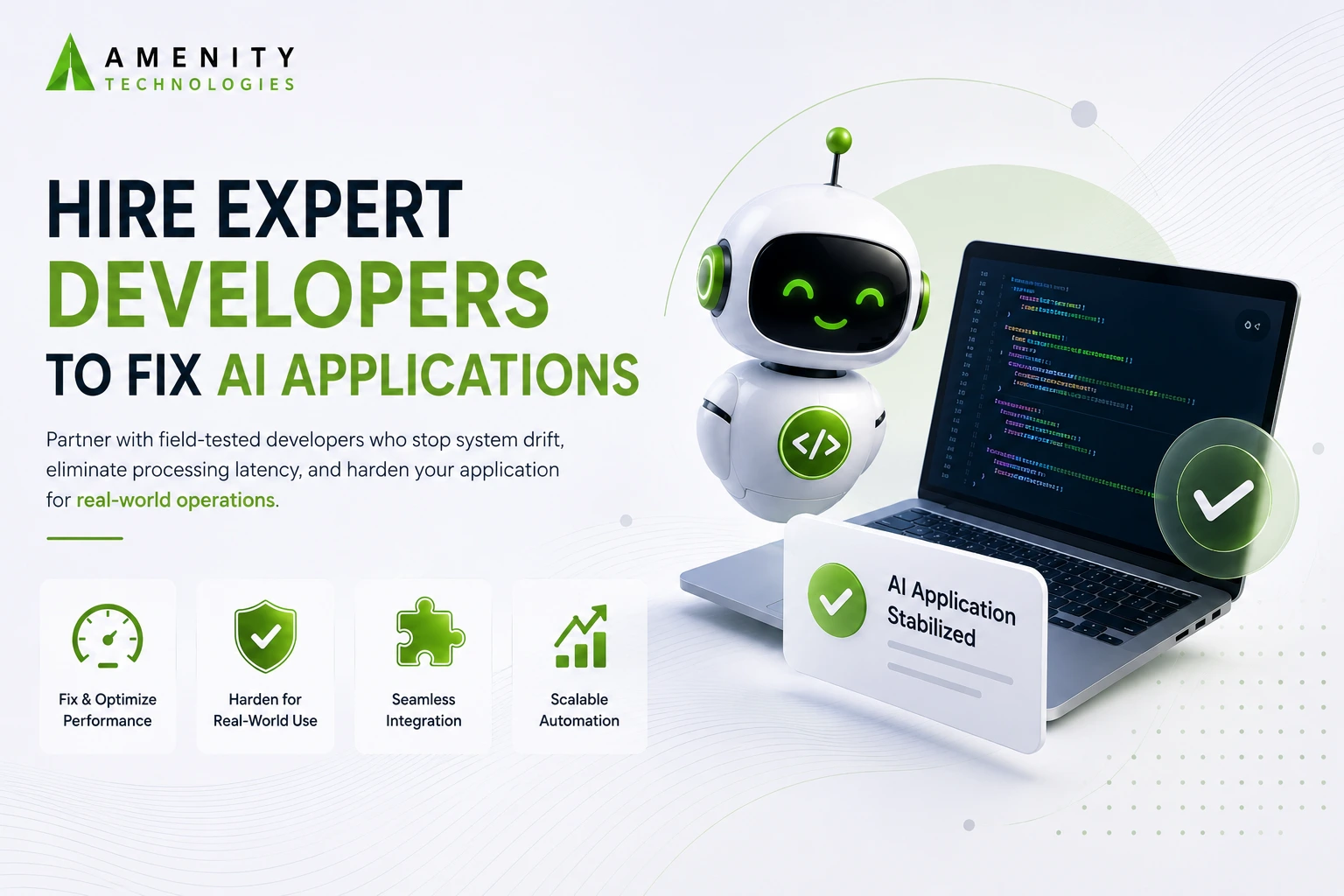



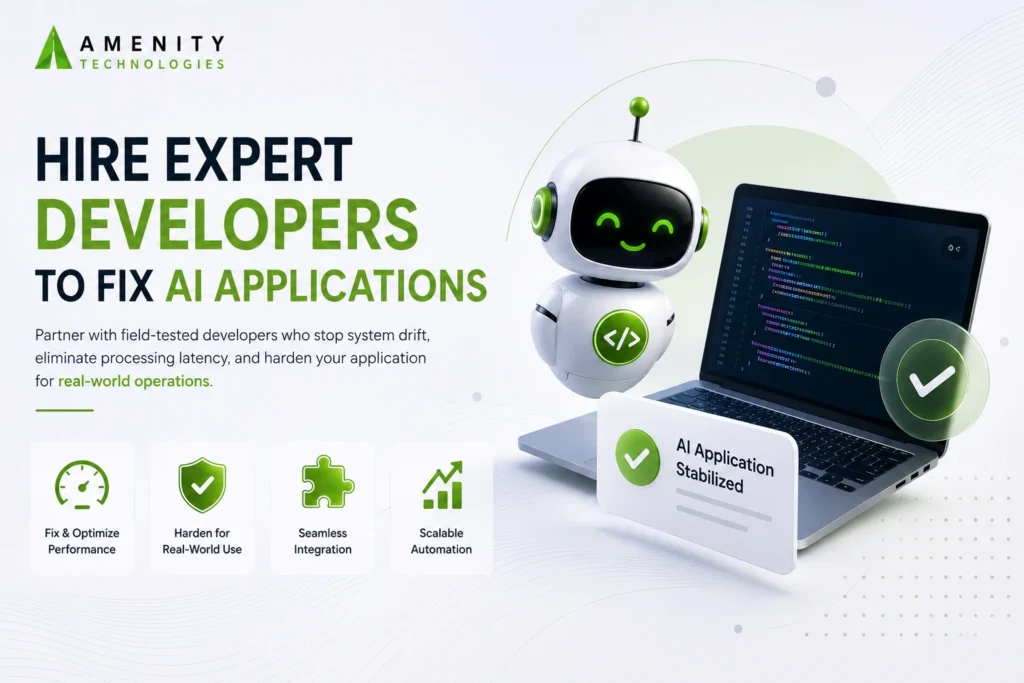
Partner with field-tested developers who stop system drift, eliminate processing latency, and harden your application for real-world operations.
Why Hire AI Remediation Developers?
Automation That Actually Scales
Live applications degrade quickly when real-world data volume spikes. Our developers re-engineer broken ingestion loops, restructure query handling, and build resilient data pipelines that process continuous multi-threaded data loads without dropping connections or failing under sudden scale expansions.
Works Across Legacy Software Environments
AI models rarely operate in isolation. Our developers are experts in making complex neural networks run smoothly within rigid on-premise configurations, hybrid clouds, or older corporate software layers without breaking surrounding microservices or requiring total system rewrites.
Faster Optimization With Modern Remediation Frameworks
By leveraging advanced profiling tools, automated telemetry, and model compression libraries, our engineers isolate performance bugs quickly. This targeted focus cuts down troubleshooting times and gets your production systems stabilized with minimal downtime.
Built for Real-World Recovery, Not Just Quick Patches
A quick software reboot doesn’t fix a fundamentally broken data dependency. Our developers look at the entire application architecture, building robust error-handling layers and deployment guardrails so your system stays up long after the initial hotfix.
Fits Into Your Existing Enterprise Systems
Our team specializes in resolving software integration friction. Whether your application is choking on raw sensor arrays, experiencing API hand-shaking drops, or failing to communicate with central databases, we clean up the middleware to ensure perfect system alignment.
Why Hire AI Optimization Developers from Amenity Technologies?
We do not just look at isolated code blocks. Our technical squad steps in as field-tested production engineers who treat the application as an interconnected ecosystem, finding and fixing the exact architectural friction points that cause performance to drop under pressure.
Hands-On with Structural Diagnostic Tools
We work daily with DeepStream, TensorRT, PyTorch profiling, and raw memory analyzers to uncover hidden memory leaks, execution deadlocks, and hidden compute overhead.
Built With Real Production Environments in Mind
We do not build for sterile lab inputs. Our day-to-day focus is tracking down what actually breaks live apps, including format drift, missing inputs, and irregular network pacing.
Validated Under Broken Operational Conditions
Before deployment, we test your modified application against corrupt network packages, heavily compressed media files, and edge-case exceptions to guarantee long-term stability.
Speed and Latency Optimization Where it Counts
We know a slow application is a broken application; We trim processing lag by optimizing model layers, fixing database queries, and cutting out useless CPU-to-GPU data copies.
Long-Term Support Beyond Immediate Hotfixes
Once your application is stabilized, we don’t vanish. We deploy active tracking scripts, cloud-native telemetry, and automated alerts so you catch incoming bugs before they affect end-users.
Pull Your Broken AI Models Out of the Failure Loop
Models that pass validation checks with flying colors inside a staging environment often trip up completely on the production floor. The moment your software encounters raw, unconditioned user inputs, shifting ambient environments, or sudden network timeouts, performance degrades. Bounding boxes begin to flicker, inference queues back up, and response accuracy tanks.
Most AI systems fail right here, not during the initial training phase, but under continuous operational pressure. Controlled training datasets simply cannot replicate the messy realities of live data drift or API handshaking delays. This exact operational breaking point is why technical teams choose to hire AI developers to salvage their systems.
Why Technical Remediation Defines Production Success
An AI application’s stability depends entirely on its execution framework. A massive model optimized on high-end cloud instances behaves completely differently when shoved into local edge environments with limited memory and tight compute restrictions. That platform shift surfaces deep architectural bugs: sudden processing spikes, severe quantization artifacts, and unexpected CPU bottlenecks.
Experienced engineering teams understand that high laboratory baseline metrics mean nothing if an application constantly times out, drops user sessions, or crashes under heavy stress. Remediating these pipeline chokepoints is what transforms an unpredictable model into a robust enterprise asset.
The Paradox of Cheap AI Patch Recruitment
Hiring unverified general freelancers to patch specialized machine learning pipelines usually ends up compounding the issue. They might deploy a quick script that keeps the app running for an afternoon, but the deeper structural cracks inevitably resurface under continuous production loads. Memory leaks build up silently, tracking anchors drift, and edge-case exceptions crash the thread.
Instead of patching over flaws, smart teams hire the best AI mobile app development specialists who take a system-wide view. We engineer for data variability, motion artifacts, and infrastructure limits from day one. Fixing the underlying architecture right away prevents the need for a total code rewrite down the line.
Where Live AI Applications Break in Production
Clean prototypes fall apart when they hit the chaos of a live environment. Unpredictable data flows and underlying infrastructure friction are usually what drag down performance and stall your processing pipelines.
Data and Model Drift
Real-world conditions change, and when they do, your model’s accuracy drops. If you don’t have automated fallbacks or continuous baseline tracking in place, things like shifting store layouts, changing lighting, or fresh consumer trends introduce silent performance decay that slowly ruins your results.
API and Pipeline Latency
A slow network call or poorly synchronized microservice can create massive backlogs. The moment an enterprise API slows down, requests begin piling up across the system, eventually causing delays that leave users stuck on frozen screens.
Memory Leaks and Compute Exhaustion
Messy tensor loops often hold onto GPU memory long after an inference cycle wraps up. Run the application for hours on end, and those lingering allocations turn into severe memory leaks that slowly choke server resources until the system suddenly crashes.
Edge Case Vulnerability
Live data streams always throw things at your model that staging datasets missed, such as distorted camera angles, weird text characters, or corrupt inputs. Without bulletproof error-handling layers, these unconditioned edge cases cause the system to guess wildly or lock up entirely.
Stabilizing the AI Pipeline Beyond the Prototype Phase
Early prototypes succeed because their boundaries are entirely predictable and clean. True system behavior only surfaces when production volumes scale up, data inputs become highly variable, and multiple third-party software dependencies begin clashing under heavy traffic.
As transaction volumes multiply, processing bottlenecks emerge in legacy code blocks that were never stress-tested during the pilot phase. Resolving these deep infrastructural conflicts requires hiring skilled AI developers to debug, upgrade, and optimize the underlying code framework for long-term survival.
Engineering for Systemic Resilience Over Initial Baseline Accuracy
Lab metrics don’t save a system under pressure. When your application goes live, consistent uptime and reliable execution under heavy multi-threaded traffic matter far more than a perfect evaluation score on a pristine training dataset. A model that runs with slightly wider operational margins but delivers absolute system stability is always better than a hyper-optimized model that freezes or drops frames under load.
At Amenity Technologies, we step in to rebuild fragile setups into resilient, enterprise-grade systems capable of handling sudden data drift and hardware constraints. If your production application is struggling with latency spikes, memory bottlenecks, or scaling bugs, we trace the root failure points and optimize your infrastructure so it performs exactly when it matters.