
20 Machine Learning Trends Every Business Leader Should Watch in 2026
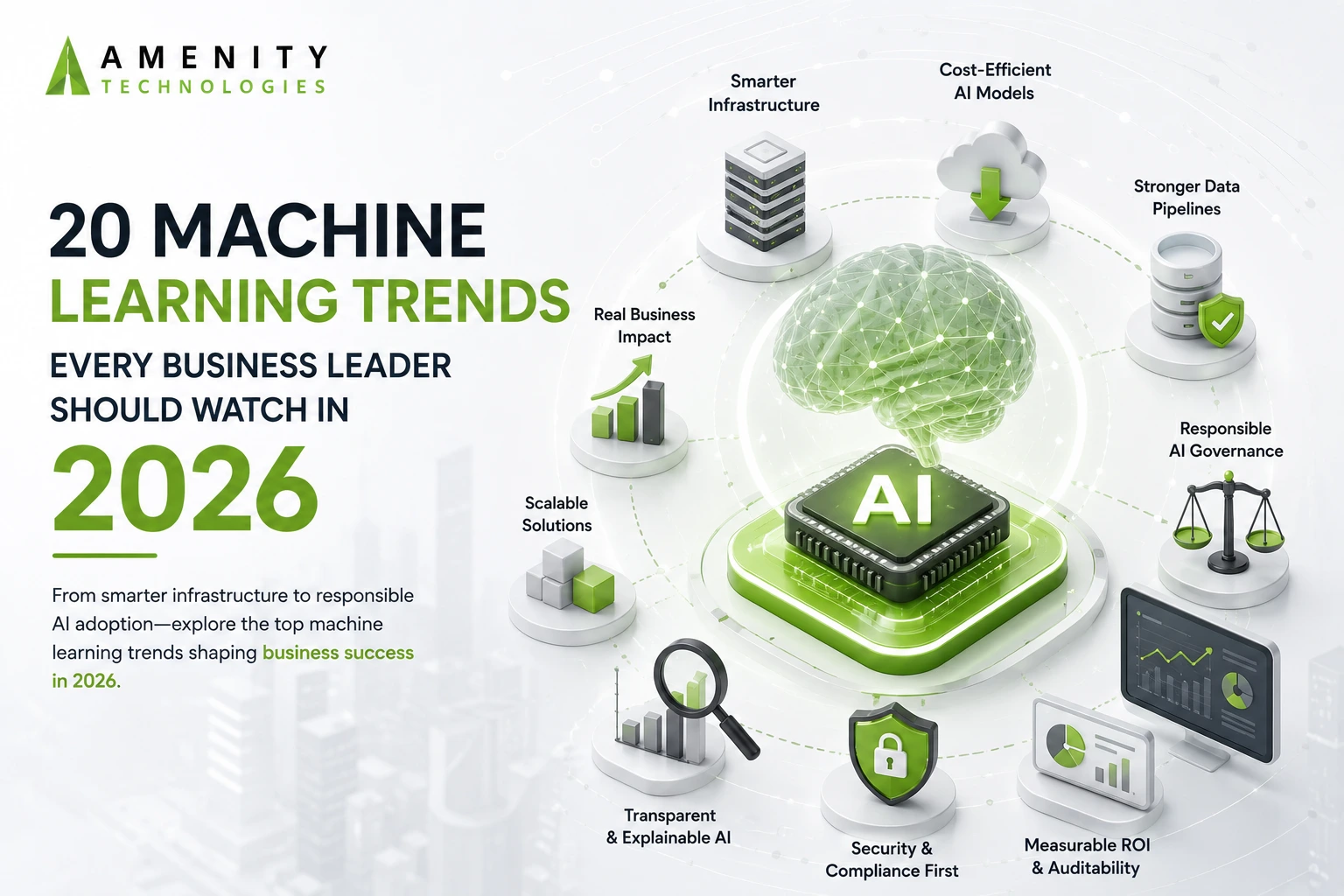
The era of writing blank checks for AI experiments is officially over. Over the last few years, enterprise boards poured millions into speculative pilots. Most of those sandboxed projects ran into a brick wall the moment engineers tried to wire them into legacy production pipelines or when CFOs looked at the staggering inference costs.
In 2026, the mandate from leadership has flipped from “show me what’s possible” to “show me the audit trail and the infrastructure ROI.”
Deploying machine learning trends for business today isn’t an AI problem; it’s a software engineering and corporate liability problem. Enterprises are no longer hunting for broad, general-purpose intelligence. They are rebuilding their data pipelines to support controlled, legally compliant, and computationally viable systems. Tracking the shift in business AI trends requires looking past frontend chat tools and examining the underlying architecture.
Infrastructure and Procurement Evolution
1. Consolidating the Single-Feature Point Tool
Two years ago, a startup could secure an enterprise contract simply by wrapping a sleek UI around a public API. Today, corporate IT departments are actively aggressive toward this vendor bloat.
Managing twenty different micro-tools introduces massive data security risks and creates disconnected operational silos. Procurement teams are consolidating their stacks into unified platforms capable of handling diverse ML business applications under a single roof.
2. Code-Level Technology Audits
Buying enterprise software used to be an administrative checklist. Now, it looks more like a forensic audit. Because data privacy lawsuits and training-set copyright challenges are filling the courts, enterprises refuse to inherit vendor liability.
Modern procurement teams require explicit documentation on data origin and fixed compute-cost predictability models.
3. The Migration to Hyper-Specific Vertical Platforms
Generic models are proving to be an expensive engineering trap. Fine-tuning a massive, multi-billion parameter model to understand a highly specific corporate task requires hundreds of engineering hours. Instead, the market is moving toward vertical platforms engineered from day one for distinct industries.
4. Small Language Models (SLMs) on the Edge
Running massive AI models for routine business tasks is becoming difficult to justify financially. Many companies are now shifting toward smaller, task-specific language models that can operate on local systems or internal infrastructure without requiring heavy cloud dependence.
For businesses, that usually means lower infrastructure costs, faster response times, better control over internal data, and fewer long-term hosting expenses.
5. Transitioning from Software Licenses to Capital Assets
More business leaders are starting to recognize that access to AI models alone is no longer a meaningful advantage. Most enterprise tools are beginning to look increasingly similar. What separates companies now is the quality of the data they’ve built internally, how organized it is, how securely it’s managed, and how effectively it supports real operational decisions.
Core Operational & Analytical Shifts
6. The Rise of Prescriptive Frameworks over Dashboards
For years, business intelligence tools mainly helped companies review past performance. Executives could see the numbers, but understanding what caused those shifts or what might happen next, still required a fair amount of interpretation.
Predictive analytics is changing that by combining live business data with forecasting models that can identify patterns and surface likely outcomes much earlier.
7. Centralized Algorithmic Risk Management
Algorithmic vulnerabilities are no longer just an IT headache; they are listed on corporate risk registers right next to cybersecurity breaches. Issues like model drift where an algorithm’s predictive accuracy degrades because real-world data patterns have shifted can cause massive financial damage if left unchecked.
8. Explainable AI (XAI) as a Legal Necessity
Businesses are becoming far more cautious about AI systems that make decisions without showing how those decisions were reached. In sectors tied to finance, hiring, insurance, or supply chain operations, regulators increasingly expect companies to explain why an application was rejected, a profile was filtered, or a vendor decision was made.
As a result, AI systems now need clearer audit trails and decision visibility instead of functioning like closed black-box processes.
9. Multi-Modal Ingestion Pipelines
Business data isn’t just rows in a SQL database. It’s security footage, voice notes from field technicians, sensor telemetry, and legacy blueprints. The latest enterprise machine learning setups focus heavily on pipelines that ingest and cross-reference multiple data types simultaneously.
10. Graph Machine Learning for Relationship Mapping
Traditional databases can store enormous amounts of information, but they are not very good at showing how separate records connect across larger systems.
That becomes a problem in areas like supplier networks, ownership structures, or fraud investigations, where the important detail is often the relationship between multiple entities rather than a single transaction itself.
Graph-based ML models are being used more often here because they can trace those connections far more effectively than standard database queries.
Tactical Workflows & Content Automation
11. Parsing Unstructured Document Chaos
Unstructured paperwork paralyzes standard corporate workflows. When data entry teams have to manually sort, verify, and key in information from varying formats, downstream business logic stalls completely.
Replacing manual data entry with context-aware document extraction pipelines completely changes the timeline. For instance, in automated invoice processing systems, moving from manual entry to specialized contextual extraction drops file validation timelines from hours to seconds. Modern architectures execute a localized scrub before the text ever hits an external network to maintain compliance.
12. From Inactive PDFs to Conversational Knowledge Base Engines
Data hoarding is an enterprise epidemic. Millions of dollars are spent generating training manuals, standard operating procedures (SOPs), and technical guides, only for that information to sit completely forgotten inside static PDF folders.
The tactical trend here is transforming these inactive data vaults into active assets. By building secure, isolated conversational interfaces on top of internal repositories, personnel can query institutional knowledge using everyday phrasing. This infrastructure change significantly reduces internal training friction.
13. Synthetic Data Generation for Biased Datasets
Acquiring real-world data for rare scenarios (like niche industrial machine failures or rare medical anomalies) is incredibly difficult. Companies are using generative architectures to safely simulate highly realistic synthetic data to train their predictive models without privacy concerns.
14. Real-Time Translation and Localization Filters
International operations usually get bogged down in messy localization spreadsheets or slow translation desks. It stalls work. Modern setups drop low-latency linguistic models directly into communication channels instead. This isn’t just swapping words. The software spots hyper-regional corporate jargon and compliance rules on the fly, making sure a support ticket or internal memo reads correctly without a human editor in the loop.
15. Automated Code Refactoring and Technical Debt Mitigation
Developers waste nearly half their work weeks fighting legacy code debt and broken dependencies. It kills momentum. To fix this, enterprises are plugging analytical tools straight into their active repositories. They run quietly in the background, including flagging security flaws, updating libraries, and rewriting messy logic while the team sleeps so engineers can focus on building new features.
The Guardrails of Autonomous Systems
16. Explicit Human-in-the-Loop Operational Architectures
The naive idea that machine learning would completely automate away entire departments has been replaced by human-machine collaboration. Autonomous systems handle repetitive, high-volume baseline tasks. However, the moment the system encounters an outcome that falls below a predetermined confidence score, the workflow automatically routes the task to a human expert.
17. The Crowding of the AI Adoption Trends Space
The rush to automate has turned chaotic, and a lot of companies are just spinning their wheels. Looking at current AI adoption trends, there is a massive divide between messy legacy setups and teams that fixed their infrastructure first. The real winners aren’t chasing flashy model announcements; they are doing the quiet, tedious work of building clean data preparation pipelines.
18. Energy-Efficient Green Computing Mandates
Running heavy models on cloud clusters means eye-watering power bills and a massive carbon footprint. Finance teams and sustainability officers are finally hitting a wall with this waste. The days of solving problems by endlessly adding more processing power are over. Developers are now forced to optimize training loops and pick specific server environments to hit strict efficiency targets.
19. The Evolution of Workflow Automation
Simple, rigid if-then automations are breaking under real-world unpredictability. The current shift is toward autonomous AI agents that can break down a high-level goal, plan their own execution steps, use external APIs, and self-correct when an unexpected error occurs.
20. Privacy-Preserving Federated Learning
Enterprises often want to collaborate without sharing raw, sensitive data (e.g., competing banks fighting fraud). Federated learning allows decentralized models to be trained across multiple separate ecosystems, sharing only the algorithmic weights rather than the underlying customer records.
Engineering a Resilient Infrastructure Roadmap
Chasing every shiny new software release is a guaranteed way to burn through your budget while building a fragmented, unmaintainable tech stack. Long-term market advantage belongs to the enterprises that treat machine learning as a disciplined extension of their core data infrastructure.
Real operational transformation requires moving past generic plug-and-play tools to build secure, production-grade pipelines. At Amenity Technologies, we specialize in building high-performance machine learning architectures tailored directly to your enterprise data layers, security guardrails, and commercial goals.
See how our engineering teams can reinforce your technical strategy by exploring our machine learning development services or map out a secure, scalable implementation blueprint with our generative AI consulting services.
FAQs
Q.1. What is the risk of model drift in enterprise machine learning applications?
A: Model drift occurs when shifting real-world data patterns cause an active algorithm’s predictive accuracy to degrade over time, requiring continuous monitoring and planned data retraining schedules to maintain performance.
Q.2. How does automated document parsing impact operational response times?
A: Transitioning from manual review to machine-learning-driven data extraction compresses text processing timelines from hours down to minutes, allowing downstream business logic to execute almost instantly.
Q.3. What is the fastest way to build a secure enterprise knowledge base?
A: Stop trying to train a massive generic model from scratch. The trend is moving toward vertical architectures and secure conversational interfaces built directly on top of your private PDFs and SOPs. You can protect your data integrity by scheduling a generative AI consulting session with us.