
Custom RAG Development Services: Handling Scanned PDFs, Tables, Images and Multilingual Content
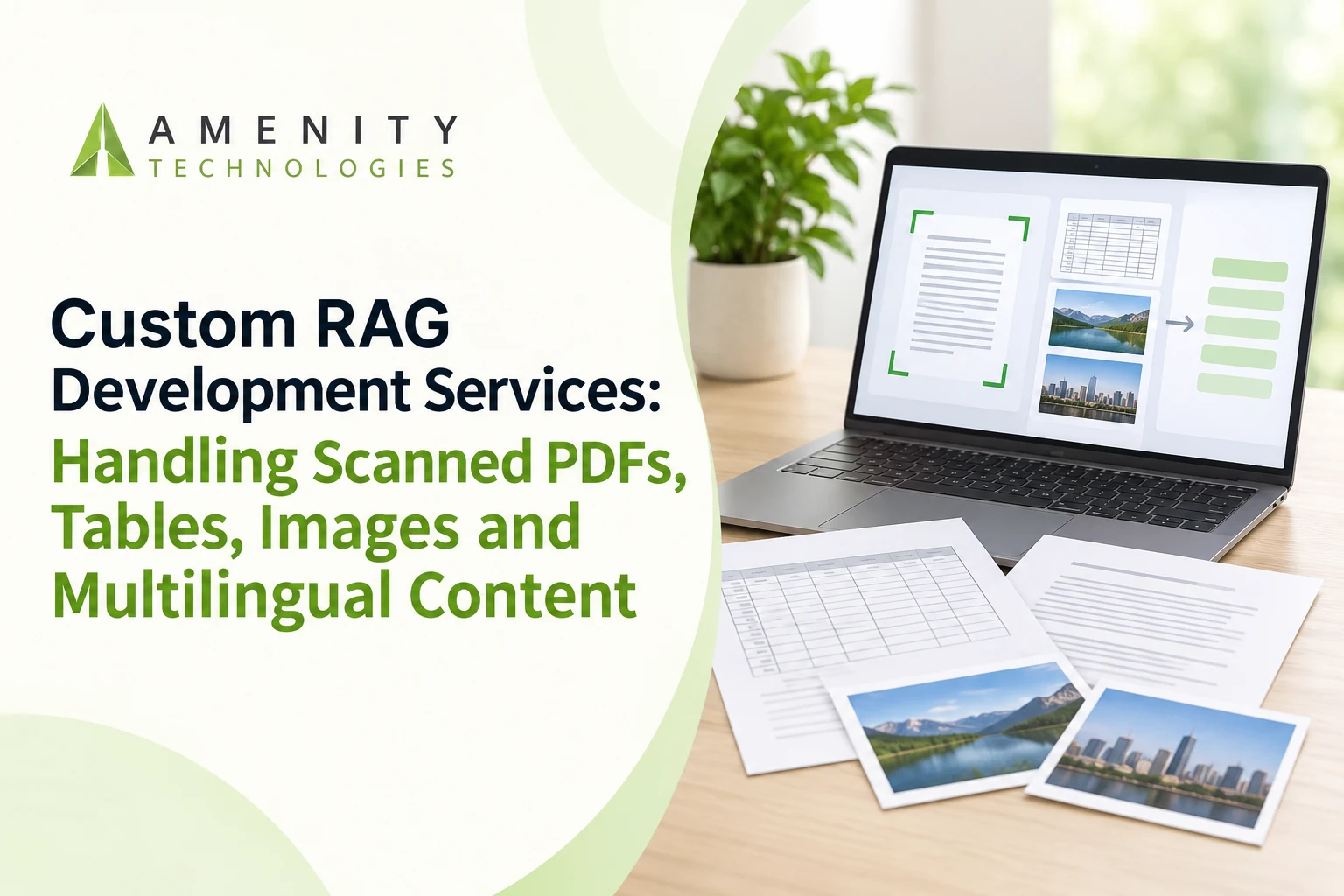
Off-the-shelf RAG tools work well on clean web pages and simple documents. Real business content is rarely that tidy: scanned contracts, engineering manuals full of tables, product sheets with diagrams, policies in several languages and documents that change weekly. This is where custom RAG development services earn their value.
Hard Content Types and Solutions
| Content | Problem | Approach |
|---|---|---|
| Scanned PDFs | No machine-readable text | OCR with layout detection and quality checks |
| Tables | Rows and columns lose meaning when flattened | Table extraction, row-level chunks, structured storage |
| Diagrams and images | Information locked in visuals | Captions, image descriptions, vision models |
| Long manuals | Answers depend on section context | Hierarchy-aware chunking with headings |
| Multilingual content | Questions and documents in different languages | Multilingual embeddings, translation, language metadata |
| Frequently changing documents | Stale answers | Automated re-indexing and versioning |
Scanned Documents
OCR quality varies with scan quality, fonts and layouts. Custom pipelines combine AI-based OCR with layout analysis and confidence scores, flagging low-quality pages for review. See intelligent document processing.
Tables
Price lists, specifications and rate cards are often tables. Flattening them into text loses which value belongs to which row. Custom approaches extract tables separately, keep column headers with each row and sometimes store them in structured databases so the system can query them precisely.
Images and Diagrams
Wiring diagrams, product photos and charts carry information. Vision-capable models can describe images, and those descriptions can be indexed alongside text. See image analytics.
Long, Structured Manuals
In manuals, "Step 4" means little without knowing which procedure it belongs to. Hierarchy-aware chunking keeps section titles and parent headings with each chunk.
Multilingual Content
Global companies hold documents in many languages. Multilingual embedding models allow a question in one language to find content in another, and responses can be generated in the user's language.
Keeping Content Fresh
Custom pipelines watch document sources, re-index changes automatically and retire old versions, so answers always reflect current information.
Measuring Success
- Retrieval accuracy on questions about tables, scans and diagrams
- OCR error rates on sample documents
- Answer correctness by content type
Our vector database and knowledge base teams build these pipelines. See our medical document platform case study.
Common Mistakes
- Assuming every PDF contains readable text
- Flattening tables into paragraphs
- Ignoring images that hold key information
- Indexing once and never updating
Key Takeaways
- Real business documents need custom parsing.
- Tables, scans, images and languages each need specific handling.
- Automated re-indexing keeps answers current.
Example: An Engineering Manual Library
An industrial equipment company had thousands of pages of manuals, many scanned, with wiring diagrams and specification tables. A generic tool returned incomplete answers. A custom pipeline extracted tables row by row, described diagrams, kept section hierarchy and flagged poor scans. Field engineers could then ask specific questions and receive answers with the exact manual page.
How Amenity Approaches Complex Document Projects
- Sample your hardest documents first
- Design parsing for each content type
- Measure retrieval accuracy by content type
- Automate updates and monitoring
Starting with the hardest documents avoids surprises later.
The Bottom Line
Your hardest documents often hold your most valuable knowledge. Custom RAG makes that knowledge usable.
Questions to Ask a RAG Provider
- How do you handle scanned documents and low-quality scans?
- How are tables extracted and stored?
- Can you index images and diagrams?
- How do you keep the index up to date?
Next Steps
Collect ten of your hardest documents, such as scanned contracts, table-heavy specifications or multilingual policies, and ask each provider to show how their pipeline handles them before you commit.
About Amenity Technologies
Amenity Technologies is a GenAI and AI development company based in Ahmedabad, India, with a team of 50+ AI specialists. We build chatbots, voice bots, RAG systems, AI agents, computer vision and custom AI software for clients worldwide. See our awards and achievements.
Related Reading
- RAG development services: security and access control
- RAG application development beyond chatbots
- Rag development services building chatbots on your own data
Frequently Asked Questions
Why do some documents need custom RAG development?
Scanned PDFs, tables, diagrams, long manuals, multilingual files and frequently changing documents are handled poorly by generic tools.
Can RAG work with scanned PDFs?
Yes, with OCR and layout analysis, ideally with confidence scores and review of low-quality pages.
How does RAG handle tables?
Custom pipelines extract tables separately, keep headers with each row and may store them in structured databases for precise queries.
Can RAG answer questions about images or diagrams?
Yes. Vision-capable models can describe images, and those descriptions can be indexed with text.
Can RAG search documents in different languages?
Yes. Multilingual embeddings let questions in one language find content in another, with answers in the user's language.
Build RAG on Your Toughest Documents
Talk to our AI team about your use case, or explore our case studies.