Need Different Solutions?
For any problem with development or anything related to service connect with us
Build a secure, AI-powered knowledge base with custom RAG architecture, enterprise-grade access controls, and accurate information retrieval across distributed business systems and repositories.
Traditional databases were built to retrieve exact matches. Modern AI applications work differently. They compare meaning instead of keywords, search across millions of embeddings, and rely on fast retrieval before a response is ever generated. As datasets grow, the way information is indexed, filtered, and retrieved becomes just as important as the language model using it.
Well-designed AI vector database solutions provide that retrieval layer. By combining vector indexing, similarity search, metadata filtering, and efficient query handling, they help AI systems retrieve relevant information with greater consistency while supporting the scale and response times expected from production environments.
Choosing a vector database is only one part of the decision. Retrieval quality is shaped by several factors working together, including how content is segmented, how embeddings are generated, how metadata is applied, and how similarity is measured during every query. A weakness in any one of those areas can affect the relevance of the results, regardless of which database is being used.
A well-planned vector embedding database is designed as part of a complete retrieval strategy rather than an isolated component. That approach produces more consistent search results, supports growing datasets, and provides a stronger foundation for AI applications that rely on accurate context.
Our vector database development services deliver an end-to-end strategy, transforming distributed enterprise information into an accessible, real-time context layer.
Every AI application places different demands on retrieval. We design vector database architectures based on data volume, query patterns, update frequency, filtering requirements, and expected response times instead of relying on a one-size-fits-all approach.
Embeddings are only useful when they represent well-prepared data. As enterprise datasets evolve we build ingestion, embedding and indexing pipelines to keep information organized, searchable and available for retrieval.
People rarely search using the exact language found in a document. Vector search development often combines semantic retrieval with structured filtering, while vector search engine development brings those capabilities together to help applications return results that better reflect the intent behind each query.
A reliable retrieval layer is fundamental to any RAG application. We develop the supporting infrastructure required for vector database for RAG, including document ingestion, embedding workflows, retrieval logic, and context delivery for language models.
Retrieval performance changes as vector collections grow. We evaluate indexing strategies, query execution, metadata filtering, and infrastructure configuration to maintain consistent search behaviour across production-scale AI applications.
A vector database can only retrieve what has been prepared for retrieval. If similar documents are embedded differently, metadata is inconsistent, or content is indexed without a clear structure, search results gradually become less predictable as the collection grows.
That’s one reason enterprise vector database projects involve more than choosing a platform. The way information is prepared, organised, and indexed often has just as much influence on retrieval quality as the database handling the search requests.
No single vector database is the right choice for every project. Some platforms are better suited to managed cloud deployments, while others offer greater control for organizations running their own infrastructure. Existing technology, expected query volumes, operational preferences, and compliance requirements all influence the decision.
Our experience with AI search infrastructure includes platforms such as Pinecone, Weaviate, Milvus, Qdrant, and ChromaDB, allowing us to recommend technologies based on technical requirements rather than familiarity with a single product.
A vector database isn’t filled once and left alone. Documents are revised, records are removed, and new information becomes available every day. If those changes aren’t reflected in the retrieval layer, search results gradually become less reliable even though the underlying data has already changed.
Regular updates, controlled indexing, and thoughtful synchronization keep the retrieval layer connected to the systems feeding it. As those systems change, the retrieval layer has to change with them. Otherwise, even a well-built implementation can gradually lose accuracy over time.
Organizations use vector search in different ways depending on the problem they’re trying to solve. Semantic search development supports internal knowledge retrieval, document question answering, technical documentation, AI assistants, recommendation engines, legal research, and product search where understanding meaning produces better results than matching keywords alone.
A successful implementation usually starts with a few practical decisions rather than technology alone. Mapping out how information flows across your departments ensures the system is built around actual business habits. By defining these structural goals early, you prevent common integration bottlenecks and set up a database that your teams can immediately rely on.
Some teams are replacing traditional search. Others are building a RAG application, introducing semantic search, or preparing an AI platform that depends on reliable retrieval from day one. The technical priorities are rarely identical, which is why we prefer to understand the application before discussing implementation.
If you’re evaluating vector database development services, speak with the engineers at Amenity Technologies about your objectives, existing technology stack, and the information your application needs to retrieve. As a Vector Database Development Company, we work alongside engineering teams to design retrieval systems that reflect the way their applications are built rather than applying the same approach to every project.
As an emerging Gen AI development company, our expertise spans a diverse range of models that help you in achieving new levels of creativity, efficiency, and intelligence.
GPT
Claude
Gemini
Llama
DeepSeek
Qwen
FLUX
Stable Diffusion XL (SDXL)
Whisper
ElevenLabs
Addressing Unique Problems with Advanced Gen AI Solutions.
50+
AI Projects Delivered Across Industries
10+
Generative AI Models Mastered
20+
Global Clients Empowered
5x
Faster Deployment Expertise
99.9%
Client Satisfaction Rate
3
Served with Scalable AI Services
Trusted by 2,000+ Brands
Read our case studies, which showcase our experience and strategy for implementing different Gen AI models into business workflows successfully.
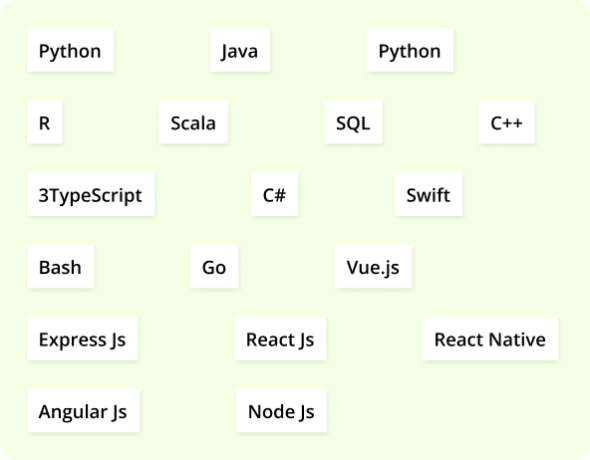
At Amenity Tech, we have a pre-vetted pool of talented developers with expertise and hands-on
experience in a range of technologies.
Create dynamic web apps using reusable components with React.
Develop structured, scalable front-end apps with Angular.
Lightweight, fast, and flexible interfaces built with Vue.js.
Create interactive, responsive websites using core JavaScript skills.
Design clean, responsive layouts using HTML5 and CSS3.
Build fast and flexible apps or data tools with Python
Develop modern web apps using Laravel’s PHP framework.
Create real-time, high-performance apps with Node.js.
Secure, scalable back-ends built with Django and Python.
Build sleek iOS apps with Swift and Apple-native tools.
Create reliable Android apps for all devices and versions.
Cross-platform apps from a single codebase with Flutter.
Build native-like mobile apps with shared React code.
Integrate smart, AI-powered features into your app.
Deploy AI chat solutions using OpenAI’s ChatGPT.
Design and train deep learning models with PyTorch.
Optimize AI outputs with expert-crafted prompts.
Extract insights from complex data with AI and ML.
Visualize and interpret data to guide business decisions.
Build scalable pipelines and manage data infrastructure.
Testimonials
Read what our clients have to say about the Amenity Tech partnership and the benefits they have received from our innovative Gen AI solutions.
The Amenity Team is a standout group of professionals in AI chatbot development, consistently delivering bug-free, expert-level code. Their strong communication skills and seamless collaboration make working with them a breeze. With deep expertise in AI chatbot projects using LLMs and ChatGPT, including web and WhatsApp platforms, you’re in the best hands!
Ganesh Tangella
Have the honor and privilege of working with Amenity on many projects these last 6 months. Amenity has demonstrated immense and exceptional capabilities in developing robust custom computer-vision-learning algorithms, Deep Neural Networks, and Convolutional Neural Networks, and has advanced our R&D exponentially! Trust can never be more valuable and critical for any startup, especially when building and developing partnerships!
I must thank Amenity for opening our eyes and expanding our AI capabilities beyond measure!
Charles B. Moss II
Excellent work, Great communication throughout the project. Took time to understand the task then provided an excellent out come.
Hanif-jan-mohamed
Dealing with amenity such good experience on our AI project. Very co operative team with polite nature.
Aarohi Kaur
Excellent work, Great communication throughout the project. Amenity delivered one of our Most Difficult NLP Based project.
Daniel Sommer
Excellent Work Experience with Amenity, completed incredible IoT work for our project.
Harnam Singh Thakur
Dealing with Amenity such Good Experience on Project. They work are Accurate According to Requirements Also Team is very co operative and Trustworthy.
Naif
How will Generative AI help my business?
Generative AI models are capable of producing new content, such as text, images, audio, code, or synthetic data, based on patterns learned from large datasets. Gen AI powers intelligent chatbots for customer support, marketing content generation, personalised product recommendations, document summarisation, and synthetic training data creation.
What type of Gen AI models do you specialise in?
We specialise in deploying a range of Gen AI models:
Can you fine-tune OpenAI models, such as GPT-4, according to industry-specific needs?
While OpenAI does not currently allow full fine-tuning of GPT-4, we implement advanced prompt engineering, embedding-based retrieval (RAG), and custom context injection techniques to make ChatGPT responses highly relevant to your domain. For open-source models, such as LLaMA 2, Mistral, or Falcon, we can easily fine-tune them.
What is the process of Gen AI implementation?
Our end-to-end Gen AI implementation includes:
How do you ensure data privacy and model compliance?
We follow strict enterprise-grade security practices and adhere to frameworks such as GDPR, CCPA, and HIPAA, where applicable. All training data is encrypted in transit and at rest, and we employ differential privacy, anonymisation, and access control policies.
Can you integrate Gen AI with our existing applications or workflows?
Yes. We offer API-based and SDK-based integration of Gen AI models with your existing applications (e.g., CRMs, chat platforms, ERPs), data sources, and other internal tools, such as Slack, Salesforce, and Shopify.