
RAG Development Services: Building Chatbots on Your Own Data
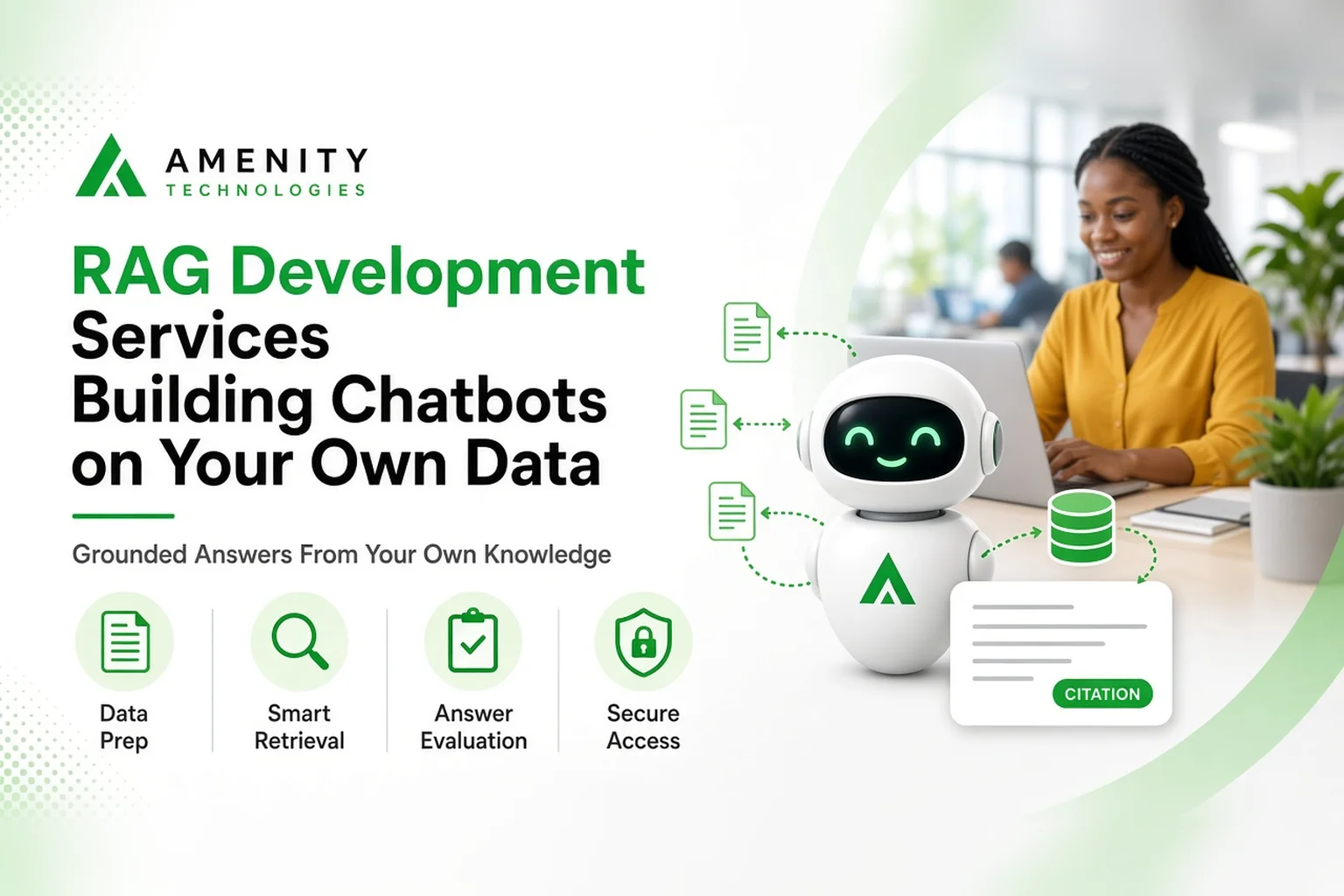
A general-purpose language model knows a great deal about the world and nothing about your business. It has not read your policies, your product documentation, or last month's pricing update. Ask it about any of them, and it may admit it does not know, or it may produce a confident answer that sounds right and is not.
RAG development services exist to close that gap. Retrieval-augmented generation, usually shortened to RAG, connects a chatbot to your own content so that answers come from material you control. This article explains how the approach works, what data preparation involves, how to test the results, which security questions need attention, and when RAG is the right choice.
How RAG Works
The process has three steps. When a user asks a question, the system first searches your content for the passages most likely to hold the answer. It then hands those passages to the language model together with the question. The model writes a reply based on that material, and many systems show the source so the reader can check it.
This differs from retraining a model on your data. Retraining changes the model itself. RAG leaves the model alone and changes what it is shown, so a change in your content does not require retraining. Updating an answer can be as simple as updating a document.
When RAG Fits
RAG suits situations where the answers already exist in documents and those documents change over time. Typical examples are support knowledge bases, policy and procedure libraries, product information, and internal reference material. It also suits cases where users need to see where an answer came from.
It is a weaker choice in a few situations. If your content is thin, outdated, or contradictory, RAG will surface those flaws, not hide them. If the task is to carry out a transaction, such as changing a booking, the bot needs a connection to the system that holds the booking, not only the ability to read documents. And if the conversation follows a fixed script with few variations, a simpler rule-based bot may be enough.
Preparing the Data
Data preparation tends to take more effort than newcomers expect, and it shapes the quality of every answer that follows.
Collect and Clean
Start with an inventory of sources: help articles, manuals, policies, slide decks, spreadsheets, ticket histories. Remove duplicates, drafts, and superseded versions. Check that each file can be read as text. Scanned documents need text extraction first, and tables and slides often lose their meaning when converted carelessly.
Split Sensibly
Documents are divided into smaller sections, usually called chunks, so that the search can find the relevant part. Chunks that are too small lose the context around them. Chunks that are too large dilute relevance, because a passage may contain the answer alongside a lot of unrelated text. Keep headings attached to the text beneath them, and attach details such as the source, date, and intended audience, since these allow filtering later.
Keep It Current
Decide who is responsible for updating content, how a change reaches the search index, and how outdated material is retired. A RAG system that is accurate at launch and neglected afterwards will drift out of date. Showing the date of each source in the answer helps readers judge how fresh the information is.
Where Answers Go Wrong
A poor answer has one of two causes. Either the search did not find the right passage, or the model found it and used it badly. The remedies differ. A search problem points to chunking, search method, or ranking. A model problem points to instructions, boundaries, and the way retrieved text is presented. Check which one you are dealing with before changing anything, or you may fix the wrong part and see no improvement.
Evaluation
Judge a RAG system on evidence, not impressions.
Build a question set from real queries. For each one, record the passage that should be found and what a correct answer looks like. Then score two things separately: whether the right passage was retrieved, and whether the final answer was correct, complete, and supported by it.
Include questions your content cannot answer. The right response there is to say so. Run the same set after every significant change, so you can see whether things improved or regressed, and keep the results over time. Record examples of failures as well as scores, because they guide the next round of fixes. Reviewers should be people who know the subject, since a fluent wrong answer is easy for a non-specialist to miss.
Designing the Answers
How the bot presents its replies affects trust as much as accuracy. Decide whether answers show their sources, so that a reader can open the original document. Decide what the bot says when it finds nothing relevant, and make sure that response is honest and useful, such as offering another route to help. Set the tone and length for your audience, and define which topics the bot should decline or pass to a person. These choices are quick to make early and awkward to change once users have formed habits around the first version.
Security and Access
Giving a chatbot access to your documents raises questions that deserve answers before launch.
- Permissions. Can every user see every document? If not, the bot must respect that. A person should never receive an answer drawn from a file they could not open themselves.
- Where text goes. If an external model service processes the question and the retrieved passages, your content leaves your own environment for that step. Check the provider's terms on retention and location.
- What goes in. Documents can contain text that tries to steer the model's behaviour. Control which sources are ingested, and treat content from outside your organisation with particular care.
- Logging and removal. Decide how long questions and answers are kept, and how a document is deleted so that it also disappears from the index.
Involve your security team in the design, not only the final review.
What a Service Should Cover
A RAG project involves more than connecting a model to a folder. A thorough service typically includes identifying the use case and sources, building the data preparation pipeline, designing retrieval and answer generation, creating the evaluation set, handling access and security, deploying the system, and monitoring it afterwards.
Amenity's site describes RAG work spanning AI search systems, document retrieval, enterprise chatbots, and workflows built with LLM tooling such as LangChain. For businesses looking for a RAG development company in India, Amenity has an office in Rajkot, Gujarat. As with any provider, ask to see how evaluation is handled and how your data is protected.
If you want to explore a chatbot built on your own content, get in touch with Amenity Technologies and describe your documents and use case.
Frequently Asked Questions
What is RAG in simple terms?
RAG lets a chatbot look up relevant passages in your own documents before it answers, so the reply is based on your content rather than only on what the model learned in training.
Does RAG stop a chatbot from giving wrong answers?
It reduces the risk but does not remove it. Poor content, weak search or loose instructions can still produce errors, which is why testing against real questions matters.
What content do we need to begin with RAG development?
Documents that hold the answers your users need, kept reasonably current and consistent. A review of the material at the start shows whether it is ready.