
AI for Insurance: Where AI Fits Across the Policy Lifecycle
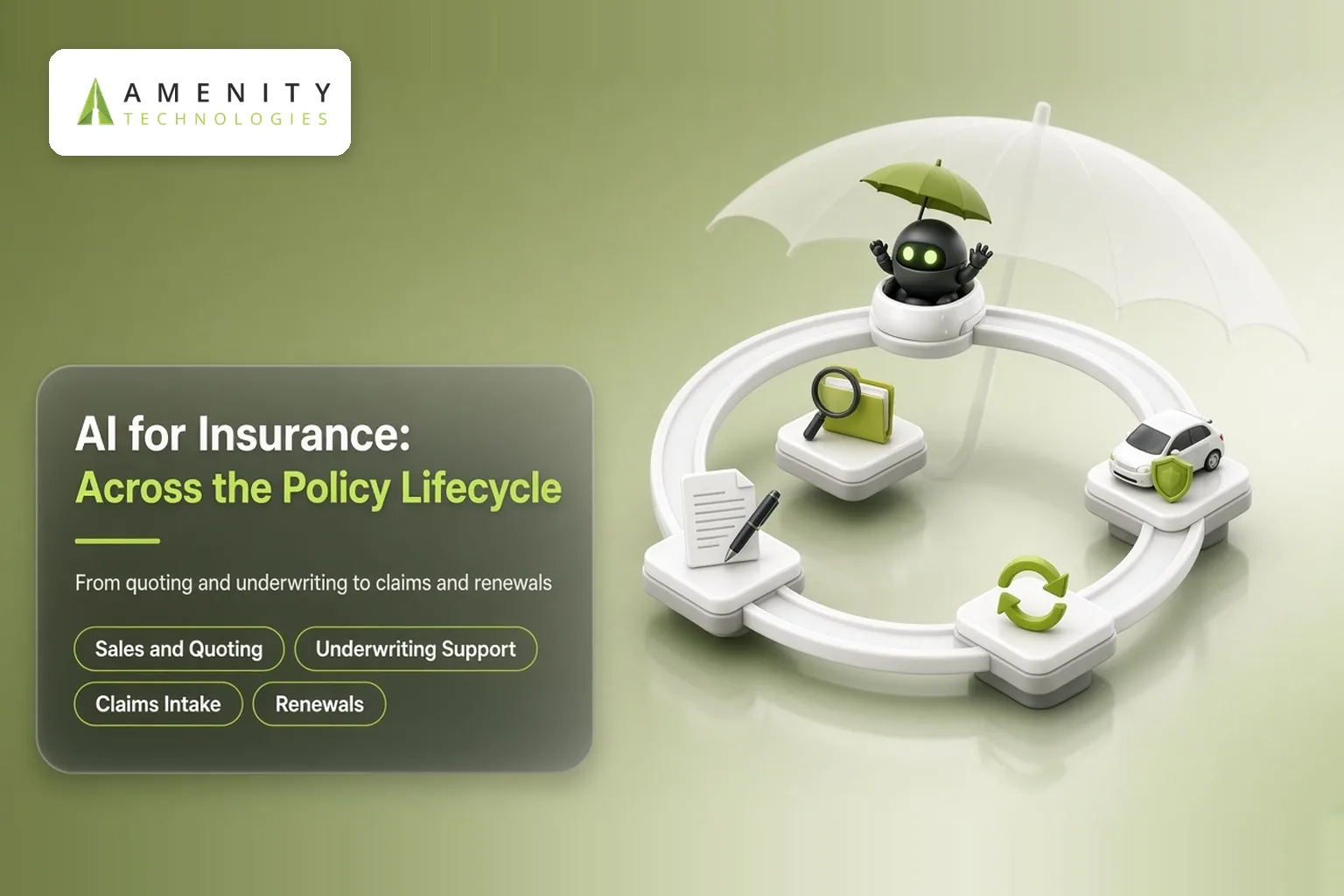
Insurance is a document-heavy, conversation-heavy business. Customers ask questions before buying, submit documents to get covered, call when something goes wrong and need reminders to renew. Each step offers AI opportunities. This guide maps them across the policy lifecycle. See our AI for insurance solutions.
The Lifecycle at a Glance
| Stage | AI application |
|---|---|
| Enquiry and quote | Chat and voice assistants explain products and collect quote details |
| Underwriting support | Document extraction and summaries for underwriters |
| Onboarding | KYC document checks and guided applications |
| Policy servicing | Self-service for changes, certificates and payments |
| Claims intake | First notice of loss by chat or voice, document collection |
| Claims review | Extracting data from bills and reports, flagging anomalies |
| Renewals and retention | Reminders, outreach and identifying at-risk customers |
Sales and Quoting
An insurance chatbot can explain coverage options in simple language, collect details for a quote and route qualified leads to agents. For agencies, see best AI solutions for insurance agencies.
Underwriting Support
Underwriters spend much of their time reading documents. Document processing extracts key fields and summarises applications, so underwriters focus on judgement. Final decisions should remain with qualified staff, within regulatory rules on fairness and explainability.
Claims Intake
First notice of loss is a stressful moment for customers. A voice or chat assistant available at any hour can capture the incident, guide document uploads and give a claim reference immediately. Read voice AI for insurance claim intake.
Claims Review and Fraud Signals
AI can extract data from bills, repair estimates and reports, check them against policy terms and flag unusual patterns for investigators. AI flags should prompt human review, not automatic denial.
Policy Servicing
Self-service for address changes, policy documents, payment status and nominee updates reduces call volume and waiting times. Integrate assistants with policy administration systems so customers can complete tasks, not just get information. See custom chatbot integrations.
Renewals and Retention
Automated reminders, personalised renewal messages and models that flag customers likely to lapse help retain business.
Compliance Considerations
- Follow insurance regulator rules on advice, disclosure and fair treatment.
- Protect personal and health data under applicable laws.
- Keep explanations for decisions that affect customers.
- Keep audit trails of AI-assisted actions. See AI chatbots in BFSI compliance.
Where to Start
Most insurers and agencies start with customer service and claims intake, where volumes are high and risk is manageable, then add document processing for underwriting and claims.
Measuring Impact
- Quote-to-policy conversion
- Time from first notice of loss to claim registration
- Claims processing time and rework
- Policy servicing calls handled by self-service
- Renewal rate
- Customer satisfaction at each stage
Common Pitfalls
- Automating decisions that need human judgement and explanation
- Assistants that only give information but cannot complete tasks
- Ignoring agents and brokers, who often prefer AI tools that support them
How Amenity Approaches Insurance AI Projects
- Map customer journeys and contact reasons across the lifecycle
- Prioritise high-volume, low-risk automation
- Integrate with policy administration and claims systems
- Pilot with real customers and agents
- Extend to document processing and analytics
This builds measurable wins while respecting regulatory and fairness requirements.
Key Takeaways
- AI opportunities exist at every stage of the policy lifecycle.
- Customer service and claims intake are common starting points.
- AI should support, not replace, underwriting and claims decisions.
- Compliance and explainability must be built in.
Insurers that connect AI across the lifecycle, rather than deploying isolated tools, see the biggest gains in speed, cost and customer trust over time.
About Amenity Technologies
Amenity Technologies is a GenAI and AI development company based in Ahmedabad, India, with a team of 50+ AI specialists. We build chatbots, voice bots, RAG systems, AI agents, computer vision and custom AI software for clients worldwide. See our awards and achievements.
Related Reading
- AI for finance teams: automating the CFO office
- Best ai solutions for insurance agencies in 2026
- AI for customer service: metrics and the hybrid support model
Frequently Asked Questions
How is AI used in insurance?
Across the lifecycle: quoting assistants, underwriting document extraction, onboarding checks, policy self-service, claims intake, claims review, fraud signals and renewal outreach.
Can AI handle insurance claims intake?
Yes. Chat and voice assistants can capture first notice of loss at any hour, guide document uploads and issue claim references.
Should AI make underwriting or claims decisions?
AI should support qualified staff with extraction, summaries and flags. Final decisions should remain with people, within regulatory rules.
How does AI help detect insurance fraud?
By flagging unusual patterns in claims and documents for investigators to review, rather than denying claims automatically.
Where should insurers start with AI?
Usually with customer service and claims intake, then document processing for underwriting and claims review.
Explore AI for Your Insurance Business
Talk to our AI team about your use case, or explore our case studies.