
Why Growing Businesses Can’t Afford to Ignore Generative AI Anymore
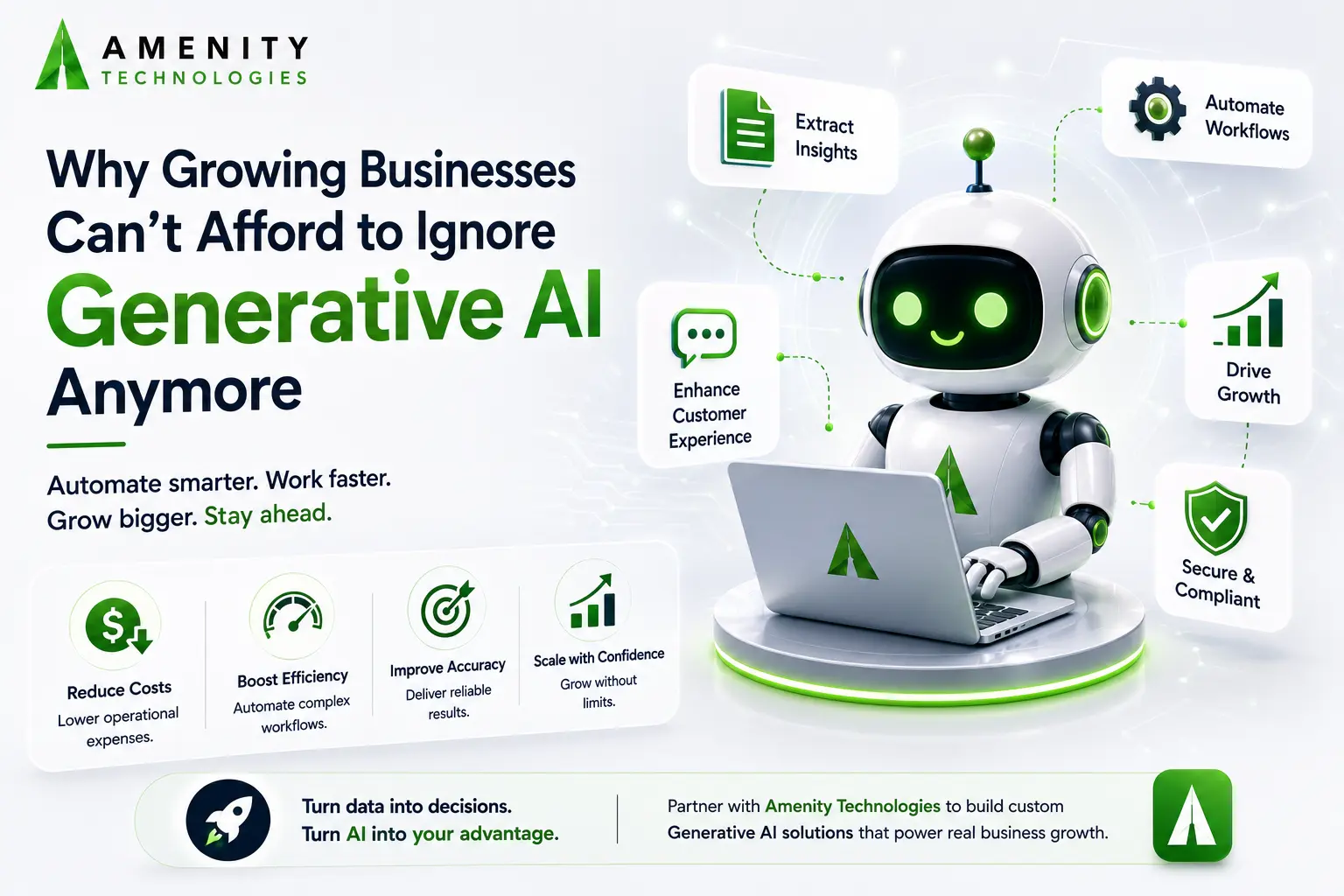
Every single day, growing companies spend critical hours on manual workflows, repetitive data extraction, and heavy operational friction that drains internal team energy. If your teams are buried under thousands of weekly support tickets, manual document processing, and slow software development cycles, you are losing structural momentum to agile competitors who run lean.
Waiting around for technology to mature is a dangerous strategic risk that causes immediate margin erosion. This detailed operational breakdown explores why growing businesses can’t afford to ignore generative AI anymore, showing you exactly how custom intelligent platforms turn complex technical overhead into measurable efficiency, lower costs, and rapid commercial scale.
The Hard Reality of the Modern Market
Many mid-market executives still treat machine learning as a secondary luxury or a future experimentation budget line item. This perspective misses a rapid corporate transformation: companies deploying custom language models are scaling operational output exponentially without adding to their fixed employee headcount.
Recent market data highlights an intense shift, with enterprise software automation growing at an unprecedented rate as global infrastructure scales. When your internal teams spend multiple hours manually extracting unstructured details from client PDFs, or writing code scaffolding from scratch, your business is actively paying an unnecessary structural tax.
The same trend is becoming increasingly visible through AI in banking, where financial institutions are automating document-intensive processes, customer service operations, and compliance workflows to improve efficiency and reduce operational costs.
Machine intelligence has switched completely from a speculative experimental project to a baseline operational survival tool.
Structural Cost Reduction Areas
Custom AI models remove major friction from back-office management. They take over high-volume administrative tasks, driving massive savings and freeing workers for high-leverage problems.
Document Processing
Bespoke systems automatically extract data from unformatted vendor invoices, legal agreements, and internal regulatory files with near-zero error rates, speeding up financial close cycles.
Legacy Code Modernization
Older software isn’t always the problem, but maintaining them is. AI can assist developers work through aging codebases, making upgrades and migrations far less time-consuming.
Regulatory Compliance Analysis
What was compliant six months ago may not be compliant today. AI in banking is helping compliance teams review contracts, identify regulatory risks, and detect potential issues before they become larger operational challenges.
Drive Productive Enterprise Output
True corporate scaling does not come from working longer hours; it comes from maximizing the output generated by every single minute of active employee labor.
Content Engine Acceleration
Instead of spending weeks drafting technical manuals, systems instantly produce precise documentation, reducing publication times down to hours.
Technical Research Compression
Finding the right information in hundreds of pages of technical documents can be a slow process. AI helps narrow the search, so engineers can spend more time solving problems and less time hunting for answers.
Content Localization
Taking a product into a new market usually means reworking more than just the language. AI can help teams adapt content for different regions while keeping the original message intact.
Re-Engineer Customer Operations
Traditional communication models force growing companies into a bad choice: hire huge contact centers or use frustrating, rigid phone menus that alienate valuable clients. AI-powered banking solutions enable faster, more efficient customer support across channels.
Infinite Volume Handling
Bespoke customer solutions resolve thousands of complex product tickets simultaneously with extreme accuracy, completely eliminating user hold times.
Deep Intent Interpretation
Advanced models easily read chaotic human emails, figuring out underlying sentiment and user frustration to prioritize high-value enterprise accounts.
Instant Context Syncing
Instead of searching through CRM records manually, teams can quickly access past customer information while a conversation continues.
The Cost of Waiting
Waiting too long can create problems of its own. While one company keeps putting things off, another may already be finding faster ways to work.
- Knowledge Walks Out the Door: A lot of important knowledge lives in people’s heads. When processes stay manual, that knowledge often stays with them instead of becoming part of the business.
- Older Software Gets Harder to Live With: Many companies keep adding fixes to old systems because replacing them feels like a bigger job. Over time, those quick fixes add up and make future changes more difficult.
- Repetitive Work Frustrates Good Employees: Most people don’t enjoy spending their day copying information between systems or handling the same task over and over. When that becomes a regular part of the job, frustration tends to follow.
Technical Benchmarks for System Evaluation
Evaluating how a generative system operates requires moving beyond vague promises and focusing purely on verifiable technical performance metrics. Your software must meet concrete business standards to justify scaling up.
Context Window Accuracy
Large, custom enterprise models must parse extensive data files without dropping crucial context. System accuracy depends on maintaining high retrieval precision even when reading tens of thousands of tokens simultaneously.
Response Generation Latency
People expect answers quickly. If a system takes too long to respond, it becomes frustrating to use, no matter how capable it is. The challenge is handling complex tasks without slowing down everyday work.
Multi-Model Interoperability
One model may work well for one task and struggle with another. That’s why many teams avoid building everything around a single system.
Building Your Implementation Blueprint
Many AI projects run into trouble for a simple reason: the information they’re working with is scattered all over the place. One team keeps records in spreadsheets, another uses an older database, and important details are often buried in documents nobody has opened in months. Before AI can be useful, that information needs to be easier to find and work with.
There’s also a practical side to consider. Nobody wants machines to handle important calls without someone paying attention. In most organizations, people still review decisions that affect customers, finances, or operations. AI can help move things along, but someone should still be able to step in when needed.
The Cross-Industry Adoption Landscape
Every modern sector faces unique regulatory and structural hurdles, but the foundational mechanics of intelligent model deployment remain remarkably consistent across different fields.
FinTech and Financial Auditing
Finance teams deal with a lot of paperwork. Reports, tax records, and audit documents all take time to review. AI can help reduce some of that workload and make information easier to work through.
Biotech and Healthcare Management
Research and healthcare teams spend a surprising amount of time on documentation. Records, notes, and reports can quickly pile up, which is why many organizations are looking for ways to reduce the administrative burden.
Supply Chain and Logistics
Keeping track of shipments, inventory, and delivery schedules can be challenging, especially when plans change. Many logistics teams now use AI to keep a closer eye on those day-to-day changes.
The Ultimate Strategic Choice
The near future of business design belongs to multi-agent generative networks. Instead of a single tool working in a vacuum, specialized models will communicate, negotiate, and transact securely with one another across departmental lines to solve macro-problems. A logistics model will coordinate instantly with a finance layer to balance inventory, while a compliance agent reviews the transaction against active industry regulations, all within seconds.
Forward-thinking leaders are building these data foundations today. Partnering with Amenity Technologies allows your business to design, deploy, and scale custom generative AI tools, generative AI banking solutions, and custom software solutions that transform static databases into active engines of ongoing operational growth.
Our AI-powered banking solutions help organizations improve operational efficiency, strengthen customer experiences, and create a scalable foundation for future growth.
FAQs
Q.1. If current enterprise tools already include built-in AI features, what are the reasons to invest in a custom generative platform?
A: Built-in AI can be useful, but it’s rarely built around the way your business works. A custom platform gives you more control over what the system sees, how it behaves, and how it fits into your day-to-day operations.
Q.2. Will we need to replace our existing systems to use generative AI?
A: Not usually. Most companies aren’t ripping out databases or replacing software just to use AI. In practice, the new system is connected to tools that are already in place, which makes adoption far less disruptive than many people expect.
Q.3. How to reduce AI errors in customer and financial workflows?
A: Problems usually start when AI is asked to answer questions without enough context. Giving it access to the right internal information; and keeping people involved when decisions carry real consequences, goes a long way toward avoiding that.