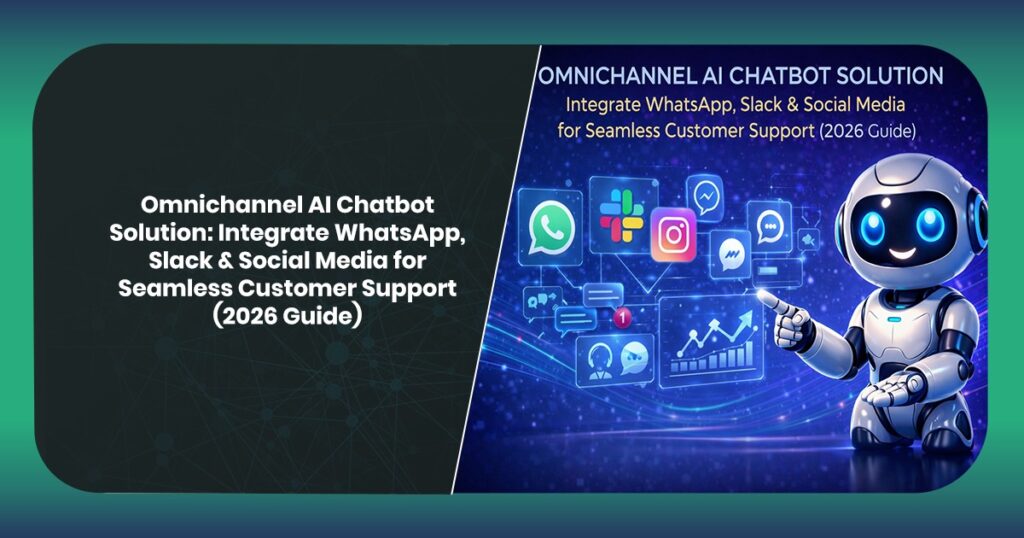


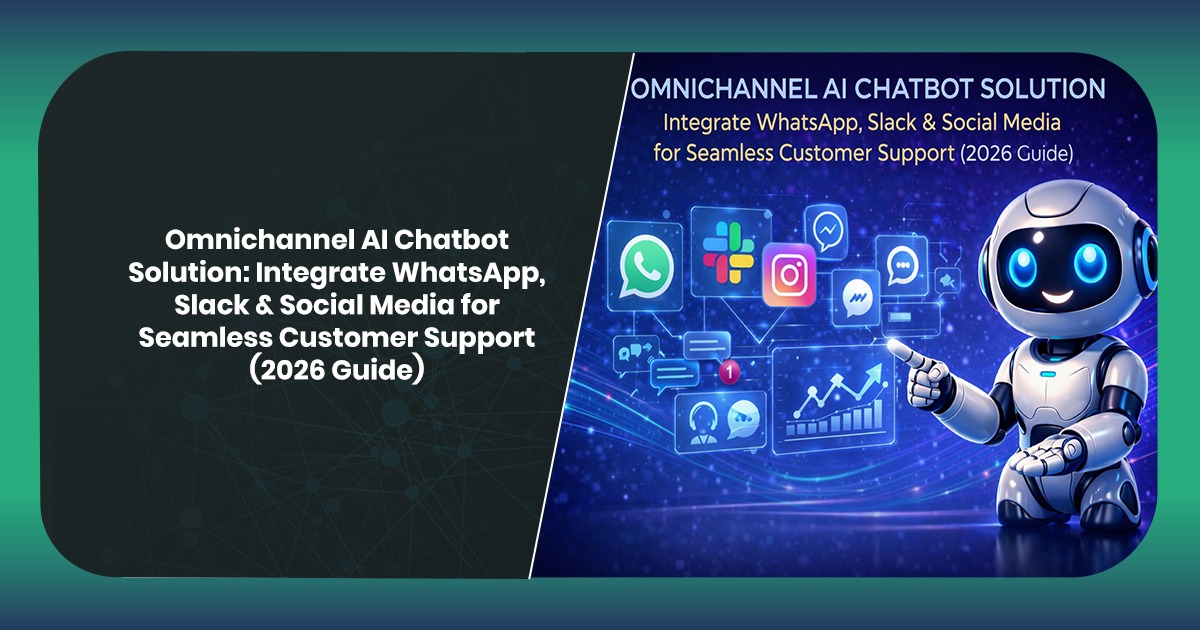



The challenge for modern enterprises is not bot construction, but cross-platform orchestration using an Omnichannel AI Chatbot Solution. A lead comes in through Instagram, support follows up on WhatsApp, and internal coordination happens on Slack. Somewhere in between, context gets lost.
That’s the real problem. It’s not about adding more channels. It’s about making them work as one system.
In this blog, we break down how a 2026-ready approach brings WhatsApp, Slack, and social platforms together, without the usual gaps in context, speed, or response quality.
Combating High-Frequency Context Switching Fatigue
Support teams don’t complain about AI. They usually complain about multiple tabs. One screen for WhatsApp. Another for Instagram. Slack somewhere in the middle. Email still open. CRM lagging behind.
Here, context is lost every few minutes. A customer asks something on Instagram. Follow up on WhatsApp. Then escalates via email. And suddenly, it’s treated like three different conversations. This shouldn’t happen in the first place.
But at the moment, every platform has different behavior like its own isolated system. Different APIs. Different response windows. Different expectations.
We’ve seen teams spend more time switching context than actually solving problems. That’s where things start breaking.
What an Omnichannel Chatbot Solution Actually Means in 2026
Let’s strip the buzzwords. An omnichannel chatbot solution in 2026 is not about being present on multiple platforms. That part is somewhat easy.
It’s about continuity. If a user starts a conversation on Facebook and follows up on WhatsApp, the system should remember the context. Not restart. Not re-ask. Not lose track.
State retention is the real shift. The conversational agent carries conversation memory across platforms. Same intent. Same context. Different channels.
That’s the difference between “multi-channel presence” and actual omnichannel behavior.
To be honest, most chatbots in 2024 were just glorified FAQ lists, 2026 is different.
Why WhatsApp Becomes the Frontline for High-Intent Conversations
In markets like India and Brazil, WhatsApp isn’t just a messaging app. It’s infrastructure.
Everything happens there including support, sales, onboarding, as well as follow-ups. Users don’t “visit websites” the same way anymore. They usually prefer messaging.
That’s why a Whatsapp AI Chatbot Solutions is often the first real touchpoint. This isn’t passive, it’s active.
We’ve seen use cases where:
- Leads are qualified before a human ever gets involved
- Product queries are resolved instantly
- Follow-ups happen without manual intervention
The expectation is simple: quick answers, no friction.
If your system slows down here, you lose attention immediately.
Why Slack Automation Drives Internal ROI Faster Than You Expect
External conversations get the spotlight. Internal workflows quietly eat time. It majorly involves HR queries, DevOps alerts, deployment updates, and access requests. All of this ends up in Slack.
A Slack AI Chatbot Solutions doesn’t “assist”; it removes steps. Instead of:
- Searching docs
- Tagging teammates
- Waiting for replies
The answer shows up where the question is asked. And we’ve worked on setups where:
- Onboarding questions dropped by half
- Incident response time improved significantly
- Repetitive internal queries disappeared almost entirely
Why Social Media AI Chatbots Are Now Bound by Time, Not Just Accuracy
Social platforms have changed. It’s no longer just about responding. It’s about responding fast.
There’s an unspoken expectation: if someone comments, they expect a reply within minutes. They won’t appreciate it if the responses take hours of time.
That’s where a Social Media AI Chatbot Solutions steps in. Especially with:
- Comment-to-DM automation
- Instant query acknowledgment
- Lead capture from engagement
If businesses miss that window, the opportunity fades quickly.
We’ve seen brands lose high-intent users simply because no one replied in time. We’ve considered speed as a baseline, not a feature.
Why Your API Gateway Becomes the Single Point of Failure
Now comes the part most blogs overlook. The backend. Because it is where things usually fall apart.
A proper multi-channel AI integration isn’t about connecting APIs, it’s about managing them under pressure.
There will be different platforms, rate limits, and payload structures. Apart from all this, there’s the real headache: fragmented API documentation.
At Amenity Technologies, we dealt with integrations where:
- Webhook formats differ slightly but break everything
- Authentication tokens expire inconsistently
- Error handling isn’t standardized
Now add cross-platform latency. A message from Instagram hits your system. Gets processed. Then routed to WhatsApp.
In this case, even a small delay becomes noticeable. And if that happens, users usually won’t care why it’s slow. They just see that it is.
The “Central Brain” Model That Actually Holds It Together
This is where most implementations either stabilize, or collapse. The architecture needs a center. We can call it the “Central Brain” because everything routes through it.
Here’s what that actually looks like:
- Webhook Listeners: Each platform pushes events into the system
- Unified API Gateway: Normalizes incoming and outgoing data
- Processing Layer: Handles intent, logic, and routing
- CRM Handshake (Salesforce/HubSpot): Syncs user context, history, and actions
The key isn’t just connection. It’s consistent.
Every channel should behave like it’s part of the same system, not a patchwork of integrations. Without this, you don’t have an omnichannel. You have chaos with connectors.
The No-Nonsense Implementation Path (What Actually Works)
Most teams overcomplicate this. However, it doesn’t need to be. It’s actually simple. We’ve narrowed it down to four steps that actually move things forward.
1. Channel Selection (Prioritize High-Impact Channels)
It is not a smart idea to focus on excelling at all channels. Try picking 2–3 platforms where your users already are. That’s usually enough to validate the system.
2. Flow Mapping (Before You Write Code)
This is where the structure gets defined. Map how conversations begin, where they tend to break, and where human intervention becomes necessary. If this isn’t clearly outlined upfront, the system won’t hold.
3. API Authentication (Where Most Delays Happen)
This is where teams underestimate effort. Permissions, tokens, and rate limits, it all adds up. You should get this stable early.
4. RAG Training (Context Over Responses)
Don’t just train for answers. Train for relevance. Your system should pull the right information, not just respond quickly.
The ROI Shows Up Faster Than Most Teams Expect
This isn’t theoretical. Once implemented properly, the impact becomes visible quickly.
We’ve seen:
- 40% reduction in first-response time
- 25% lower cost-per-ticket
- Noticeable drop in repetitive queries
- Higher conversion from messaging channels
The key is not automation alone. It’s removing friction across systems.
Final Thought: This Isn’t About Channels But Continuity
Most teams approach this as a platform problem. But, it’s usually not. It’s a continuity problem. Users don’t think in channels. They think in conversations. If your system treats every platform separately, you’re forcing them to restart every time.
That’s where user experience is negatively affected. And that’s exactly what this blueprint of omnichannel AI chatbot solution is designed to fix.
If you’re planning to implement an Omnichannel Chatbot Solution, the difference isn’t in the tools; it’s in how the system is structured from the start.
At Amenity Technologies, we focus on building systems that actually hold under real usage, which means across platforms, APIs, and scale, without adding operational friction.
FAQs
Q.1. How do you ensure conversation context is maintained across platforms?
A: This comes down to identity mapping and centralized session handling. If the system can identify the same user across platforms such as WhatsApp, Slack, and social channels. The context can be carried forward rather than resetting it.
Q.2. What’s the biggest technical risk in multi-channel AI integration?
A: Most teams underestimate API inconsistency. Different platforms behave differently under load, and even small webhook delays or payload mismatches can break the experience if not handled centrally.
Q.3. How do you handle platform-specific limitations without breaking the experience?A: You don’t force uniformity, you standardize logic instead. The backend stays consistent, while the frontend adapts slightly to each platform’s constraints.