
Rule-Based Chatbots Explained: How They Work, Examples & When to Use Them (2026 Guide)
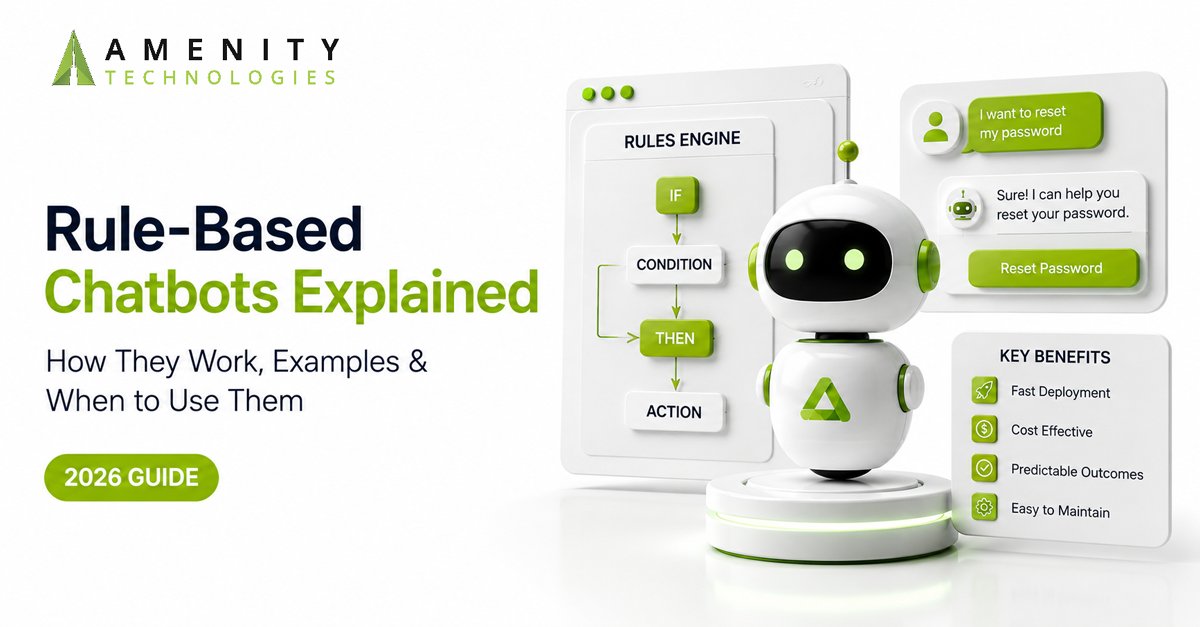
Rule based chatbots are often overshadowed by Generative AI. Most conversations have moved toward AI: what it can understand, how it responds, and how far it can go. But when you look at how businesses actually use chatbots day to day, a lot of interactions are still simple, repeatable, and structured. That’s where these rule based assistants continue to hold up.
In this blog, we’ll go through how they work, where they still make sense, and how they compare with AI chatbots when the use case is more practical than experimental.
Defining Rule Based Chatbots
A rule-based chatbot is a bot that works on predefined rules and decision trees. It responds to user inputs based on specific conditions, keywords, or selections, rather than understanding intent or learning from conversations.
In simpler terms, it follows a structured path. If the input matches a rule, it delivers a fixed response. If it doesn’t, the conversation usually stops or redirects.
How Do Rule-Based Chatbots Work
At a surface level, rule-based chatbots appear simple. But the way they’re structured behind the scenes is what defines how effective they are. Most interactions follow a predictable flow.
1. User Input
The workflow is triggered by user input capture. The input could be a typed message, a selected option, or a button click. In many cases, businesses guide users toward predefined options to reduce ambiguity.
This input is crucial because rule-based systems function efficiently when inputs are structured, not open-ended.
2. Keyword Detection or Input Matching
Once the input is here, the rule-based assistant doesn’t try to interpret it in a broader sense. It simply checks whether it matches something it already knows.
Sometimes that’s a keyword. Sometimes it’s a button or a selected option. In many setups, businesses actually prefer guiding users toward buttons, just to avoid ambiguity.
Because the system isn’t trying to “understand” language. It’s just looking for a match. If the input fits, the flow continues. If it doesn’t, there’s usually no fallback unless it’s been built in. That’s where the difference starts to show.
3. Decision Tree Logic
This is where rule-based assistants actually take shape. Behind the interface, everything is mapped out in advance. One input leads to one path, and that path leads to the next step. It’s not dynamic. If a user selects a certain option, the chatbot moves in that direction, every time, without variation.
For example, if someone checks order status, the system may ask for an ID, then return the result. The flow doesn’t change unless someone has designed it to.
Over time, these paths can grow. And when they do, managing them becomes less about building and more about maintaining structure.
4. Predefined Response
Once the condition is met, the response is already there. It doesn’t get generated. It doesn’t adapt. It’s simply delivered. That’s why responses stay consistent across users. The same input takes the user to the same response, regardless of context.
This can be useful in such cases where clarity is more important than flexibility. But it also reveals that the system won’t adjust if the situation slightly changes.
Putting It Together
If you look at it as a complete flow, it works like this:
User input → matched against rules → directed through a decision path → response delivered
There’s no learning layer in between.
That’s what makes rule-based assistants predictable, and in certain cases, very effective.
Real Examples of Rule-Based Assistants
In 2026, you can usually find rule-based assistants in places where nothing really changes much from one user to another.
Same questions. Same actions. Same paths. That’s where they hold up.
1. FAQ Chatbots
A lot of FAQ bots don’t even let you type freely. You just pick from options such as shipping, refunds, account help. Once you click, the answer shows up.
It works because the system already knows what you’re looking for. There’s no guesswork involved.
2. Website Support Bots
These show up when you’re trying to find something quickly.
Instead of searching the whole site, the bot nudges you step by step. Choose this, then this, and you land where you need to.
It’s not doing anything complex. Just cutting down the effort.
3. Lead Generation Bots
Lead generation is another straightforward use case of the rule-based assistants.
The bot gathers information like name, email, or requirements through a fixed sequence. Every step is predefined, which means the interaction stays focused and predictable.
Advantages
Predictable Responses
The response is always consistent. You won’t see any variation here, which is actually useful for controlled environments.
Easy to Implement
As compared to AI-driven systems, rule-based bots are quicker to set up and don’t require training data.
Low Maintenance
Since the tools don’t learn from interactions, they don’t need continuous tracking or frequent model updates.
Works Well for Structured Queries
In cases where user input is limited and predictable, rule-based systems perform reliably.
Limitations
No Understanding of Context
In case a user asks something outside predefined rules, the chatbot cannot process the task and it may not respond effectively.
Limited Flexibility
The system only works within the flows it has been given. Anything outside that flow results in friction.
Scaling Becomes Complex
As more scenarios are added, decision trees can become difficult to manage.
Not Suitable for Open Conversations
If interactions are unstructured or require interpretation, rule-based chatbots fall short.
Rule-Based vs AI Chatbots (Key Differences)
This is where the differences become important. Rule-based assistants and AI-driven tools operate on fundamentally different methods.
How They Respond
– Rule-based chatbots follow predefined paths.
– AI chatbots interpret intent and generate responses.
Flexibility
– Rule-based systems are limited to structured flows.
– AI chatbots can handle variation in input.
Use Case Fit
– Rule-based bots work perfectly fine where interactions are repetitive and controlled.
– Advanced AI solutions are better suited for dynamic, unpredictable conversations.
Maintenance
– Rule-based bots require updates when flows change.
– AI systems require training, monitoring, and refinement.
Practical Perspective
In many businesses, it’s not a choice between one or the other.
Rule-based assistants are usually the best fit for:
- Navigation
- Data collection
- Simple queries
AI chatbots are used for:
- Deeper conversations
- Support resolution
- Contextual interactions
The difference is not about capability, but about fit.
When Should You Use Rule-Based Chatbots
It would be wrong to presume that every situation requires AI. In fact, rule-based agents are often proved to be the right choice when the goal is clarity and control.
Use Them When:
Interactions Are Repetitive
If users ask the same type of questions regularly, rule-based systems handle them efficiently.
Inputs Can Be Structured
When users can be guided through buttons or options, rule-based chatbots work well.
Speed Matters More Than Flexibility
If the objective is to deliver quick responses rather than complex interaction, these systems are sufficient.
You Need Simple Lead Capture
For collecting basic user information, structured flows perform reliably.
Avoid Them When:
- User queries vary significantly
- Conversations demand interpretation
- Multiple contexts need to be handled simultaneously (effectively)
In such cases, AI-based systems become more suitable.
Final Thoughts: Simplicity Still Has Its Place
Rule-based chatbots are often seen as limited compared to AI systems. But in the right context, that limitation becomes an advantage in many cases.
Not every business problem requires intelligence. Some require structure. The rule-based systems are predictable, controlled, and efficient.
And when the interaction is clear, repetitive, and well-defined, rule-based chatbots do exactly what they are designed to do, without unnecessary complexity.
If you’re considering chatbot implementation, the decision isn’t just about choosing AI or rule-based, it’s about choosing what aligns well with your existing workflow.
At Amenity Technologies, we can help you design chatbot solutions that align with real use cases, whether that means structured rule-based solutions or more advanced AI-driven communication.
FAQs
Q.1. Are rule-based chatbots still relevant in 2026 with AI chatbots becoming common?
A: They are relevant in 2026, especially in setups where things don’t change much. If the interaction is simple and repeatable, a rule-based approach often does the job without adding extra complexity.
Q.2. How complex can a rule-based chatbot become over time?
A: It depends on how many cases you keep adding. What starts off simple can turn into a fairly large decision tree, and at that point, managing it becomes the bigger challenge.
Q.3. Can rule-based chatbots be combined with AI chatbots?A: Yes, and that’s actually how a lot of systems are set up now. The structured part is handled by rules, and anything that goes beyond that can be passed to an AI layer.