




Technology is evolving fast, and chatbots have evolved with it. These tools are no longer simple pop-ups answering a few preset questions users might have. Today, they sit at the intersection of customer experience, operational efficiency, and business trustworthiness. They can resolve policy-related queries, qualify leads, guide purchases, support employees, and in some cases, they even influence real decisions.
Yet one question keeps coming up during strategy discussions:
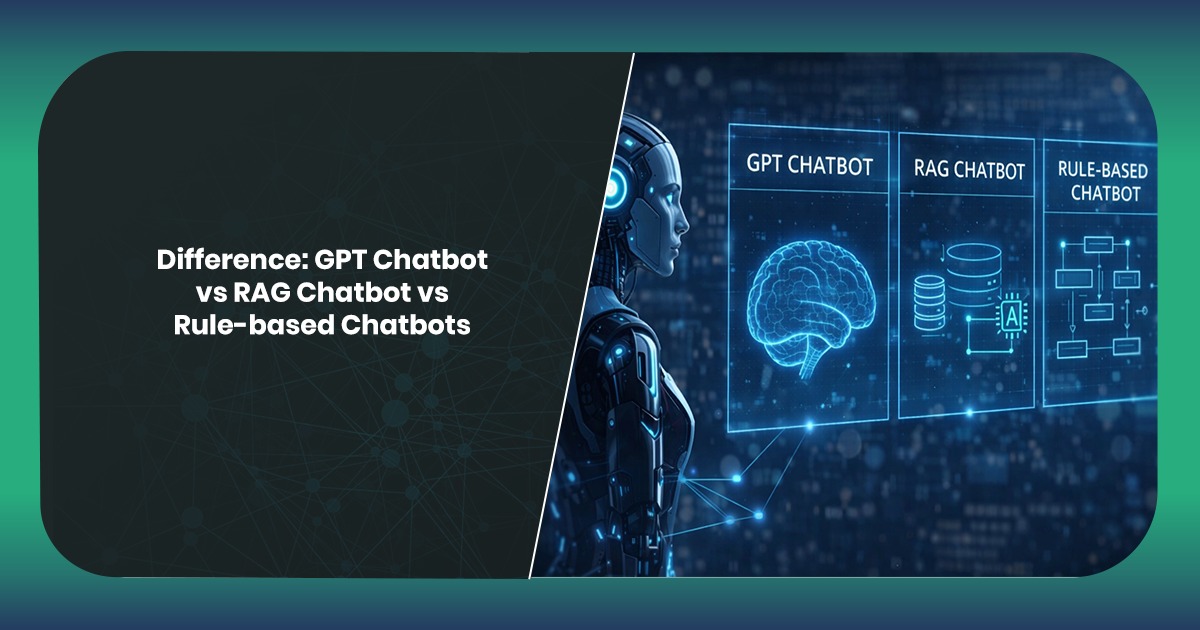
Should we use a GPT chatbot, a RAG chatbot, or just stick with a rule based chatbot?
On the surface, all three chatbots are designed to interact with users. But under the hood, each chatbot is built differently, serving distinct purposes. If you end up investing in the wrong architecture, it won’t just affect performance, but can quietly open the door for compliance risks, reduced trust, and long-term maintenance challenges..
In this article, you will take a practical, experience-driven look at GPT, RAG, and rule based chatbot, how they work, where they struggle, and how businesses should think about accuracy, context, and scalability when choosing between them.
How Your Chatbot Selection Impacts Outcomes
You may not find any problem at the very first day of chatbot implementation. Problems usually surface weeks or months later. It could be when responses start drifting, when users have unexpected queries, or when your teams realize they can’t completely trust the chatbot’s outcome.
All of this happens because the chatbot architecture decides how answers are generated, how much control the team has, how updates are managed, and how the system manages risk at scale. Choosing the right AI chatbot development approach early can help you prevent costly rework later.
Rule-Based Chatbots: Predictable, Controlled, and Still Very Relevant
Rule-based chatbots are often underestimated because they aren’t flashy. But they are still widely used for a reason. At their core, rule-based chatbots follow predefined paths. If a user selects an option or enters a known phrase, the chatbot responds according to a rule that was written and approved beforehand. The design of these types of tools is easy. There is no interpretation or content generation involved with rule-based chatbots.
Where Rule-Based Chatbots Excel
Rule-based systems work best when:
- Questions are repetitive and well-defined
- Response behavior must be consistent
- Compliance and auditability matter
(That’s why they’re common in banking FAQs, appointment scheduling, onboarding flows, and internal support systems.)
Where They Fall Short
There’s no doubt that the rule-based chatbots are reliable. However, they are not conversational in the modern sense. There is a lack of flexibility that keeps these chatbots lagging behind other advanced communication tools. Rule-based chatbots struggle with:
- Limited natural language understanding
- Failing when users phrase questions differently
- Requiring manual updates for every new scenario
- Feeling inflexible in longer conversations
These tools can be used to produce deterministic answers. However, the responses will not be accurate if the rule logic is flawed.
GPT Chatbots: Fluent, Flexible, and Sometimes Too Confident
GPT chatbots entered the market as a breakthrough in conversational AI. They became popular because they responded in full sentences, handled open-ended questions, and sounded surprisingly human. But this fluency comes with significant flaws.
Pure GPT chatbots do not retrieve facts unless connected to external data sources. Instead, they generate responses based on patterns learned during training. This becomes a critical concern when they continue responding even when they lack the correct information. Often, they end up predicting plausible-sounding but inaccurate answers.
What GPT Chatbots Do Well
- Handle free-form, conversational input
- Respond naturally to vague or broad questions
- Adapt quickly to new topics
- Require minimal upfront scripting
The Hidden Risk
GPT-based chatbots are impressive communicators. However, fluency without grounding introduces risk potential. These systems may sound confident but may introduce challenges like:
- Generating inaccurate information
- Mixing outdated facts and current ones
- Struggling to keep up with policy or domain-specific accuracy
- Making compliance teams nervous
RAG Chatbots: Where Intelligence Meets Accountability
RAG (Retrieval-Augmented Generation) chatbots were developed to solve a specific problem: how to maintain GPT’s fluency while controlling accuracy.
Instead of relying only on what the model “knows,” RAG systems retrieve relevant information from approved sources before generating answers, grounding responses in verified data. Answers are grounded in verified data, making responses more trustworthy.
Why RAG is a Practical Upgrade
The primary reasons why the RAG-based chatbots are developed are:
- Reduce hallucinations significantly
- Keep responses aligned with real data
- Allow easy knowledge updates without retraining models
- Support enterprise-scale use cases
This is why the RAG chatbot development services are best suited in customer support, internal knowledge bases, insurance, healthcare, legal, and technical domains.
The Trade-Off
The major concerns in investing in the RAG systems are that they require:
- Well-structured data sources
- Thoughtful system design
- Slightly higher setup effort
For many enterprises, this effort pays off in long-term trust and stability.
Context Handling: Conversations vs Continuity
Context isn’t just about remembering the last message from the users. It’s about maintaining consistency across an entire interaction to ensure seamless communication that strengthens user experience.
- Rule-based chatbots track context through states
- GPT chatbots maintain conversational flow but may drift factually
- RAG chatbots combine conversational memory with factual grounding
As we can see, RAG-based chatbots can perform efficiently in multi-step explanations and complex workflows.
Scalability: More Than Just Handling Traffic
Scalability isn’t only about handling thousands of chats. It’s about managing growth without losing control.
- Rule-based chatbots scale safely but slowly
- GPT chatbots scale quickly but introduce risk
- RAG chatbots scale knowledge and conversation together
For growing organizations, RAG offers a more sustainable path.
Compliance, Control, and Long-Term Risk
This is where most of the decision-makers pause to reassess their strategy.
- Rule-based systems are easy to audit
- GPT systems are difficult to govern
- RAG systems balance flexibility with oversight
As a result, regulated industries increasingly favor RAG or hybrid models that combine rule-based workflows, retrieval-backed answers, and controlled language generation.
Final Verdict
The goal of conversational AI-driven chatbots isn’t to sound human, it’s to support humans in effective ways. Keep in mind that fluency without accuracy erodes trust and control without flexibility frustrates users. When you understand the key differences between GPT, RAG, and rule-based chatbots, your business stops chasing trends, and begins building systems you can actually depend on.
Based on our suggestion, you can consider rule-based chatbots when workflows are stable, accuracy is non-negotiable, and flexibility is not quite necessary. The GPT chatbots are preferred when conversations are exploratory, creativity matters more than precision, and risk tolerance is quite high. And choose RAG-based chatbots when accuracy and trust matter, knowledge changes frequently, and you want intelligence with accountability.
At, Amenity Technologies, we design chatbots based on business risks, instead of just following trends. C You can go through our service pages and contact the support team for assistance or to book our client-centric services.
FAQs
Q.1. Are GPT chatbots unsafe for business use?
A: No. These chatbots are not unsafe. But, yes they hold risk potential if you use them without consideration. If possible, you should avoid putting your confidential data in it. Plus, you can consider using them when accuracy isn’t the primary concern for you.
Q.2. Which chatbot type is easiest to maintain long-term?
A: RAG-based chatbots are known to maintain the balance between flexibility and maintainability. That’s why they can be considered as the easiest ones to maintain in the long-run.
Q.3. Is a hybrid chatbot better than choosing one approach?
A: In most real-world cases, hybrid chatbots are a better option because they combine flexibility of generative models with the control and reliability of structured systems. This will keep natural conversations, maintain accuracy, and lead to better risk management.
Q.4. When should I NOT use GPT chatbots?A: It is better that you avoid relying on GPT-based chatbots in critical conditions when accuracy, compliance, and legal accountability is essential.