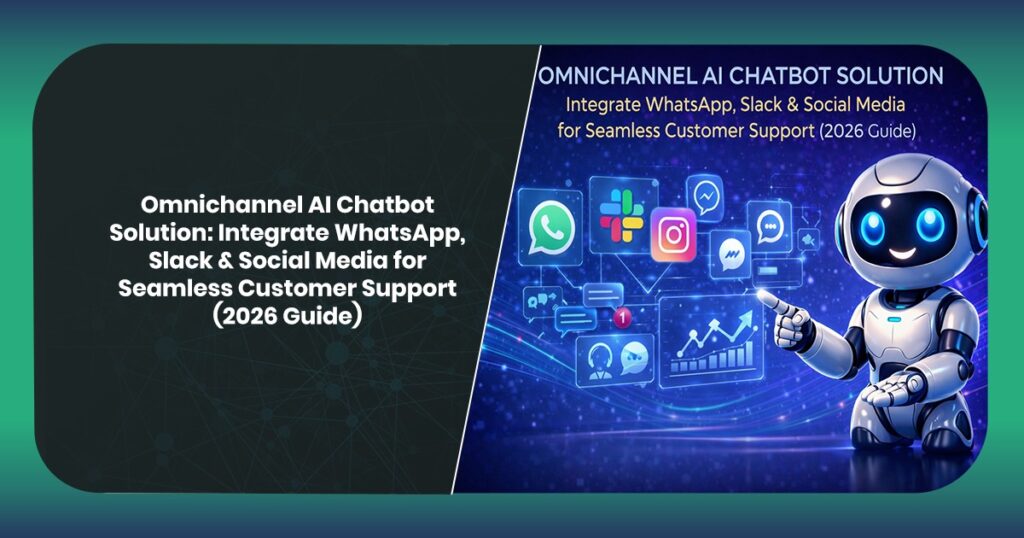





AI chatbots are no longer merely supporting tools that we implement on websites. These tools have advanced, offering tailored support, automate complex workflows, assist with decision-making, and deliver personalized experiences to users across multiple industries. When you successfully implement these AI-powered chatbots, they remove friction, guide decisions, and can even unlock measurable business value.
Businesses actively deploy chatbots to automate high-friction workflows. If you’re exploring use cases of AI for Industries, we’re sure that you are not looking for theory. You want to clearly understand how businesses are leveraging these smart chatbots and what outcomes businesses can expect.
This blog post explores the same.
By the end of this insightful blog post, you will learn about the most impactful AI chatbot use cases across major industries. These use cases involve a clear focus on real business outcomes.
Why AI Chatbot Use Cases Look Different Across Industries
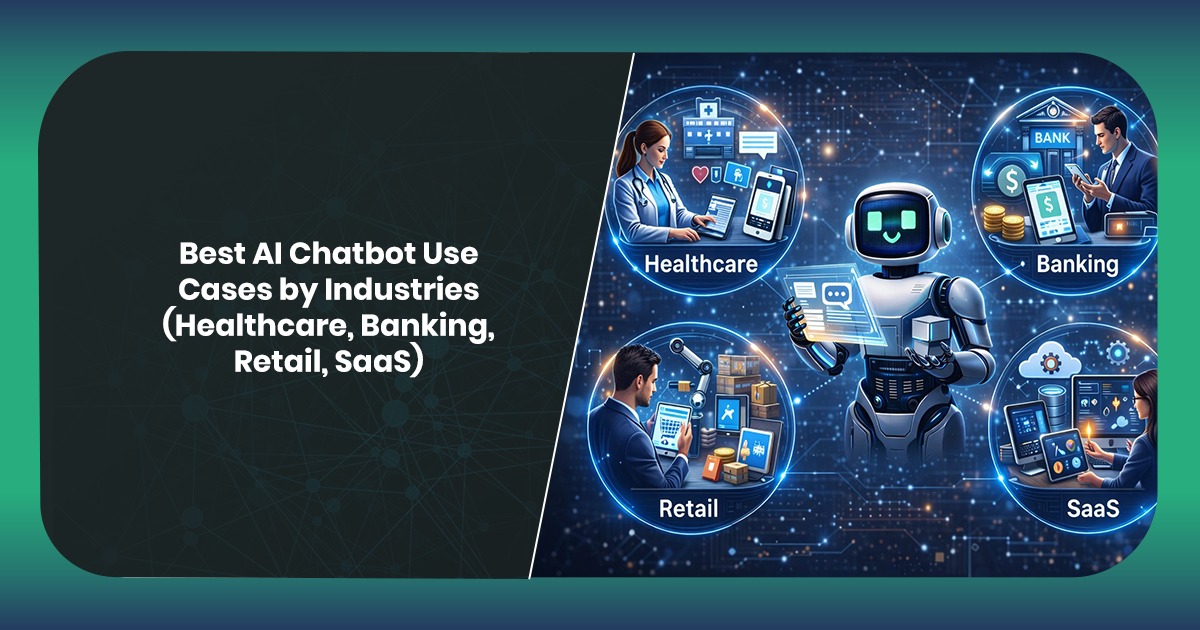
Every industry has its own objectives and challenges. Organizations in the healthcare sector focus on accuracy and trust. The banking sector demands compliance and data security. Retail businesses depend heavily on customer experience. And SaaS enterprises prioritize speed and scalability.
To meet distinct purposes, the most successful chatbot implementation is never one-size-fits-all. Each chatbot is built around specific business workflows, customer expectations, and operational realities.
Let’s move forward and take a look at how that plays out in practice.
Real-World AI Chatbot Use Cases
1. SaaS & Business Strategy: Intelligent Knowledge Assistant
– Project: AI based Blog Search
– Industry: Business Strategy & Consulting
- The Challenge: Executives and clients needed instant access to strategic insights buried within a massive library of 5,000+ documents and blog posts.
- The Solution: We developed a Retrieval-Augmented Generation (RAG) Chatbot that acts as an intelligent analyst. It uses a serverless vector database to retrieve context-aware answers and dynamic LLM selection to ensure high accuracy.
- The Outcome: The chatbot significantly reduced hallucination rates and provided users with instant, accurate strategic advice, proving that complex knowledge bases can be made accessible through simple conversation.
2. Hospitality & Service: AI Voice Bot for Reservations
– Project: AI Restaurant Table Booking Voice Bot
– Industry: Hospitality / Retail
- The Challenge: Managing table reservations manually is time-consuming for staff and can lead to missed calls during peak hours.
- The Solution: We built a Voice AI Agent that users can chat with to select a restaurant. The AI then autonomously places a real phone call to the restaurant to make the reservation, providing a real-time transcript of the call to the user.
- The Outcome: This reduced manual effort for users, improved booking success rates, and offered complete transparency by letting users “see” the AI’s conversation with the venue.
3. Corporate Training: AI Sales Training Simulator
– Project: LEISA Talk – Sales Training Voice Bot
– Industry: Corporate Training / SaaS
- The Challenge: Traditional sales training (role-playing) is resource-intensive and hard to scale.
- The Solution: We created a Voice-Activated Sales Training Bot that simulates various customer personas. It allows sales professionals to practice pitches and handle objections in realistic, spoken conversations with the AI.
- The Outcome: The tool provided an immersive training environment that improved sales readiness and confidence without requiring constant supervisor involvement.
4. Customer Support: Automated Lead Generation & FAQ Bot
– Project: Amenity AI Lead Gen Bot
– Industry: General Business Support
- The Challenge: Handling repetitive queries and qualifying leads 24/7 can overwhelm support teams.
- The Solution: We deployed a dual-purpose chatbot. It uses a RAG pipeline to answer FAQs instantly and a structured flow to collect visitor details (name, company, intent) for sales qualification.
- The Outcome: The bot efficiently filters inquiries, answers common questions using cached responses to save costs, and automatically emails qualified leads to the sales team.
Final Thoughts: Make Smart Decision and Scale Your Business
Hasty decisions without proper investigation never lead to expected results. So, it is better that you first gather critical information related to your business requirement for chatbot implementations. If you are sure that your operations need automated support and smoother workflows, you can move forward with a chatbot strategy that delivers real and measurable value.
Across healthcare, banking, SaaS, retail, insurance, and education, businesses are proving that conversational AI works, when it’s applied with intention. You can make the smart decision by trusting Amenity Technologies for your AI chatbot development needs. We have an in-house team of chatbot experts that specializes in building and delivering custom-tailored solutions that aid business operations.
Connect with us today and learn more about our AI chatbot solutions. You can also ask your questions to our support team to make the right choice that supports long-term business growth in your respective industry.
FAQs
Q.1. Are AI chatbots suitable for all industries?
A: Yes, you can use AI chatbots in your particular industry. However, it is recommended that you get industry-tailored chatbots for better operational consistency and expected outcomes.
Q.2. Which industry sees the fastest ROI from chatbots?
A: As seen often, retail and SaaS businesses usually experienced quicker ROI because of the direct impact on conversions. Chatbots help answer buying questions, guide users through products or plans, reduce cart abandonment, qualify leads, and speed up decision-making. This leads to the fastest ROI.
Q.3. Can one chatbot handle multiple use cases?
A: Yes, you can use one chatbot for different use cases. However, for better initial results, you should begin with only one use case. Then, gradually, you can expand use cases over time.