
AI for Doctors: Reducing Admin With Documentation, Messaging and Intake Support
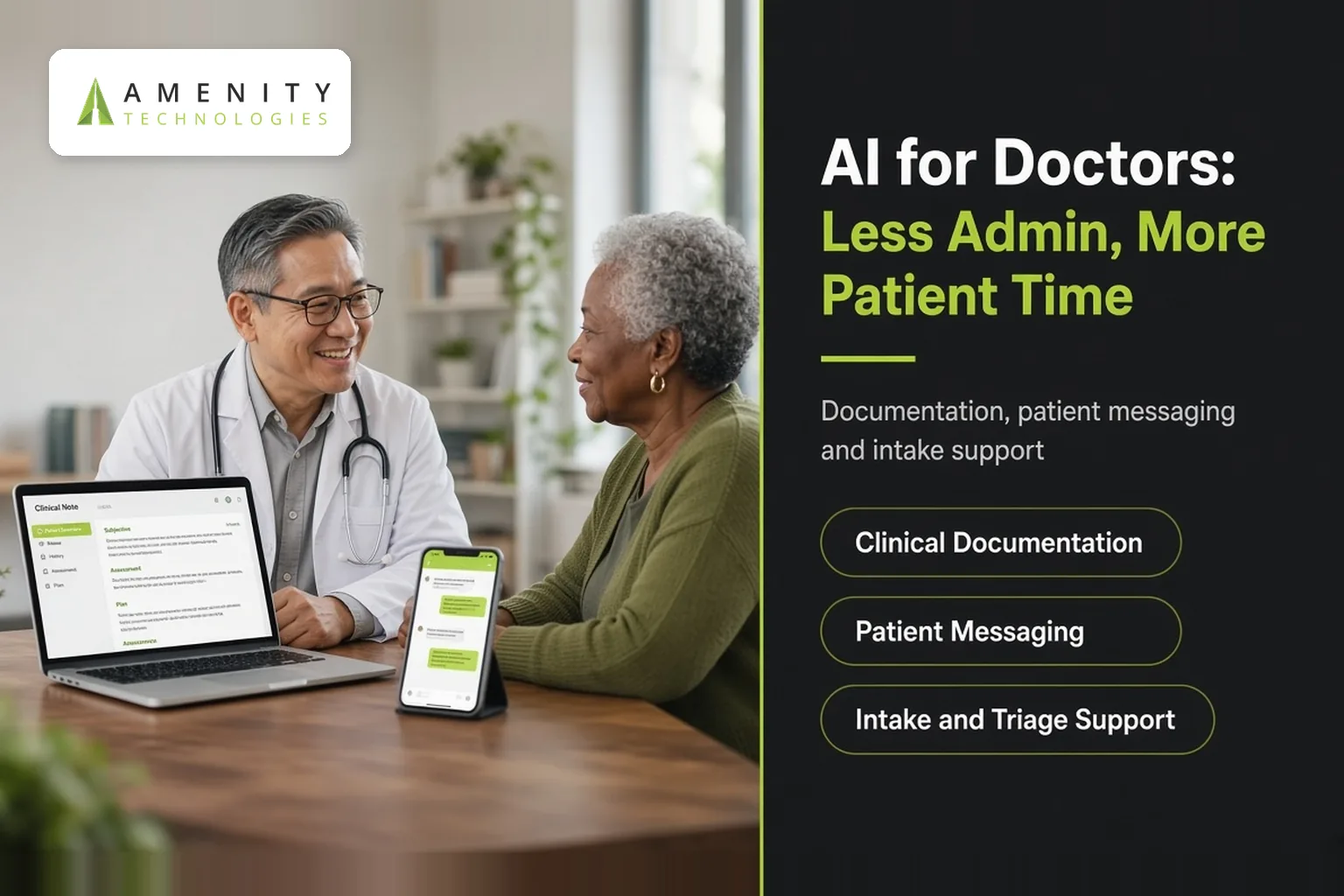
Doctors often say the hardest part of their job is not medicine but paperwork. Notes, letters, forms, messages and phone calls take time away from patients. AI does not replace clinical judgement, but it can take on much of the administrative load around it. Explore our AI for doctors and healthcare solutions.
Where AI Saves Doctors Time
| Task | How AI helps | Doctor's role |
|---|---|---|
| Clinical notes | Drafts structured notes from consultation recordings or dictation | Reviews and approves |
| Referral letters and summaries | Drafts from notes and records | Edits and signs |
| Patient messages | Answers routine questions and drafts replies | Handles clinical questions |
| Pre-visit intake | Collects history and reason for visit before the appointment | Reviews before consultation |
| Record review | Summarises long histories and reports | Verifies key details |
| Appointments | Booking, reminders and rescheduling | None |
Clinical Documentation
AI documentation tools turn a recorded or dictated consultation into a draft note in the doctor's preferred format. The doctor reviews, corrects and signs. Patients should be informed and give consent where recording is used. Our document processing and medical document management platform work supports these workflows.
Patient Messaging
A practice assistant can answer common questions, such as timings, preparation for tests, fees and directions, and route clinical questions to the doctor with context. This reduces phone load and response times. See healthcare chatbot solutions.
Pre-Visit Intake and Triage Support
Before an appointment, AI can collect the reason for visit, symptoms, medications and history in a structured form, so consultations start with information ready. Any symptom checker must escalate red-flag symptoms immediately and must support, not replace, clinical triage. Read about voice AI for patient intake.
Safety Principles
- The doctor remains responsible for clinical decisions and signs off on notes.
- AI outputs are drafts, checked before use.
- Urgent symptoms trigger immediate escalation.
- Patient data is protected under applicable laws.
- Patients know when AI is involved.
See our healthcare AI compliance checklist.
Solo Practices vs Larger Clinics
- Solo doctors: start with booking automation and patient messaging.
- Group clinics: add intake, documentation and shared knowledge for staff.
- Specialty practices: customise templates and terminology to the specialty.
Measuring the Benefit
- Minutes saved per consultation on documentation
- Calls and messages handled without staff
- No-show rate after automated reminders
- Patient satisfaction with communication
For hospital-wide needs, read AI for hospitals.
Questions Doctors Should Ask AI Vendors
- Where is patient data stored, and is it used to train models?
- Which privacy laws and agreements do you support?
- How are urgent symptoms detected and escalated?
- Can notes follow my specialty's templates and terminology?
- How do I correct errors, and are corrections used to improve the system?
- Does it integrate with my practice management or EMR system?
Answers to these questions reveal whether a tool is built for real clinical practice.
How Amenity Approaches Clinical Practice AI Projects
- Shadow front desk and clinical workflows to find time sinks
- Start with booking and messaging automation
- Add documentation support with doctor review
- Integrate with practice systems securely
- Measure time saved and patient satisfaction
Doctors stay in control at every step, and every AI output is reviewable.
Key Takeaways
- AI saves doctors time on notes, letters, messages and intake.
- Every AI output is a draft for the doctor to review.
- Patient consent, data protection and urgent escalation are essential.
- Start small with booking and messaging, then expand.
The best AI tools for doctors feel invisible: they save minutes on every patient without changing how care is delivered.
About Amenity Technologies
Amenity Technologies is a GenAI and AI development company based in Ahmedabad, India, with a team of 50+ AI specialists. We build chatbots, voice bots, RAG systems, AI agents, computer vision and custom AI software for clients worldwide. See our awards and achievements.
Related Reading
- AI for healthcare: a privacy and compliance checklist
- AI for hospitals: an operations automation guide
- How ai voice bots improve healthcare front desk automation 2026 guide
Frequently Asked Questions
How can AI help doctors?
AI can draft clinical notes and letters, summarise records, answer routine patient messages, collect pre-visit information and manage appointments, while doctors keep control of clinical decisions.
Is AI clinical documentation accurate?
It produces drafts that can save time, but doctors must review and correct them before signing.
Do patients need to consent to AI recording consultations?
Patients should be informed and give consent where consultations are recorded, in line with local laws and professional guidance.
Can AI triage patients?
AI can collect symptoms and flag urgent cases for immediate escalation, but it should support, not replace, clinical triage by qualified staff.
Where should a small clinic start with AI?
Usually with booking automation and patient messaging, then documentation and intake as needs grow.
Reduce Admin in Your Practice
Talk to our AI team about your use case, or explore our case studies.