
AI for Banking: Where AI Delivers Value Beyond Customer Chatbots
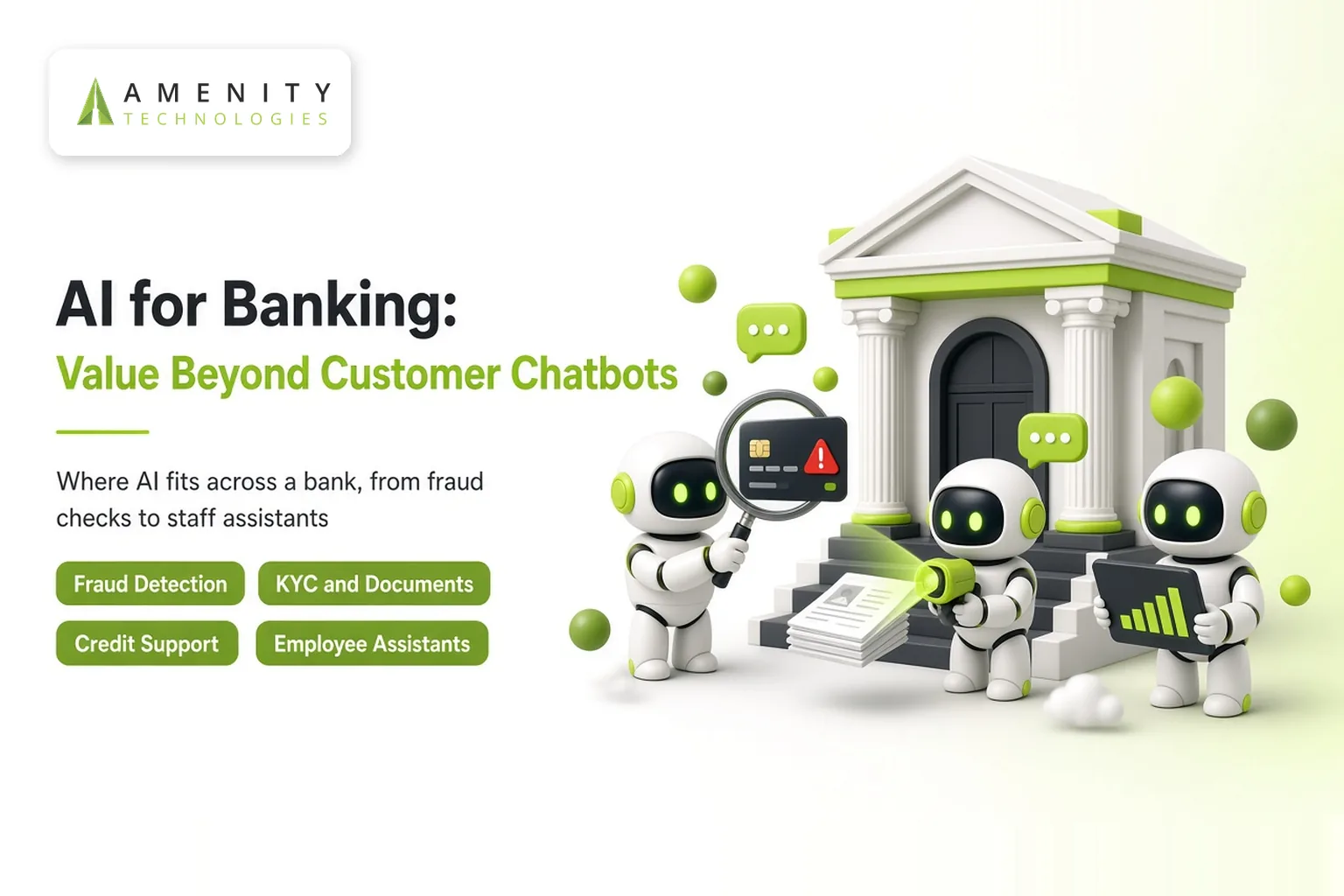
Customer chatbots are the most visible form of AI in banks, and we cover them in detail in our guide to AI chatbots in banking. But much of the value of AI for banking sits behind the scenes: in fraud teams, credit departments, operations centres and compliance functions. This guide maps those opportunities.
Where AI Fits Across a Bank
| Function | AI application | Human role |
|---|---|---|
| Fraud and AML | Detect unusual transactions and patterns in real time | Investigate and decide |
| Onboarding and KYC | Extract and verify data from identity and address documents | Review exceptions |
| Credit | Summarise applications, extract financials, support risk analysis | Make lending decisions |
| Operations | Automate document-heavy back-office tasks | Handle exceptions |
| Collections | Prioritise accounts and send personalised reminders | Handle sensitive conversations |
| Compliance | Monitor communications and map regulations to policies | Interpret and act |
| Employees | Policy and product assistants for branch and contact centre staff | Serve customers |
Fraud Detection
Machine learning models learn normal behaviour for accounts and flag anomalies, such as unusual locations, amounts or sequences. Combined with rules, they reduce both missed fraud and false alarms. Investigators keep the final decision.
KYC and Document Processing
Account opening and loan processing involve many documents. Intelligent document processing and AI-based OCR extract data, check consistency and flag missing items, shortening onboarding times.
Credit Support
AI can extract figures from financial statements and bank statements, summarise applications and highlight risks for credit officers. Lending decisions must follow regulatory requirements on fairness and explainability, with people accountable.
Employee Assistants
Branch and contact centre staff answer questions on hundreds of products and procedures. A RAG assistant built on approved internal documents gives fast, cited answers. See enterprise knowledge base development.
Governance for Banking AI
- Model risk management: validation, monitoring and documentation
- Explainability for decisions that affect customers
- Data protection and residency requirements
- Audit trails for AI-assisted actions
- Compliance with your regulator's guidance on AI, outsourcing and data
Read how AI supports compliance and audit in BFSI.
Where Banks Usually Start
- Customer service automation for common queries. See banking chatbot solutions.
- Document processing for onboarding and loans.
- Internal knowledge assistants for staff.
- Fraud and credit analytics once data foundations are ready.
Key Takeaways
- The biggest banking AI gains are often in fraud, KYC, credit and operations.
- AI supports decisions; accountable people make them.
- Model risk management and explainability are essential in regulated banking.
Example: Faster Account Opening
A bank receives thousands of account applications a month, each with identity and address documents. Staff re-key details and chase missing items, so onboarding takes days. With document AI extracting and checking data, complete applications move straight to approval and incomplete ones trigger an automatic request for the missing document. Staff focus on genuine exceptions, and customers get accounts faster.
Common Pitfalls
- Starting with high-risk decisions before proving value in operations
- Weak model monitoring after launch
- AI projects disconnected from core systems and processes
How Amenity Approaches Banking AI Projects
- Map processes and data across functions
- Prioritise use cases by value, risk and data readiness
- Pilot with strong governance and model documentation
- Scale with monitoring and regular validation
Risk, compliance and IT are involved from the first workshop.
Measuring Success
- Fraud losses and false-positive rates
- Account opening and loan processing times
- Staff hours saved in operations
The Bottom Line
Chatbots are often the first step, but the larger opportunity lies across fraud, onboarding, credit and operations. Banks that build shared data foundations, clear governance and strong model risk management can extend AI safely from one function to the next, compounding value with each new use case.
About Amenity Technologies
Amenity Technologies is a GenAI and AI development company based in Ahmedabad, India, with a team of 50+ AI specialists. We build chatbots, voice bots, RAG systems, AI agents, computer vision and custom AI software for clients worldwide. See our awards and achievements.
Related Reading
- Conversational AI for banking: designing secure journeys
- Chatbot for banking: an implementation roadmap
- A 2026 guide to using ai chatbots in the banking industry
Frequently Asked Questions
How is AI used in banking beyond chatbots?
For fraud and AML detection, KYC document processing, credit analysis support, back-office automation, collections prioritisation, compliance monitoring and employee knowledge assistants.
Can AI make lending decisions?
AI can support credit officers with extraction, summaries and risk signals, but lending decisions must follow regulatory requirements on fairness and explainability, with people accountable.
How does AI help prevent banking fraud?
Machine learning models learn normal account behaviour and flag anomalies in real time, reducing missed fraud and false alarms, while investigators decide.
What governance does banking AI need?
Model risk management, explainability, data protection and residency, audit trails and compliance with regulator guidance.
Where should a bank start with AI?
Often with customer service automation, document processing and internal assistants, then fraud and credit analytics.
Explore AI for Your Bank
Talk to our AI team about your use case, or explore our case studies.