
10 Key Benefits of Natural Language Processing for Modern Enterprises
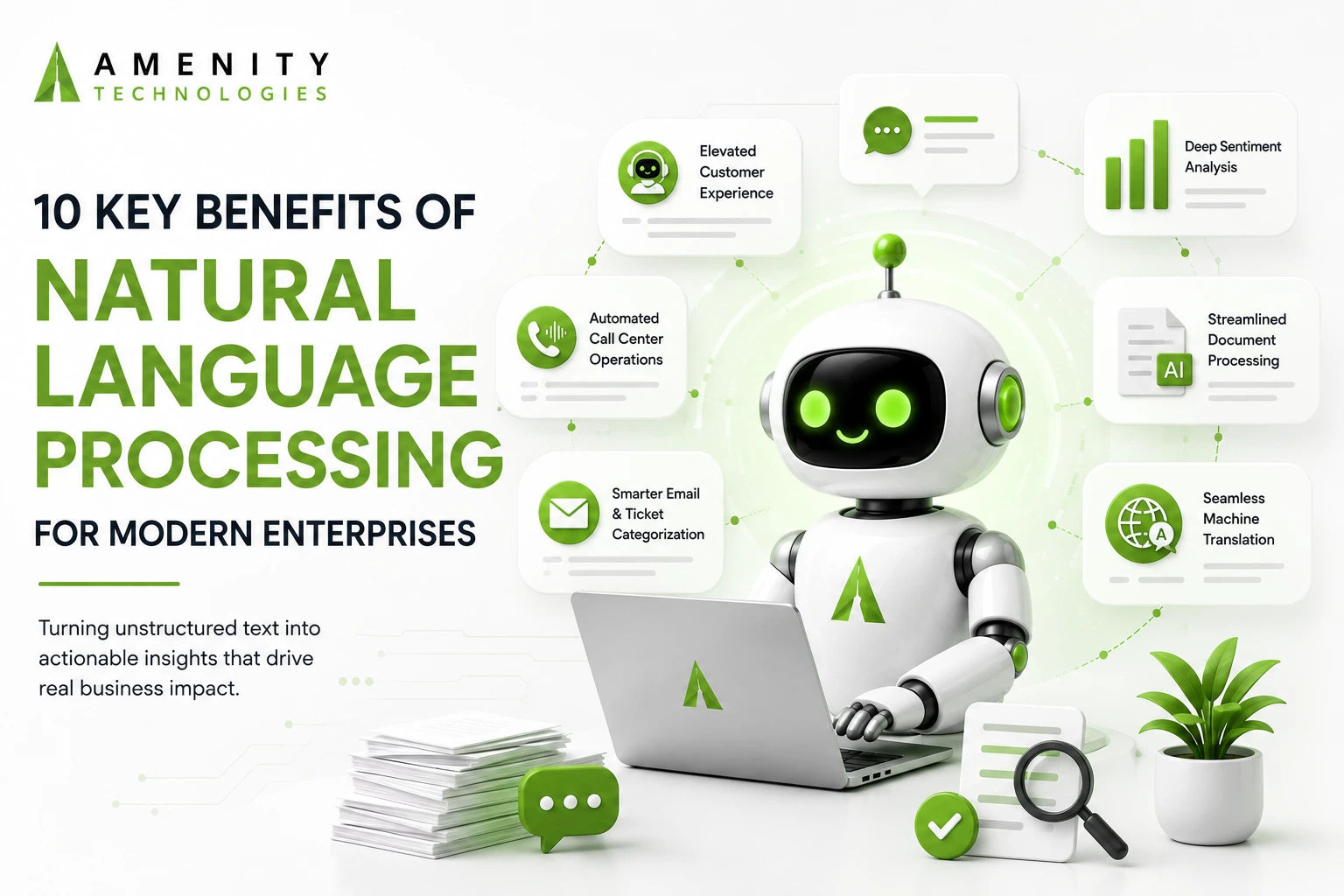
Every company is sitting on a mountain of text data it has no idea what to do with. Contracts, customer emails, chat transcripts, and internal support logs stack up constantly, but traditional software treats this information as unreadable noise. Unless a professional sits down and reads it line by line, the context is completely lost, forcing leadership teams to make critical operational decisions with a massive blind spot.
Using enterprise NLP solutions changes this baseline entirely. Instead of running basic keyword searches that break the moment someone uses a synonym, natural language processing lets software read between the lines. It translates messy human language into structured, predictable data your business can use to automate workflows, spot friction before it escalates, and protect profit margins.
If you want to move past the marketing hype and build software that lasts, this post will help you. Here, we have discussed some of the key benefits of natural language processing that modern enterprises can leverage.
List of the Merits of Natural Language Processing
1. Elevated Customer Experience (CX)
Most people have dealt with customer support bots that completely lose track of the conversation after one unusual question or spelling mistake. Instead of solving the issue, the interaction usually becomes more frustrating than helpful.
That’s one area where AI language models are changing customer support systems quite noticeably. Rather than depending entirely on fixed responses, these systems are better at understanding how people naturally type and speak during conversations. Customers can explain issues more casually without needing perfectly structured queries every time.
For businesses, that usually means fewer repetitive support escalations and faster handling of routine requests.
2. Deep Sentiment Analysis & Market Intelligence
Customer surveys rarely show the full picture. Most people avoid them completely unless something goes seriously wrong.
That’s why many businesses now monitor customer conversations directly through emails, support chats, reviews, and social interactions.
This helps teams:
- Notice frustration earlier
- Track repeated complaints
- Identify unhappy accounts
- Respond before issues grow further
In many cases, these signals appear long before customers formally raise concerns or stop doing business altogether.
3. Streamlined Document Processing
Manually entering data from forms, customs paperwork, and invoices wastes thousands of hours and leads to constant, costly data-entry mistakes. Legacy software isn’t much help because it just scans text shapes without understanding what the numbers actually mean.
Modern document parsing reads inbound files the way an analyst would. The software scans complex files like insurance claims or supply chain manifests, extracts the specific data fields you need such as policy limits or tracking codes and passes them straight to your ERP system. This keeps your data pipelines moving smoothly without human bottlenecks.
4. Automated Call Center Operations
Scaling a call center the traditional way means constantly hiring more staff, which ruins your margins during seasonal traffic spikes. Plus, forcing users to navigate through endless phone menus just to get to the right department kills customer satisfaction.
By embedding speech-to-text and semantic parsing directly into your phone networks, the software can handle inbound calls conversationally. The system listens to what the caller wants, determines the exact problem, and routes them to the right specialist instantly. For simple tasks like checking an order status, the voice system resolves the issue entirely on its own.
5. Smarter Email & Ticket Categorization
Inbound support inboxes are a constant source of chaos. If you rely on human dispatchers to manually read, tag, and assign incoming emails, you build massive delays right into your response times.
Linguistic classifiers fix this by analyzing incoming text fields the second they arrive. The system automatically detects the core issue, evaluates its urgency, tags it, and routes it to the relevant department. This process becomes critical for the customer support teams as they can now resolve urgent high-priority tickets significantly faster and easier.
6. Seamless Machine Translation
Businesses expanding into new regions usually end up spending heavily on localization. Product manuals, onboarding documents, technical specifications, support material, everything needs to be rewritten properly for different markets.
Older translation tools rarely handle that well on their own. Teams still have to review the output manually because certain instructions sound off, technical wording changes meaning, or the translated version simply does not read naturally for local users.
That’s where natural language processing applications are becoming far more useful. Instead of translating text line by line, these systems evaluate the surrounding context before generating output. The result is usually cleaner documentation with far less manual correction required afterward.
For companies managing multilingual operations regularly, that can reduce both turnaround time and localization workload quite noticeably.
7. Enhanced Decision-Making with BI
Traditional BI dashboards work well for charts, spreadsheets, and structured databases. The problem is that a large amount of business information never exists in neat spreadsheet format to begin with.
In one enterprise project, we worked with a growing archive of more than 5,000 internal publications, reports, and operational documents that teams could not search efficiently.
The system was redesigned to:
- Organize large volumes of internal content
- Make older reports searchable through natural queries
- Reduce time spent locating operational information
- Help teams access historical business data faster during planning discussions
Instead of manually digging through documents, teams could retrieve relevant information conversationally from a centralized repository during ongoing decision-making workflows.
8. Augmented Content Creation
Writing technical guides, compliance summaries, and standardized product descriptions takes up a massive amount of your team’s time. This repetitive documentation work often bogs down your creative staff and stalls product rollouts.
Through NLP automation, businesses reduce part of that manual effort by handling structured content generation and repetitive language-processing tasks more efficiently.
We applied a human-centric focus to this issue within the healthcare space, developing a specialized narrative engine for patient support networks. By chaining advanced multimodal engines with synthetic speech synthesis, the application transforms simple photos and brief notes into immersive, emotionally resonant memory timelines with natural audio narration. This balances processing speed with deep personal empathy.
9. Proactive Fraud Detection
Phishing attempts and online fraud have become far more convincing over the last few years. Many traditional security systems still rely heavily on numerical activity patterns, which means suspicious communication often goes unnoticed until much later.
A common weak point is inbound communication itself, especially lead forms, emails, support requests, and customer-facing chat systems.
To reduce that risk, businesses are now using ML-driven screening systems that can:
- Review incoming messages in real time
- Detect suspicious wording patterns
- Identify inconsistent requests
- Flag unusual communication behavior before it reaches internal teams
Instead of reacting after a security issue escalates, teams can isolate questionable interactions much earlier in the process.
10. Automated Human Resources (HR)
When companies hire at scale, HR teams often receive thousands of resumes in a short time. Basic resume screening tools are easy to manipulate because many applicants simply copy keywords from the job description into their resumes.
Modern NLP for business applications are improving this process by analyzing the broader context behind a candidate’s experience instead of relying only on repeated keywords.
Advanced recruiting tools use linguistic analysis to look at the actual context of a candidate’s career progression and project history. The software cuts through the fluff to find the profiles that truly match your technical requirements, streamlining your early-stage recruiting pipeline and dropping your time-to-hire significantly.
Driving Measurable Enterprise Efficiency with NLP
Simply integrating a generic AI API into your internal systems isn’t going to lead to a lasting competitive advantage. Real operational value comes from building custom software architectures that are tailored directly to your data infrastructure, your security requirements, and your actual commercial goals.
That is exactly what we focus on at Amenity Technologies. We design, build, and deploy high-performance language infrastructure that automates complex document workflows, secures sensitive corporate data, and simplifies market analysis. Reach out to our engineering team today to build durable, production-grade language pipelines into your core software systems.
FAQs
Q.1. How do we choose the right NLP business use case without risking our budget?
A: Target your largest, costliest text-heavy bottleneck first. Building a small proof-of-concept for automated document parsing or customer ticket classification proves clear ROI before expanding infrastructure.
Q.2. What is the main structural difference between legacy keyword tools and modern NLP?
A: Legacy tools depend on rigid, exact string matching which breaks easily. Modern NLP deciphers semantic meaning, sentence context, intent, and structural grammar to handle natural, unstructured text.
Q.3. How safe is our proprietary corporate data when using advanced language models?
A: Your data stays secured by avoiding public consumer APIs. Deploying custom language architectures inside private cloud instances or on-premise hardware ensures your data never leaves your network.