

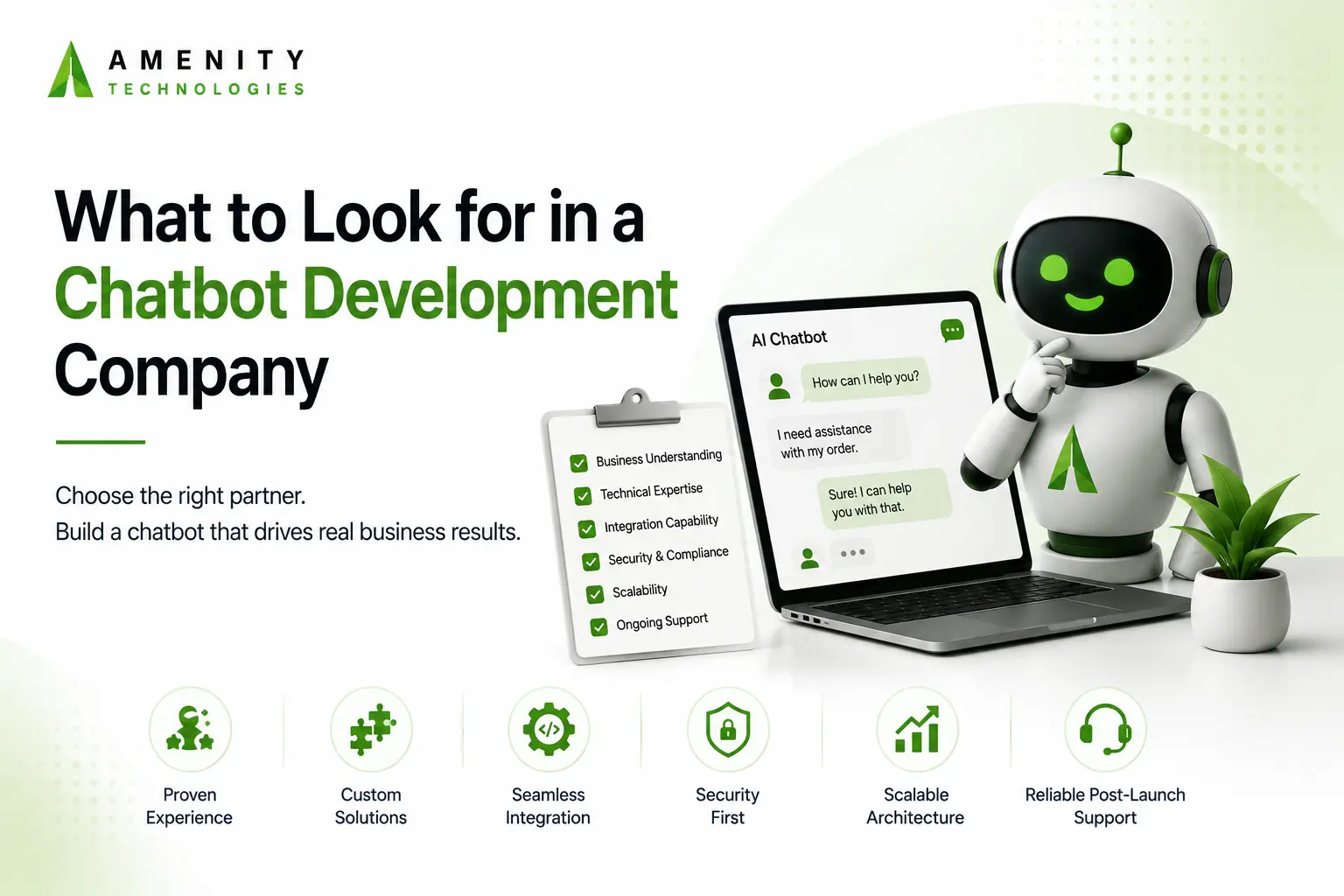
Finding a chatbot development company isn’t difficult. Finding one that’s the right fit for your business usually takes more work.
Most companies can show a polished demo, list the AI models they work with, and promise automation. Those things matter, but they don’t tell you how the chatbot will perform once it’s become part of your daily operations.
The better question is not “Who builds chatbots?” It’s “Who can build one that works for the way our business actually operates?”
That’s where the evaluation process changes. Instead of comparing feature lists, you’re comparing experience, technical thinking, collaboration, and the ability of the best chatbot development company to build a solution that can grow with your business.
Does the Company Understand Your Business Before Recommending a Solution?
The first conversation with an AI chatbot development company often reveals more than the proposal itself. Some teams begin by discussing AI models, pricing, or delivery timelines. Others spend that time understanding how your business operates. The second approach usually leads to a solution that’s built around your requirements rather than adapted from an existing template.
Before evaluating technical capabilities, understand how the company approaches the discovery phase.
Business-First Discovery
An AI build is only as good as the operational insight behind it. Before line one of code is written, a development team needs to understand how your business actually moves: how your staff handles daily tasks, where customer communications stall, and which friction points are worth automating in the first place.
A seasoned development partner doesn’t push features right out of the gate. They dig into your current workflows first, establishing a clear operational baseline before proposing any technical architecture.
Defining the Chatbot’s Role
Purpose dictates architecture. You don’t build an internal agent for pulling technical specs the same way you build a front-facing lead qualification bot. They solve entirely different operational problems and require completely different backends.
Locking down that core purpose early sets the scope. It tells you exactly how deeply the language model needs to process context, which APIs must be exposed, and how the user experience should feel. More importantly, it gives you a sharp filter when interviewing vendors. You can bypass generic AI sales pitches and ask for proof of work on the exact problem you’re trying to solve.
Pinpointing the Root Challenge
Clients rarely come to us asking for a specific software architecture; they come because an operational process is breaking down. Usually, the symptom is rising support costs, slow response times, or hours lost to manual data entry across disconnected systems.
A capable engineering partner looks past the superficial request to diagnose the actual bottleneck. By solving the root operational problem rather than just layering software over a flawed process, you avoid over-engineering features that add friction without driving measurable ROI.
Can They Build Beyond a Basic Chatbot?
Launching a basic chatbot is easy today; building one that handles complex backend connections, fits your exact workflow, and scales with your business is a different story.
Custom Builds vs. Off-the-Shelf Limits
Pre-packaged tools work fine until you hit custom logic or non-standard integrations. A proper engineering partner offering custom chatbot development services adapt the software to how your business actually runs, never forcing you to warp your processes around a restrictive vendor platform.
Utility First, Hype Second
Sophisticated models and fast APIs mean nothing unless they fix a specific headache. Whether an agent deciphers messy user intent or pulls records automatically, every line of code needs to yield a tangible operational win. Focus on practical ROI, not buzzwords.
Engineered for Real-World Change
Workflows shift, team needs grow, and software setup has to keep up. That’s why systems must be built modularly from day one. You want an architecture that takes on new logic and features smoothly, saving you from a costly rebuild down the road.
Will the Chatbot Fit Into Your Existing Business Environment?
Evaluating a development partner isn’t just about looking at what they can code. You have to know how seamlessly their software will plug into the stack you already run on.
A bot standing on its own adds zero value. To actually save time, it needs to talk to your CRM, pull live support tickets, search internal wikis, and sync back to your ERP. Without those connections, you’re just adding another isolated app your team has to manage manually.
Bring integration strategy into your earliest vendor talks. Make them detail exactly how their software hooks into your current stack, where custom APIs are required, and where they’ve wired up similar setups before.
Security and scale demand that same scrutiny. A system that handles a hundred messages a day needs to scale to tens of thousands without crashing or requiring a complete ground-up rewrite. Any enterprise chatbot development team offering high-grade chatbot solutions should walk you through their approach to data encryption, user access controls, compliance standards, and long-term infrastructure stability.
At the end of the day, technical depth isn’t about bragging about how many AI frameworks a vendor uses. It’s about whether they can engineer software that drops into your current operations smoothly and keeps running as your company scales.
How Does the Company Approach Development?
Flawless tech means nothing without clean execution. Beyond looking at stack diagrams, you need to dissect how a team plans, communicates, and manages a build from kick-off to launch.
Get granular on their process. How do they lock down specifications? Who runs the weekly updates? Are the actual AI chatbot developers writing your code accessible for deep technical calls, or will you be filtered through account managers? Direct access to engineers prevents critical technical details from getting lost in translation.
When vetting chatbot development services, don’t just pick the shortest timeline. A rigid approach to architecture, rigorous staging, and iterative testing is what separates high-impact business chatbot development from a project that breaks the second real users hit it.
What Happens After the Chatbot Goes Live?
Deployment isn’t the finish line. Staging environments never capture how real users actually talk, so the day your system goes live is the day real optimization starts.
Maintaining high-performing AI chatbot solutions takes continuous work. You have to comb through failed queries, fix unexpected drop-offs, and update response logic as your products change. System APIs change too, if your CRM updates, your bot’s backend connection needs maintenance so data flow doesn’t quietly break.
That post-launch reality is the core of real conversational AI development. Good engineering teams don’t hand over the keys and walk away. They set up long-term monitoring, patch edge cases, and scale the infrastructure as your active user base grows.
Questions to Ask Before You Make a Decision
Sales demos are designed to look polished. To see how a vendor actually operates under the hood, you need to push past the pitch deck and ask specific execution questions. How they answer reveals everything about their actual engineering depth, cost transparency, and whether they can build software that drives real business outcomes.
Consider asking:
- Have you delivered chatbot projects similar to our business requirements?
- How do you determine the right solution before development begins?
- Which business systems can the chatbot integrate with?
- How are testing, quality assurance, and performance measured?
- What support and optimization do you provide after deployment?
- If our requirements change in the future, how will the chatbot be updated?
Straight answers here make vendor evaluation simple. You end up judging teams on their actual engineering chops and post-launch support, not on pitch-deck claims or lowball bids.
The Bottom Line
You don’t just need a vendor who can ship a working chatbot. You need a team that understands your backend, respects your operational workflows, and sticks around to refine the system as your business changes.
At Amenity Technologies, we build custom AI chatbot solutions tailored to your actual architecture, ensuring your automation investment pays off long after launch.
FAQs
Q.1. Should one prefer investing in a custom AI chatbot or an off-the-shelf solution?
A: Invest in a custom AI chatbot if tailored backend integrations, enterprise data security, and scalable unique workflows are required. Off-the-shelf solutions work best for standard, budget-friendly customer support with basic, pre-built rules.
Q.2. What technical questions should one ask a potential chatbot developer during a discovery call?
A: They can ask how the bot connects to legacy databases, how they handle data encryption and PII compliance, what their approach is for handling fallback/unclear queries, and whether you will have direct access to core AI engineers during development.
Q.3. How does Amenity Technologies guarantee a clear ROI on custom chatbot development?
A: We define concrete performance metrics such as ticket deflection rates, lead conversion speed, and operational cost savings before writing a single line of code. This ensures every feature directly contributes to measurable business returns.
Q.4. Can Amenity Technologies build internal AI chatbots to automate HR or IT helpdesks?
A: Yes. We specialize in both customer-facing and internal enterprise bots. An internal AI assistant lets your staff instantly pull policies, search wikis, or resolve IT requests without interrupting other team members.
