
A Practical Guide to Avoiding 9 Business Chatbot Development Mistakes
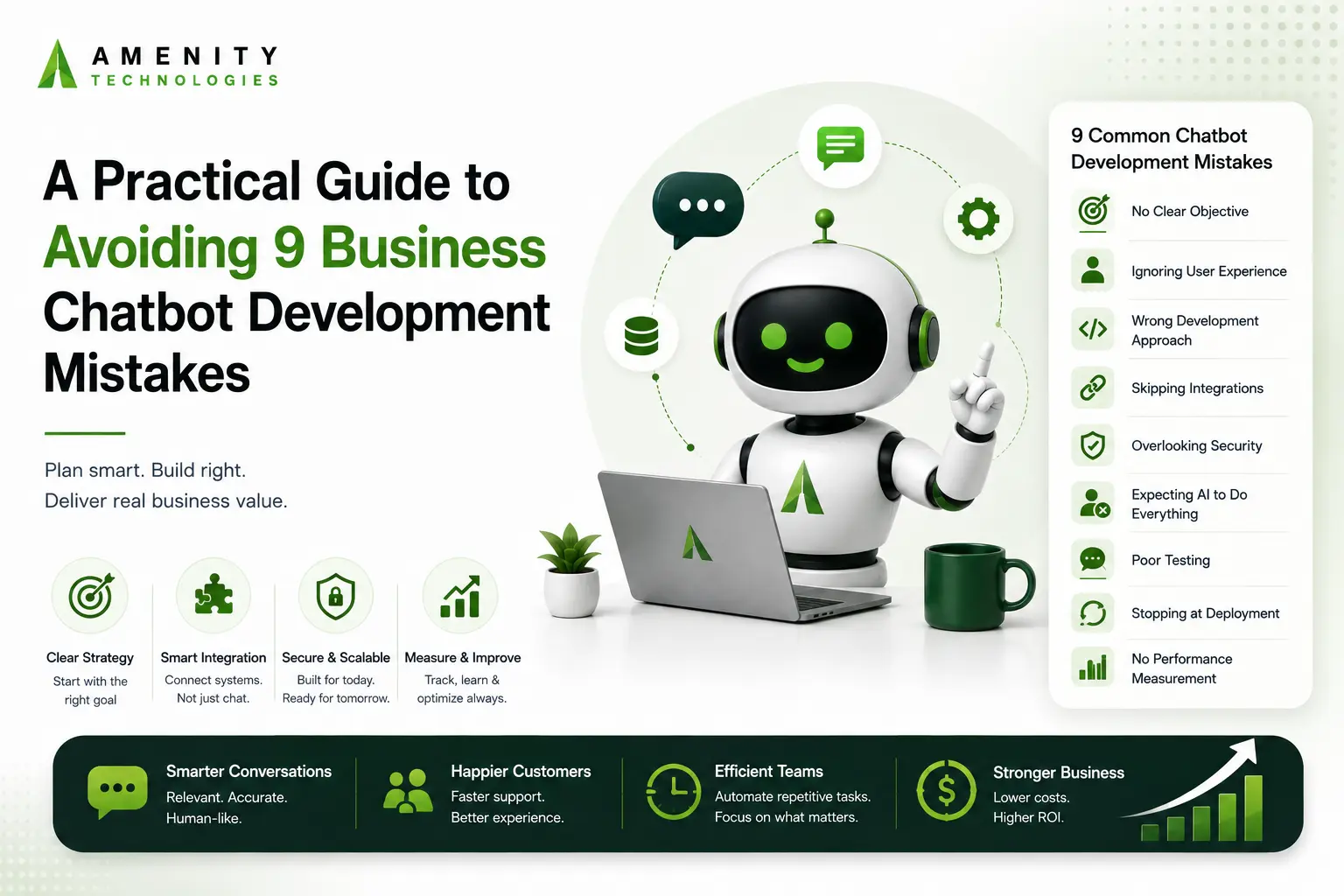
The reason why many chatbots fail to perform well isn’t bad AI. They fail because of lazy planning, missing backend data, or forced integrations that never actually fit existing workflows.
Simply picking a top-tier platform won’t save a project if the underlying architecture was built on guesswork. If you want a system that actually handles customer load and drives ROI, you have to sidestep the engineering and strategic missteps that sink most deployments.
In this quick, practical guide, you’ll learn about nine business chatbot development mistakes to watch out for and how to fix them early.
Common Business Chatbot Development Mistakes
When you’re aware of common chatbot development mistakes, they’re much easier to avoid. Here are some common mistakes you should watch out for:
Mistake #1: Building Without a Clear Business Objective
Most business chatbot projects get greenlit for the wrong reasons. An executive sees a competitor’s rollout, reads about automation trends, and demands a bot, without anyone first asking what operational problem it’s supposed to solve. That enthusiasm usually replaces proper planning.
The main issue with this approach is that without a targeted objective, you have no clear benchmark for success. Organizations end up asking a single bot to act as a support agent, a sales rep, an internal wiki, and a task automation engine all on day one. Modern AI can handle complex workflows over time, but trying to launch with all of them simultaneously bloats the codebase and breaks the conversation logic.
You need to isolate the single biggest pain point in your current process before starting business chatbot development. Fix that specific issue first like resolving routine order status queries and lock down the integration. Once you prove the concept and hit your performance metrics, then you can start expanding its capabilities.
Mistake #2: Designing for the Tech Stack Instead of the User
Slapping advanced AI onto a workflow doesn’t automatically make it better. A huge mistake teams make is getting obsessed with what the technology can do, rather than looking at how people will actually interact with it. When you build just to show off complex logic, you usually end up with wordy answers, confusing navigation, and annoyed users who just want a straight answer.
Every path in your conversational flow needs to be built around the person on the other end of the screen. Users don’t care about the underlying model architecture; they want fast, accurate responses that solve their problem in as few steps as possible.
Putting user experience ahead of technical flexing is what actually drives adoption. If a system is frustrating or slow, people will bypass it and call support anyway. A chatbot only generates real ROI if your customers and staff choose to use it every day.
Mistake #3: Choosing the Wrong Development Approach
AI chatbot development on the wrong framework will have negative impacts later. A lot of teams take the easy path early on, picking a platform because it’s quick to set up rather than checking if it can actually handle their operational needs. Drag-and-drop, no-code builders are fine for basic FAQ bots. But the second you need complex data routing, custom API integrations, or strict enterprise security rules, those platforms turn into a bottleneck.
You have to look at what the system needs to do six to twelve months down the line, not just on launch day. If your roadmap includes deep backend integrations or complex multi-step workflows, forcing a simple no-code tool to do heavy lifting is a recipe for rework.
Starting with a custom chatbot development or hybrid architecture might take more planning up front, but it saves you from outgrowing your stack in six months. Swapping out your entire codebase because your initial tool hit a wall is a massive waste of time and engineering budget.
Mistake #4: Ignoring Integrations During Planning
Without direct access to core enterprise software, chatbot implementation falls short. Disconnecting the bot from your CRM or ERP limits it to basic automated replies, ultimately pushing manual data entry right back onto your staff.
System integrations belong in the initial architectural blueprint, not the post-launch roadmap. Your engineers must establish clear API pathways to live operational databases from day one. Skipping this step guarantees expensive backend refactoring later, and leaves you with a basic messaging widget instead of a functional business engine.
Mistake #5: Treating Security as an Afterthought
Security isn’t a checklist item you bolt on a week before launch. If your bot touches sensitive records or internal documents, it carries the exact same risk profile as your main database.
Complex enterprise chatbot development amplifies this issue. The second you introduce multi-department permissions, user authentication, and live API endpoints, security becomes an architectural design choice. You either map out compliance and data boundaries on day one, or you end up tearing apart perfectly good code to patch basic vulnerabilities right before go-live.
Mistake #6: Expecting AI to Replace Every Human Interaction
Even the most advanced conversational AI solutions have limitations. Automating 100% of your customer touchpoints can result in broken workflows. Chatbots excel at repetitive query resolution, but they fail hard when faced with nuance, high-stakes edge cases, or ambiguous user intent.
Forcing a bot to handle complex issues without a safety net just frustrates users and bloats your escalation queue anyway.
The fix is architectural, not conversational: build smooth human-in-the-loop fallbacks. Define exact handoff triggers so complex sessions pass directly to live staff with full transcript context. Let the bot handle volume; let your team handle judgment.
Mistake #7: Launching Without Testing Real Conversations
Developers write clean test scripts. Real customers don’t. Internal QA almost always passes because engineers instinctively type well-formatted questions that align with the bot’s underlying intent maps.
Live users do the exact opposite. They write fragmented sentences, swap topics mid-stream, and throw unexpected context at the system.
Ignoring this gap violates basic AI chatbot best practices and guarantees day-one failure. You have to stress-test conversational models against raw, messy user inputs such as typos, non-linear questions, and ambiguous requests before deployment. If you don’t break the logic in staging, your users will do it in production.
Mistake #8: Assuming Deployment Is the Finish Line
Go-live isn’t the end of the project. It’s just where real operational data starts flowing. User habits shift, services evolve, and edge cases accumulate. A static bot starts degrading the moment you stop maintaining its core model.
Continuous AI chatbot optimization needs to be built into your post-launch workflow. That means analyzing failed intents, spot-checking transcript logs, and retraining fallback triggers on actual conversation data every week.
If nobody is auditing unstructured user queries to update the underlying knowledge base, your completion rates will drop. Treating a bot like set-and-forget software turns a high-value asset into legacy overhead fast.
Mistake #9: Measuring Success Too Late
If you wait for user complaints to tell you the bot isn’t working, you’ve already lost. Without clear telemetry configured before go-live, you won’t know if the system is saving money or just driving customers away quietly.
Serious business chatbot development treats performance tracking as an immediate priority. You need line-of-sight on containment, drop-off steps, and failed handoffs from the first interaction. Without these baseline metrics, you can’t spot broken user paths, refine fallback logic, or prove real financial value to stakeholders.
Turn Chatbot Mistakes Into Long-Term Business Value
Deploying a reliable bot comes down to upfront planning, tight integration, and aggressive post-launch maintenance. Cut corners on any of those three, and the system breaks down fast, costing you money instead of saving it.
At Amenity Technologies, we build custom AI chatbots designed for real-world reliability and enterprise security. If you need a team that handles the heavy lifting, from initial conversational architecture to ongoing optimization, reach out to us today. Let’s build a solution that actually delivers measurable ROI.
FAQs
Q.1. How to improve my chatbot’s performance?
A: Regularly review conversations, update responses, fix recurring issues, and optimize the chatbot based on user behavior and feedback.
Q.2. What is the biggest chatbot development mistake?
A: Starting development without a clear business goal is one of the most common mistakes, as it makes it difficult to measure success or deliver real value.
Q.3. Can the team of Amenity Technologies help integrate a chatbot with existing CRM or ERP?
A: Yes. The team develops chatbots that seamlessly connect with CRM, ERP, helpdesk, scheduling, and other business applications.