

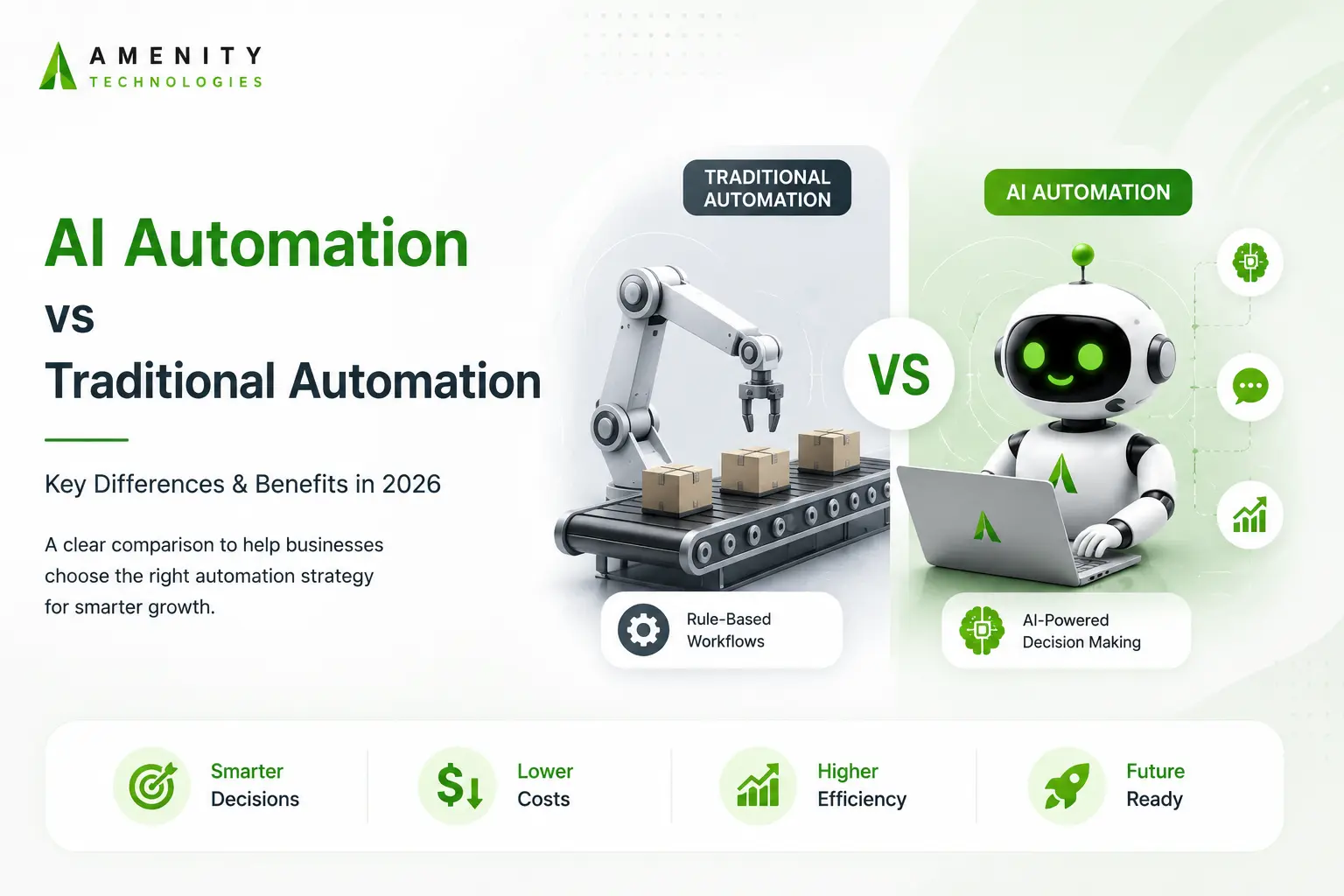
A surprising number of businesses already use automation every day without thinking much about the technology behind it. The real conversation starts when those automated processes begin running into situations they weren’t built to handle. That’s usually when teams start asking whether adding AI makes more sense than adding another set of rules.
The comparison isn’t really about old versus new. Traditional automation still handles many business tasks extremely well, while AI automation opens the door to work that fixed rules struggle to manage. Understanding where each approach fits is often more valuable than deciding which one is “better.” In this blog post, we’ll do exactly the same.
Why the Process is More Important Than the Technology
People often compare automation technologies before looking at the work itself. That’s usually where the confusion begins. An invoice approval process behaves very differently from customer support, document reviews, or contract analysis. Treating them as the same type of task rarely leads to the right outcome.
Traditional Automation works best when the process follows the same sequence every time. AI Automation becomes more useful when information changes from one request to the next or when decisions depend on context instead of fixed rules. The process comes first. The technology simply follows that decision.
Where Rule-Based Automation Still Makes Sense
Even in 2026, there’s a reason many businesses continue depending on rule-based automation. For work that follows the same sequence every time, it simply works. Processing payroll, sending scheduled reports, routing invoices, or triggering routine notifications doesn’t usually require interpretation. The expected outcome is already known.
That’s where traditional automation still proves its value. It handles repetitive processes with consistency, and for many organisations, there’s little reason to replace something that’s already doing the job effectively.
When Rules-Based Systems Become Inefficient
Rule-based systems begin to struggle when the same request no longer produces the same answer every time. A customer email can ask five different questions. An invoice may arrive in a different format. A contract might contain terms that weren’t considered when the workflow was first created. At that point, adding more rules often creates more work than it removes.
This is where intelligent automation becomes useful. Instead of relying on predefined paths, it can work through information that changes from one case to another and respond with greater flexibility. The process still matters, but it no longer depends on predicting every possible scenario in advance.
A Practical Comparison: AI Automation vs Traditional Automation
| Factor | Rule-Based Automation | AI-Driven Automation |
| Decision making | Follows predefined rules | Responds to context and changing inputs |
| Best suited for | Repetitive, predictable work | Variable, knowledge-based work |
| Handling exceptions | Needs new rules | Can adapt to different situations |
| Data | Structured information | Structured and unstructured information |
| Maintenance | Increases as rules grow | Requires monitoring and refinement |
| Common examples | Payroll, reports, approvals | Email analysis, document processing, support requests |
Neither approach is better in every situation. The choice depends on how the work behaves. Stable processes usually benefit from fixed rules, while activities involving changing information, language, or judgement often benefit from AI workflow automation.
The Power of a Hybrid Approach
Many organisations don’t replace existing automation when they introduce AI. They build on it. A rule-based workflow might still move invoices through an approval process, while AI handles document extraction before the workflow begins. The two approaches often solve different parts of the same process.
It isn’t unusual to find both approaches running inside the same workflow. A business might rely on business process automation for the steps that never change, while AI is introduced only where people still spend time reviewing documents, sorting requests, or making routine decisions. The result is a process that’s easier to manage because each part is doing the job it’s best.
Looking Beyond the Initial Investment
Implementation costs usually dominate the early conversations. A few months later, the discussion often changes. A small process update needs another rule. A policy changes and the workflow has to be adjusted. An exception appears that nobody planned for when the automation was first built. Those ongoing changes are where the real cost often starts to show.
That’s why enterprise automation is rarely judged by deployment alone. Teams also look at how easily the automation can adapt, how often it needs attention, and whether keeping it running will still make sense a few years from now.
What Usually Works in Practice
Keep the Rules Where They Already Work
There’s rarely a good reason to replace automation that’s already doing its job well. If a process is stable and predictable, changing the technology alone won’t improve the outcome.
Introduce AI Where Work Starts Slowing Down
The need for AI usually becomes obvious in the parts of a workflow where people still spend time reading documents, sorting requests, or deciding what happens next. That’s where AI-powered automation tends to make a noticeable difference.
Expand Gradually Instead of Rebuilding
Large automation projects don’t always begin with sweeping changes. Many organisations start with a single workflow, learn from it, and extend the approach only after it proves useful.
Let the Process Decide
The strongest automation projects aren’t built around a preferred technology. They grow from a clear understanding of how the work is done and where improvements genuinely matter.
Why Automation Projects Often Miss Expectations
Many automation projects begin with the right technology but the wrong process. A workflow that already causes delays, depends on incomplete information, or changes from team to team rarely improves just because it’s automated. The same problems often continue, only faster.
The stronger projects usually start by simplifying the work first. Once the unnecessary steps are removed and responsibilities are clearer, the technology has far less to compensate for. Good automation solutions support a well-designed process. They don’t fix one that’s already struggling.
Better Results Usually Start With Smaller Changes
There’s often pressure to automate as much as possible, especially at the beginning of a project. In reality, smaller improvements are easier to measure and far less disruptive. A single workflow that saves hours every week usually delivers more value than several automations that nobody fully trusts or uses.
That gradual approach is becoming more common across organisations investing in AI Workflow Automation. Teams learn from one process, refine what works, and then apply those lessons elsewhere instead of trying to redesign everything at once.
Growth Changes the Way Automation Is Managed
A workflow that works well for one team doesn’t always fit another. Different departments often follow different processes, use different systems, and measure success in different ways. As automation spreads, consistency becomes just as important as speed.
That shift is one reason enterprise automation becomes necessary rather than connecting a few workflows. It calls for clear ownership, sensible governance, and automation that can grow without becoming difficult to maintain. The strongest projects don’t expand because more automation is available, they expand because each addition continues to solve a genuine business problem.
Automation Becomes More Valuable When It Feels Invisible
The best automation often goes unnoticed. People aren’t thinking about workflows while they’re answering customers, reviewing documents, or processing requests. They simply expect those tasks to move without unnecessary delays or repeated manual effort. That’s usually a better measure of success than the number of automations running in the background.
That idea is changing how organisations view AI for business operations. The goal isn’t to introduce AI into every process. It’s to remove friction where it exists and leave everything else alone. When automation becomes part of everyday work instead of a separate initiative, adoption tends to happen much more naturally.
Where Each Approach Brings the Benefits
Neither approach is better by default. The value comes from using the right one for the right type of work. That’s why many organisations continue investing in both instead of treating one as a replacement for the other.
Traditional Automation Works Best When…
- The process follows the same steps every time.
- Accuracy depends on fixed business rules.
- Tasks need to run consistently without frequent changes.
- Simplicity is more valuable than flexibility.
AI Automation Adds More Value When…
- The work involves emails, documents, or natural language.
- People spend time making similar decisions every day.
- Information changes from one request to the next.
- Existing workflows are slowed down by manual reviews.
The Better Choice Depends on the Work
No automation approach fits every business process. Before deciding how a workflow should be automated, spend a little time understanding how that work actually happens. A few practical observations often make the decision much clearer.
Look at How the Work Changes
- Processes with the same outcome every time usually don’t need AI.
- Frequent changes often call for a more flexible approach.
Pay Attention to Manual Effort
- Repetitive decisions usually create better automation opportunities than repetitive clicks.
- If people spend time reviewing emails, documents, or requests, there’s often room for improvement.
Think Beyond Today’s Workflow
- Business processes rarely stay the same for years.
- Choose an approach that can adapt without creating unnecessary maintenance every time something changes.
Finding the Right Automation Strategy for Your Workflow
There isn’t a single automation approach that fits every business. Some processes benefit from clear rules and predictable workflows, while others need the flexibility to handle changing information and routine decision-making. The right choice depends less on the technology itself and more on the way the work is carried out.
If you’re evaluating AI automation services, start by understanding the process before selecting the solution. That principle applies to businesses of every size and is the same practical approach Amenity Technologies follows when helping organisations build automation that supports long-term business goals instead of short-term trends.
FAQs
Q.1. Can traditional automation and AI automation work together in the same workflow?
A: Yes. That approach is called a hybrid approach. Traditional automation handles predictable, structured steps (like moving data between databases), while AI steps in when the process requires analyzing unstructured data (like reading an email or summarizing a document).
Q.2. How to know if a process requires AI or just simple rule-based automation?
A: You can look at the data input. If the process follows fixed business rules and uses structured, identical data every time, traditional automation is best. If the data relies on natural language, emails, varying document formats, or manual decision-making, it requires AI.
Q.3. How does AI automation handle accuracy compared to rule-based systems?
A: Traditional automation offers 100% predictable accuracy based strictly on your rules, but it fails entirely on complex data. AI automation handles complex data gracefully but operates on probabilities, meaning it requires built-in confidence thresholds or human-in-the-loop reviews to ensure accuracy.
Q.4. How to ensure that a specific automation strategy supports long-term goals instead of short-term trends?
A: Avoid rushing into technology for the sake of it. Partner with strategic teams like Amenity Technologies to thoroughly analyze how your specific workflows run first, ensuring you build infrastructure that adapts as your business evolves.
