

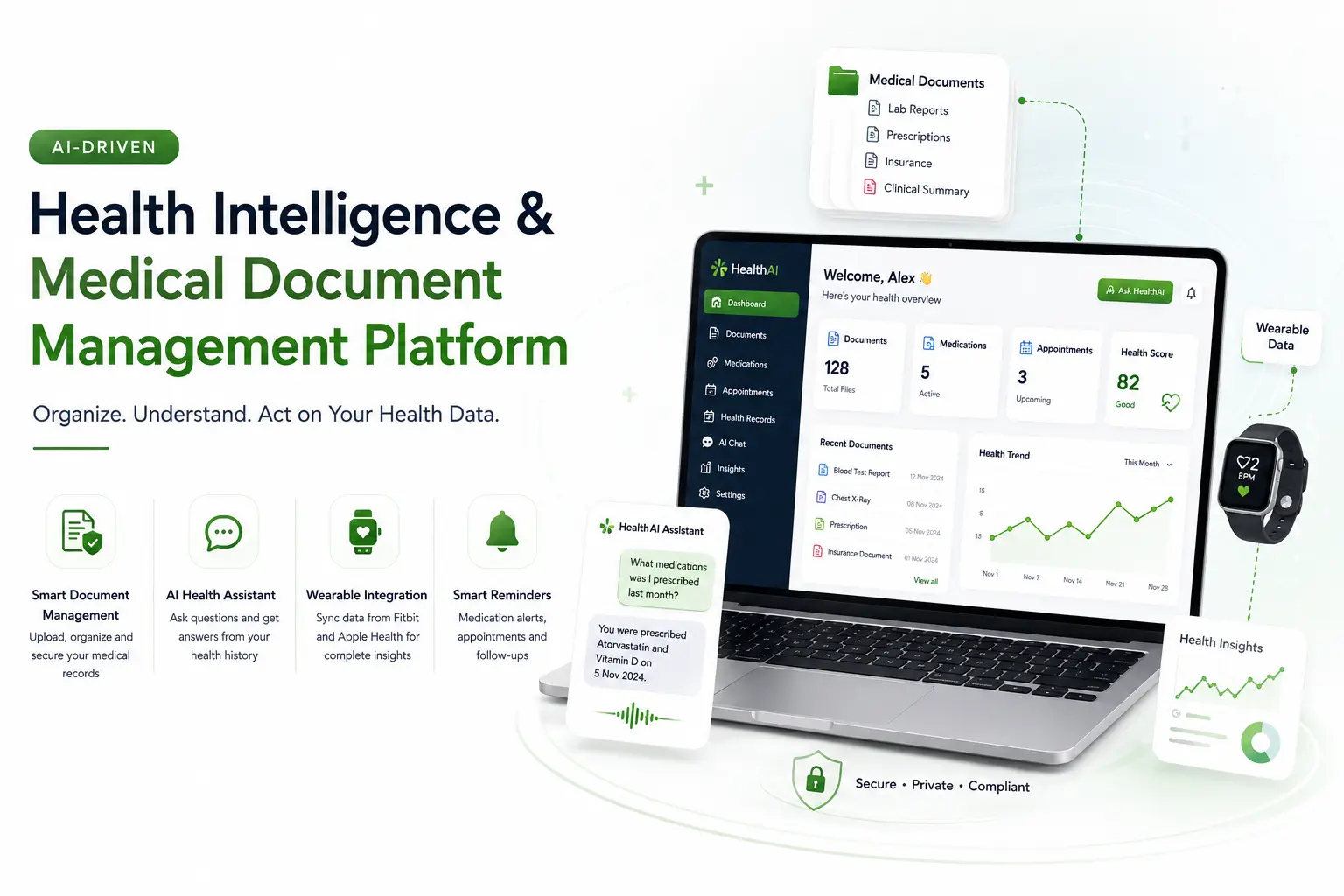
Healthcare data is rarely organized in a way that helps patients or providers make faster decisions. Medical records sit across disconnected systems, lab reports arrive in different formats, prescriptions get buried in email threads, and wearable health data often remains isolated from clinical history.
Amenity Technologies wanted to solve this fragmentation problem with a single AI healthcare platform capable of organizing medical documents, analyzing health records, and delivering meaningful health insights in real time.
The goal was not to create another document storage system but build a practical health intelligence platform. A health intelligence platform that could understand clinical documents, structure medical information automatically, and allow users to interact with their health history through conversational AI.
Where Traditional Medical Record Systems Fall Short
Most medical document management systems focus heavily on storage. Very few focus on usability after the upload process is complete.
That gap became obvious early in the project.
Users were dealing with:
- Scattered medical records across multiple sources
- Different document formats and inconsistent file quality
- Time-consuming searches through old prescriptions and reports
- Manual appointment and medication tracking
- No meaningful connection between wearable health data and medical history
The larger issue was context. A prescription alone says very little unless it is connected with lab reports, follow-up visits, ongoing medications, or recent health patterns. Existing systems rarely handled that relationship properly. That became one of the biggest focus areas during development.
Building Around Healthcare Usage Patterns
Instead of approaching the project like traditional medical document management software, the development process focused on how users naturally interact with healthcare information.
People rarely open a medical platform just to “view files.” They usually want answers.
Sometimes it is a quick check before a consultation. Sometimes they need to confirm medication history, compare older reports, or review previous test results without opening multiple documents manually.
The backend architecture was developed using FastAPI and Python to support those interactions in real time. Uploaded records, conversational queries, wearable inputs, and extracted clinical information all needed to work together without creating delays inside the platform.
A large portion of the engineering effort went into keeping those workflows responsive while handling multiple healthcare data streams simultaneously.
Turning Uploaded Reports into Structured Medical Data
One challenge appeared almost immediately once document uploads started flowing into the system.
Medical records rarely arrive in a clean, standardized format. Some lab reports were scanned poorly. Insurance papers followed completely different layouts. A few prescriptions even included handwritten notes that were difficult to process consistently.
The platform needed to work across all of them without forcing users to reorganize files manually first. Using Azure AI Document Intelligence, uploaded records were sorted into categories such as:
- Prescriptions
- Lab reports
- Insurance documents
- Clinical summaries
- Diagnostic records
But sorting documents was only part of the requirement.
The larger goal was making medical information searchable and usable afterward. The system extracted structured healthcare data from uploaded files so users could later retrieve relevant information conversationally instead of manually opening every document one by one.
As more records were processed, the platform gradually evolved beyond basic document storage and started functioning more like a medical document intelligence platform built around faster information access.
Making Medical Search More Context-Aware
A standard chatbot experience would not have worked well for this project.
Users were not looking for broad medical information copied from generic healthcare sources. They wanted answers connected directly to their own reports and medical history.
That requirement pushed the development team toward a Retrieval-Augmented Generation (RAG) framework using LangChain and LangGraph.
Before generating responses, the system retrieved relevant information from uploaded records, extracted clinical entities, and historical healthcare data. This helped the platform produce answers grounded in patient-specific context rather than generalized AI output.
Users could ask questions such as:
“What medications was I prescribed after my last blood test?”
“Show my previous thyroid reports.”
“When was my last follow-up consultation?”
The difference felt practical immediately. Instead of manually searching through multiple documents, users could retrieve information conversationally from a single interface. It became one of the most useful aspects of the AI medical records analysis workflow built into the platform.
Bringing Wearable Data into the Healthcare Context
Another major focus area involved wearable device integrations.
The platform connected with the FitBit and Apple Health data so live wellness metrics could become part of the broader medical context instead of remaining isolated inside separate applications.
This included information related to:
- Activity trends
- Heart rate patterns
- Sleep behavior
- General wellness indicators
The integration itself was relatively straightforward. The more important challenge was contextual relevance.
A wearable metric becomes significantly more useful when viewed alongside prescriptions, historical reports, or ongoing treatment history. The system used those combined inputs to support reminders, proactive notifications, and personalized health observations.
That shift helped the product feel more like a connected health intelligence platform rather than a static healthcare archive.
Reducing Manual Healthcare Administration
A surprising amount of healthcare management still depends on repetitive manual tasks.
Medication reminders, appointment tracking, follow-up schedules, and report organization often become ongoing responsibilities for users managing long-term conditions.
Part of the platform’s workflow logic focused on reducing that friction through clinical document automation.
The system extracted relevant healthcare entities from uploaded records and used them to support:
- Medication scheduling reminders
- Calendar synchronization
- Follow-up appointment notifications
- Context-aware health alerts
If someone sees these automation steps individually, they may not find them significant enough. However, they can eliminate a significant amount of repetitive administrative effort when considered together.
Infrastructure Designed for Scalable Retrieval
As the number of uploaded records increased, search performance started becoming a much bigger part of the overall experience. Medical histories, reports, and wearable data can build up quickly over time, so retrieval speed needed to stay consistent.
The platform used Supabase, PostgreSQL, and pgvector to handle contextual search more efficiently across patient records. Azure Blob Storage managed uploaded files securely, while Docker-based deployment workflows helped keep development and release cycles stable.
A large part of the infrastructure is closely aligned with real-world healthcare analytics platform development, particularly around retrieval speed and structured healthcare data handling.
Technology Stack Used
The platform combined modern AI tooling with scalable cloud infrastructure to back intelligent healthcare operations.
Core Development Stack
FastAPI, Python, LangChain, LangGraph, OpenAI GPT-4, NLP
AI and Document Intelligence
Azure AI Document Intelligence, RAG architecture, contextual retrieval systems
Infrastructure and Storage
Supabase, PostgreSQL, pgvector, Azure Blob Storage, Docker
Integrations and Deployment
Fitbit API, Apple Health integrations, OAuth authentication, GitHub Actions, Azure Container Apps
The Bigger Opportunity Behind Healthcare Intelligence
Healthcare systems generate enormous amounts of patient data every day, but organizing that information into something genuinely usable remains a major challenge for many providers.
For Amenity Technologies, the project focused on building healthcare AI solutions that could simplify how medical information is processed, retrieved, and accessed during real healthcare workflows.
The platform combined conversational retrieval, wearable integrations, and structured document processing into a connected system built around practical healthcare usage instead of isolated software features.
Over time, the project evolved beyond basic record management into a broader healthcare intelligence platform focused on accessibility, retrieval speed, and operational efficiency.
Tech Stack
The platform required a technology foundation capable of processing medical documents, supporting contextual AI conversations, integrating wearable health data, and retrieving patient information with minimal latency. The selected stack enabled structured healthcare data extraction, high-speed contextual search, scalable AI workflows, and secure handling of growing volumes of medical records and health intelligence data.
Technologies Used:
- FastAPI
- Python
- LangChain
- LangGraph
- OpenAI GPT-4
- NLP
- Azure AI Document Intelligence
- RAG
- Supabase (PostgreSQL + pgvector)
- Azure Blob Storage
- Fitbit API
- Apple Health API
- OAuth
- Push Notifications
- Azure Container Apps
- GitHub Actions (CI/CD)
- Docker
FAQs
Q.1. How does the platform handle different medical document formats?
A: The platform was built to process multiple healthcare document types, including scanned PDFs, mobile-uploaded prescriptions, insurance records, pathology reports, and clinical summaries. Azure AI Document Intelligence helped structure information even when document layouts were inconsistent.
Q.2. Could users search their medical history conversationally?
A: Yes. Users could ask natural questions such as previous medication history, older test results, or follow-up timelines without manually opening multiple documents.
Q.3. How could AI medical records analysis improve long-term patient care?
A: Over time, AI medical records analysis can help organize fragmented healthcare histories, surface overlooked patterns, simplify follow-up tracking, and improve accessibility to older clinical information.
