

The client was handling a growing volume of travel inquiries every day, but their response process was still heavily manual. Website visitors often waited hours for package details, itinerary clarifications, or booking responses, especially outside business hours. During peak travel periods, the support inbox became difficult to manage, and high-intent leads were starting to slip away before the sales team could respond. If an agency takes hours to reply to an inquiry, that potential customer will simply close the tab and book with a competitor who answered them in minutes.
To address these operational gaps, Amenity Technologies provides custom AI travel chatbot development focused on improving customer interactions, automating travel-related inquiries, and streamlining backend communication workflows such as booking confirmations, itinerary updates, and support email handling.
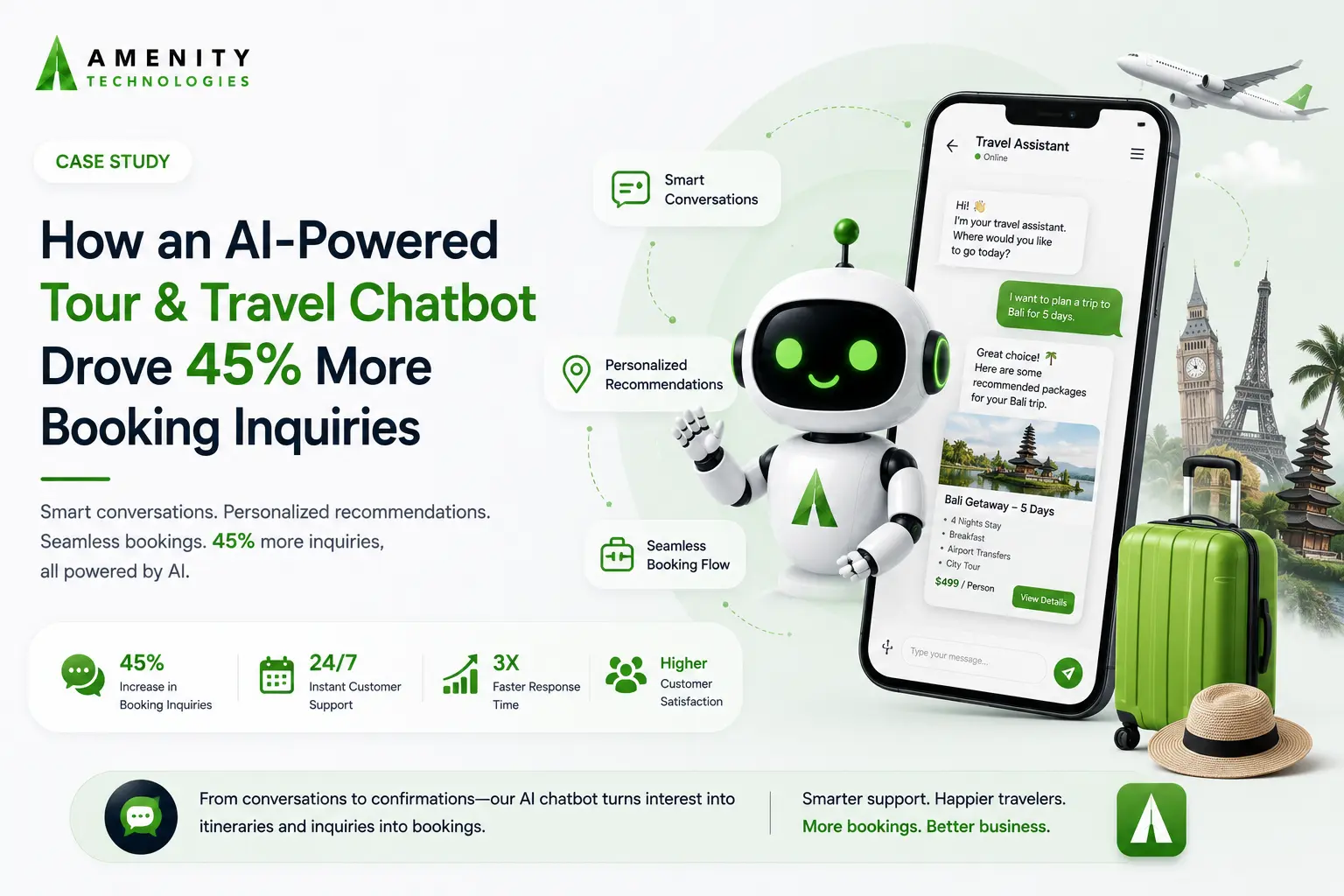
By deploying an intelligent AI travel chatbot on the front end alongside a background email ticketing bot, we helped the business secure a 45% jump in booking inquiries while reducing their overall support costs by 60%.
AI Chatbot Strategy That Improved Travel Booking Inquiries
The Growth Bottleneck: Handling Support at Scale
Most inquiries were coming in late evenings, weekends, and during holiday campaigns. Customers wanted quick answers about pricing, hotel options, itinerary flexibility, and availability, but the internal team could not keep up consistently during high-volume periods.
For a scaling agency, using manual labor to answer these repetitive questions is incredibly expensive and slow. Standard keyword-based chatbots rarely help because they break down the moment a user phrases a question naturally. On the other hand, leaving everything to a small human team leads to massive email backlogs and lost revenue. As an experienced travel chatbot development company, we knew the business needed a system that understands the actual meaning behind a traveler’s words.
Making the Booking Experience Less Frustrating
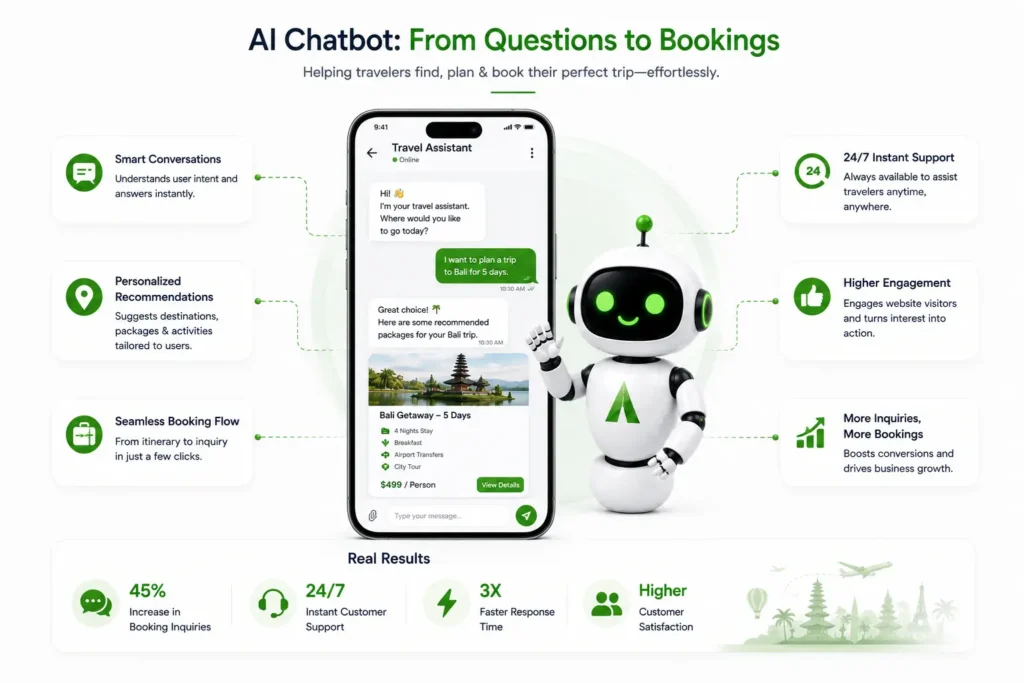
Travelers rarely describe trips in neat search terms. Most type questions are the same way they would ask a real travel advisor. We kept that behavior in mind while building this AI chatbot for travel industry brands. Instead of forcing users through stiff menu options, the chatbot responds more like a travel advisor having a real conversation.
The chatbot pulled information directly from package pages, itineraries, pricing sections, FAQs, and backend travel data so responses stayed accurate and context-aware during conversations.
We also used PostgreSQL vector similarity search so the system can understand intent behind searches like “peaceful weekend getaway with historical places” without depending only on exact keywords.
Keeping the System Stable During Heavy Traffic
Travel platforms usually slow down when too many users start searching at once. We wanted to avoid that from the beginning, especially during holiday booking periods when traffic spikes are common.
The internal team could update tour packages, pricing, and chatbot workflows from a centralized dashboard without relying on developers for routine changes.
Since package availability keeps changing, Celery was added to process bulk updates in the background instead of during live chats. That keeps conversations responsive even while the system is syncing fresh data.
On the tech side, the chatbot runs on LangChain, PostgreSQL, WooCommerce, WordPress, custom REST APIs, and structured prompt engineering workflows designed for fast, reliable responses.
Managing the Email Ticket Lifecycle Without the Stress
The website chatbot handled live visitor conversations well, but email support remained a serious operational problem. The client was receiving a constant flow of itinerary questions, booking concerns, cancellation requests, and follow-up inquiries every single day. During peak travel periods, inboxes became difficult to manage.
We built a second automation layer using n8n to control the entire support email workflow from start to finish.
The system keeps track of every incoming email the moment it arrives. After connecting directly with Salesforce and Microsoft Outlook, it automatically creates tickets, updates ticket statuses, assigns conversations, and tracks communication history using the email content itself. That removed hours of repetitive admin work from the support team’s daily routine.
More importantly, it reduced the chances of missing urgent customer requests or high-intent booking leads buried under large email volumes.
Why the Chatbot Started Converting Better
When we built this tour booking chatbot solution, our goal wasn’t just to deflect customer service tickets. If a chatbot only acts as an automated FAQ page, it misses the entire point of customer acquisition. The system needs to sell.
Most travel websites lose leads because their checkout or contact forms are too rigid. A traveler finds a package they like, but they want to swap a hotel or add an extra day in Rome. Instead of forcing them to fill out a 10-field contact form and wait 24 hours for a sales agent to email them back, the chatbot handles the modification instantly. It pulls data directly from the backend, shows the updated itinerary variation, and locks in the user’s contact information on the spot.
Instead of leaving the website to wait for an email reply, travelers could modify plans, ask follow-up questions, and continue the booking conversation immediately. We targeted the exact moment user intent was highest late at night, directly on the package page and gave them an immediate next step.
What Changed After Deployment
Within weeks of deployment, the support workflow looked noticeably different. The chatbot started handling routine customer questions automatically, which reduced pressure on the internal team during peak booking periods.
Booking inquiries increased by 45%, largely from travelers browsing outside normal business hours. Support costs dropped by 60% after repetitive itinerary and package-related questions stopped flooding the inbox daily.
The email workflow improved too. With n8n sorting inquiries and routing conversations automatically, reply delays that previously stretched for hours were reduced to just a few minutes for standard requests.
Solved: Hallucinations and Live Inventory Syncing
Travel businesses cannot afford wrong information. If a chatbot mistakenly promises airport transfers, hotel upgrades, or tour availability that does not actually exist, the damage goes far beyond a bad customer experience.
To prevent that, we built strict controls inside the LangChain and RAG workflow. The chatbot only responds using verified WooCommerce product data and approved package documents. If the requested information is missing, the conversation immediately moves to a live agent instead of generating a risky answer.
We also handled live inventory syncing with Celery workers running small background updates every few minutes, helping the chatbot stay aligned with real-time package availability during busy booking periods.
Build Your AI Strategy with Amenity Technologies
Every travel enterprise faces the same core challenge: scaling your volume shouldn’t mean scaling your support headache. At Amenity Technologies, we build custom AI solutions that integrate directly into your existing tech stack, whether you run on WordPress, Salesforce, custom APIs, or specialized booking software.
If your travel business is struggling with delayed responses, overloaded inboxes, or missed booking opportunities during peak traffic periods, Amenity Technologies can help you build a travel agency AI assistant that fits directly into your existing operations.
Tech Stack
The solution required two interconnected systems: an AI-powered travel assistant capable of understanding package-related queries and an automated ticket management workflow for handling customer emails at scale. The technology stack supported semantic search, intelligent information retrieval, background data processing, AI-assisted email drafting, automated ticket lifecycle management, and seamless integration with existing travel and customer support operations.
Technologies Used:
Travel Chatbot Platform
- LangChain
- Prompt Engineering
- Celery
- PostgreSQL
- WooCommerce
- WordPress
- Hostinger
AI-Powered Support Ticket Automation
- n8n
- Microsoft Outlook API
- Salesforce REST API
- OpenAI Embeddings
- Gemini
- Anthropic
- Pinecone
- JavaScript
- Custom Feedback Portal
FAQs
Q.1. How does the AI chatbot avoid giving travelers incorrect pricing or itinerary details?
A: It uses Retrieval-Augmented Generation (RAG) to strictly pull real-time data from your WordPress and WooCommerce databases instead of guessing
Q.2. Do our developers need to update the chatbot every time a tour package changes?
A: No, your team can manage tour updates, pricing changes, and conversation workflows directly from a simple, custom admin dashboard.
Q.3. Can the chatbot understand natural questions, or do users have to type exact keywords?
A: It uses PostgreSQL vector similarity search to accurately interpret the traveler’s true intent, even when they phrase questions casually.
