
 ALL ARTICLES



Most support systems work fine, until they suddenly don’t. A payment gateway goes down. Orders get delayed. A product update breaks something unexpectedly. Within an hour, support queues double in size and teams start firefighting instead of actually helping people.
That’s usually when businesses discover how fragile their customer service process really is. A lot of companies still depend on rigid automation tools built around fixed commands and scripted flows. Those systems hold up under predictable conditions. Real customers are rarely predictable.
People type incomplete thoughts. They jump between issues mid-sentence. They explain problems emotionally, not logically.
Traditional automation struggles with that. NLP-driven AI chatbots were built for it.
Overtaking Scripted AI Systems: The New Support Standard
Most old support bots fail for one simple reason: they expect customers to behave perfectly.
They wait for exact keywords, sentence patterns, and flows. But support conversations in the real world are actually messy.
Someone might type: “My card got charged but the account still says inactive.”
Another person says: “Paid already. Why locked out?”
The issue is the same, but the wording is completely different.
Older systems often treat those as unrelated requests. Human agents then end up manually stepping in, rerouting tickets, checking accounts, and calming frustrated users who already thought automation was supposed to make things easier.
That’s where support fatigue starts creeping in internally too. Teams spend half the day patching gaps between disconnected tools instead of solving higher-level customer problems.
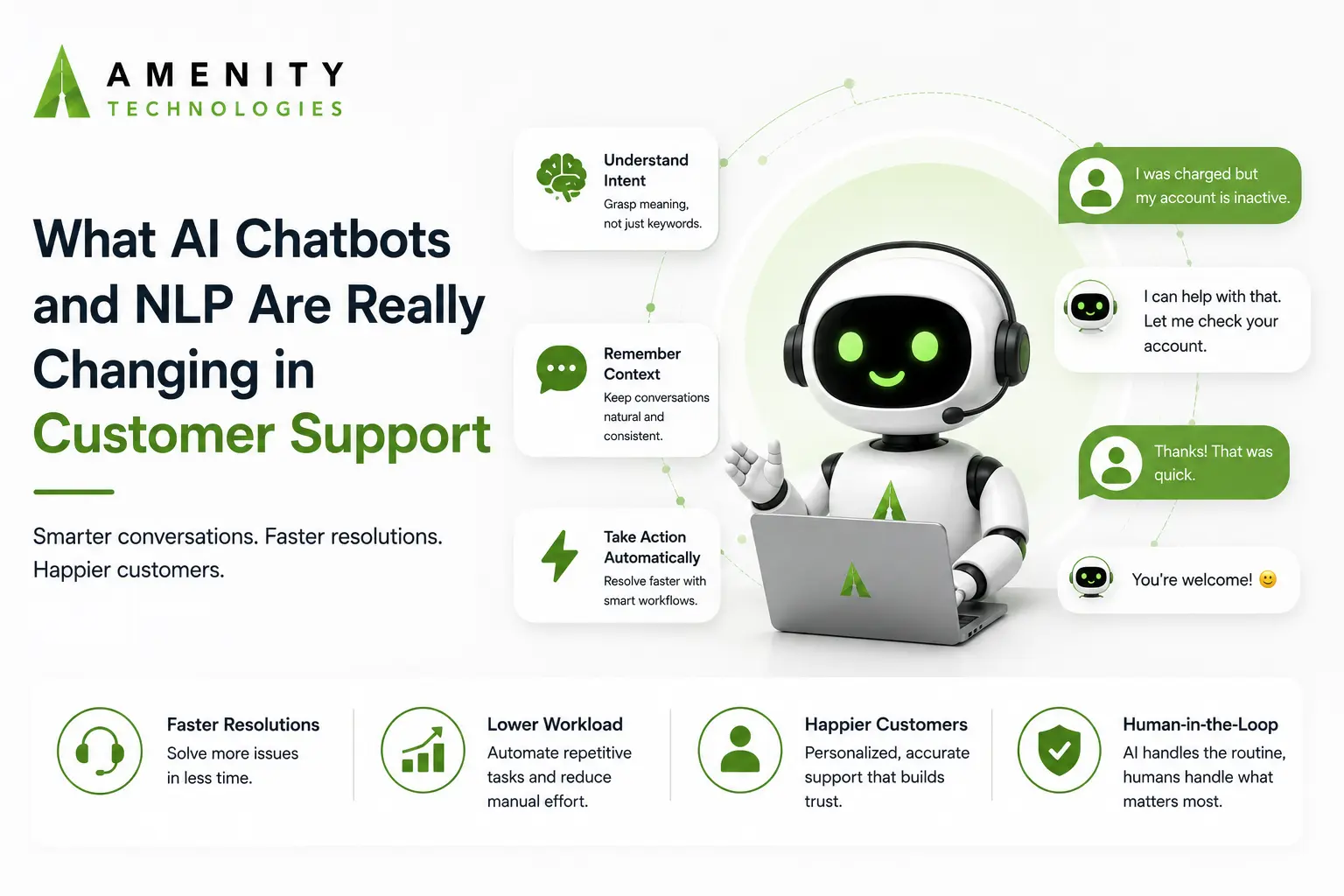
NLP chatbots work differently. Instead of hunting for exact phrases, they interpret intent, context, and conversational meaning behind the message. That allows support systems to respond more naturally, route issues more accurately, and reduce the constant back-and-forth that slows both customers and support teams down.
NLP Changed the Way AI Understands People
Natural Language Processing changed the entire dynamic. Older chatbots scanned for matching words. Modern AI customer support focuses on meaning. That sounds like a small difference until someone watches it happen during a live support conversation.
Customers no longer need to phrase requests carefully just to get help. The system interprets intent from natural language patterns, even when the message itself is vague, rushed, or poorly written.
It Pulls Meaning From Chaos
Users usually don’t present their concerns in clear chronological order. The NLP-based customer support automation solves this issue as they can be effectively trained to grasp the user’s concern.
It Remembers Context
Customers easily get frustrated if they have to repeat information again and again. Context retention can be a game changing here. It solves the friction quietly, making the user experience smooth.
It Handles Human Writing Habits
Normal human communication involving typos, slang, abbreviations, and rushed wording, no longer breaks the interaction flow.
It Connects Conversations to Action
The bigger shift happens behind the scenes. AI systems can trigger workflows automatically based on urgency, account history, or recurring support behavior.
That operational layer matters more than flashy chatbot conversations.
Prioritizing Human-in-the-Loop (HITL) Approach
A lot of executives still hesitate around AI support systems because they assume customers will feel like they’re talking to machines all day.
Honestly, that concern is fair. Bad automation does feel robotic.
But the strongest AI support environments usually feel less robotic overall because human teams finally have room to focus where they’re actually needed.
That’s where the human-in-the-loop (HITL) approach turns out to be critical. Instead of forcing AI to handle every situation independently, smart support systems allow AI and human agents to work together in the same workflow.
Think about how much support volume comes from repetitive requests:
- Password resets
- Order tracking
- Billing confirmations
- Appointment updates
- Account access problems
Those conversations eat up hours every single day.
Once automation absorbs the repetitive load, human agents can focus on situations where tone, empathy, judgment, or negotiation genuinely matter. When conversations become sensitive, complex, or emotionally charged, the system can smoothly escalate to a human without disrupting the customer experience. That’s the exact part many businesses miss.
The best AI chatbot solutions are not replacing human interaction. They’re protecting human attention from getting wasted.
Support Teams Feel the Difference First
Most companies notice the operational impact internally before customers even say anything.
Agents stop bouncing between systems constantly. Ticket queues move faster. Escalations become more organized. Teams spend less time manually forwarding conversations to the “right department.”
A lot of helpdesks still rely heavily on manual triage. Someone has to read incoming requests, prioritize them, categorize them, and reroute them manually.
At scale, that becomes chaos. Especially during product launches, seasonal traffic spikes, or service outages. AI automation removes a surprising amount of invisible operational drag.
Tickets Get Prioritized Faster
Urgent issues stop getting buried under routine requests.
Routing Stops Becoming Manual Labor
The system identifies where conversations need to go before human agents even open them.
Teams Spend More Time Solving Problems
That sounds obvious, but many support departments lose enormous time just organizing workflows.
AI Support Is Becoming Operational Infrastructure
The chatbot itself is only part of the story now. What businesses really want is AI-powered customer service that connects directly with operational systems.
That includes:
- CRM platforms
- billing systems
- inventory databases
- ERPs
- ticketing environments
- internal documentation systems
Once those integrations exist, support changes dramatically.
Instead of saying, “Please wait while I check that for you.” the system already has access to the information needed to resolve the issue immediately.
Customers notice speed, but they also notice momentum. Conversations feel smoother when there are fewer pauses, transfers, and repeated verification steps.
That experience compounds over time.
Legal Teams Are Feeling the Pressure Too
Support conversations don’t always stay simple for long.
For legal teams, customer support conversations are usually far more complex than simple back-and-forth communication.
Refund disputes, policy complaints, and account escalations usually end up crossing multiple departments. By the time legal or compliance teams step in, the same case has often been reviewed three or four times already.
AI tools are starting to reduce some of that repetition quietly.
- Policy Checks Happen Faster: Teams no longer have to manually dig through documentation for every dispute.
- Drafting Stops Eating Time: Legal teams stop rewriting the same responses again and again.
- Risk Patterns Surface Earlier: Certain complaints start revealing larger operational problems before they spiral.
Customers Notice Friction Immediately
Most customers are more patient than businesses assume. What frustrates them is confusion.
Getting transferred twice. Explaining the same issue repeatedly. Waiting hours for a reply that barely answers the question. That’s usually where trust starts dropping.
AI-powered support helps remove a lot of that friction before conversations become exhausting.
The biggest difference customers notice is simple: things move faster without feeling chaotic.
The Best Support Systems Feel Effortless
Most customers do not care whether a chatbot uses NLP or advanced AI models. They care about whether problems get solved quickly.
That’s where support is heading now. It’s going to be fewer delays, fewer dead ends, and fewer repetitive conversations.
At Amenity Technologies, the focus stays on building conversational systems that work naturally inside real business environments. Not robotic. Not overcomplicated.
Just faster, smoother support that feels easier for everyone involved.
FAQs
Q.1. Can AI chatbots reduce ticket backlog during peak support hours?
A: Yes, chatbots can be really helpful, especially during outages or seasonal spikes. AI systems can instantly sort conversations by urgency, resolve repetitive issues automatically, and prevent support queues from becoming unmanageable for human teams.
Q.2. Why do support agents still spend time manually routing tickets?
A: Many helpdesks still depend on disconnected systems and manual categorization. Without AI automation, agents often waste hours forwarding conversations between departments instead of actually resolving customer issues faster.
Q.3. Do customers actually prefer AI-powered support experiences?
A: Most customers do not care whether support is AI-powered. They care about getting quick answers without delays, repeated explanations, unnecessary transfers, or confusing back-and-forth conversations.