
 ALL ARTICLES



Most enterprise leaders are quietly fighting a losing battle against their own workflows. You have likely automated what you can with legacy, rule-based software, yet true AI workflow automation remains inaccessible as teams still spend hours manually fixing broken triggers, handling data exceptions, and managing rigid communication gaps between isolated software systems.
When things stop going according to plan, traditional automation tends to break down. A process gets stuck, work starts piling up, and teams end up stepping in manually to keep things moving.
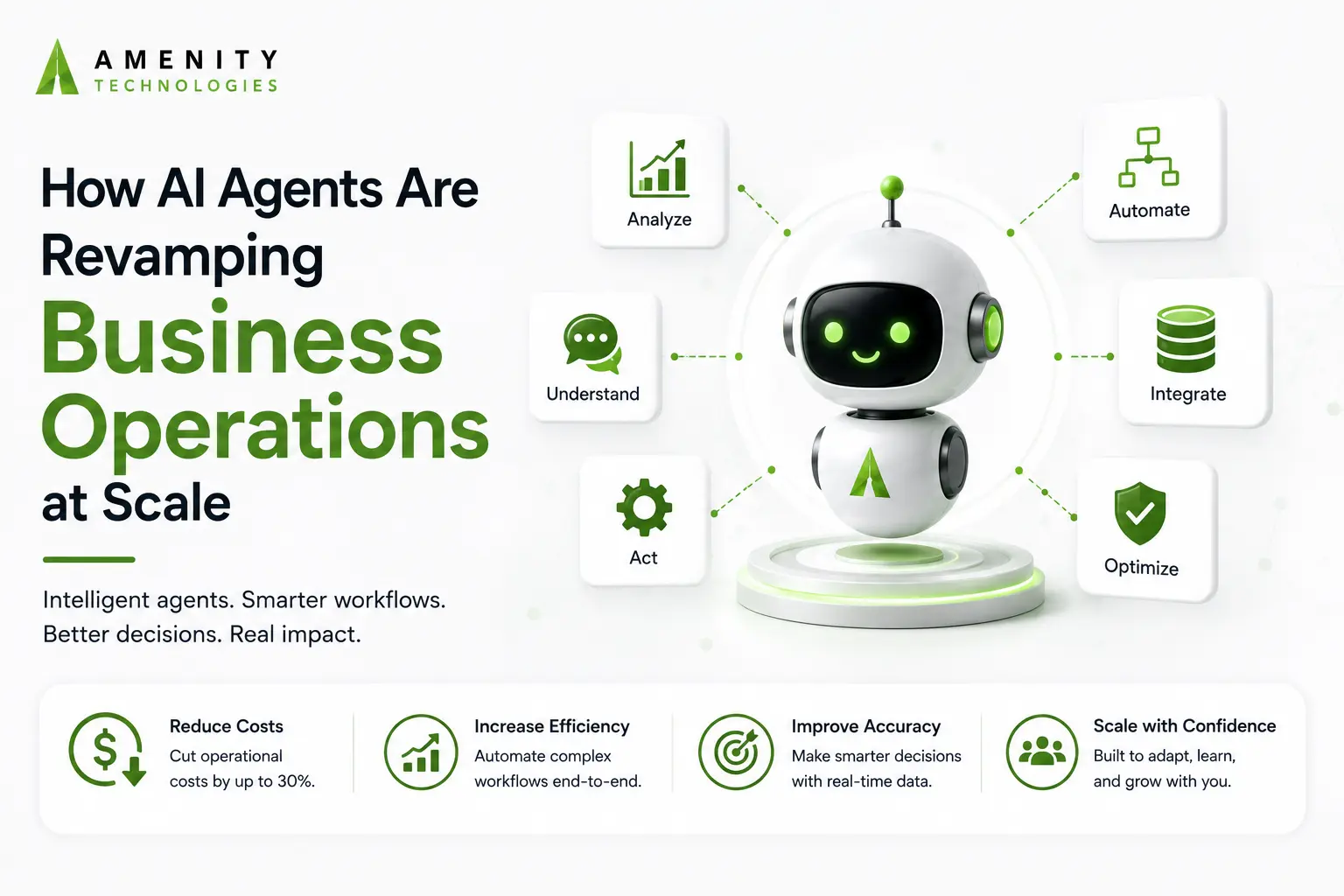
That’s why we are seeing AI agents transforming business operations globally in 2026. Instead of following a fixed set of instructions, they can work through changing situations, make decisions based on new information, and handle multi-step tasks with far less human intervention.
The Limits of Rule-Based Automation
Traditional Rule-Based Automation in enterprise automation operates like a simple train on a straight track. If a customer fills out a form, the system sends a template email. But if that customer replies with an unpredicted request, the system derails, requiring immediate human intervention to get things back on course.
The fragility leads to an invisible tax on your growth, it forces skilled operators to act as digital duct tape. Implementing dedicated AI agents for business and shifting from rigid scripts to autonomous systems cuts average operational costs by 30%.
With enterprise adoption expanding at a projected 45% compound annual growth rate through the turn of the decade, the corporate choice is no longer about simple optimization; it is about operational survival. Businesses looking to outpace this shift frequently seek to hire an AI developer to build robust foundations.
Inside the Decision-Making Engine of AI Agents
Unlike passive chatbots that just match keywords to static answers, autonomous AI agents operate within a continuous, self-correcting structural framework. They do not just converse; they execute.
The Observe Phase
The agent continuously ingests unstructured environmental data, tracking open API endpoints, unformatted emails, live system logs, and shifting database parameters. It converts this messy chaos into structured context instantly.
The Plan and Reason Phase
Using underlying large language models mixed with short-term operational memory, the agent analyzes the incoming data against your business goals. It weighs potential dependencies, evaluates edge cases, and calculates the optimal step-by-step resolution path.
For example, when processing complex health intelligence data, advanced agent frameworks utilize LangChain and LangGraph to run a context-aware Retrieval-Augmented Generation (RAG) loop. By matching user queries against deep historical data stored in high-performance vector databases like Supabase (pgvector), the planning engine performs high-speed semantic similarity searches to extract clinical entities and verify real-world dependencies before making a decision.
The Act Phase
Once the path is determined, the agent connects directly with your enterprise stack. It updates your CRM, pings internal databases, issues system commands, or safely triggers external vendor workflows without human delays, often using low-latency, token streaming to deliver live information back to endpoints instantly.
A Practical Execution Example
Consider a marketing analysis workflow. Instead of an entire team spending a week pulling cross-platform data, an agent tracks performance variables, drafts a deep strategic brief, and queues media budget adjustments for rapid human sign-off.
Looking to transition to modern, AI-powered operations and move past brittle, script-based tools? Discover how Amenity Technologies engineers custom enterprise AI agents that integrate directly into your legacy software infrastructure to automate your most complex workflows
Where AI Agents Make the Biggest Impact
These agents drive next-generation business process automation, yielding higher ROI when used for high-friction settings where data changes quickly and decisions have a significant and immediate financial impact.
Complex Process Automation
Deploying enterprise AI agents clarifies these bottlenecks; many business processes look straightforward until real-world situations get involved. An invoice arrives with missing information. An onboarding request lacks key details.
We see this friction daily in document-heavy sectors like healthcare. Modern autonomous systems remove manual friction by layering Azure AI Document Intelligence directly into a FastAPI backend. The agent automatically ingests, categorizes, and extracts structured data from unstructured formats such as prescriptions, lab reports, and insurance claims, instantly synchronizing follow-up calendars and administrative tasks without human data entry.
Breaking Data Silos for Decision Support
Acting as an intelligent organizational layer, an agent simultaneously monitors live procurement logs, warehouse inventory levels, and global market pricing. It flags supply chain shortages days before your production line suffers a costly shutdown. Businesses seeking tailored algorithms for these setups often leverage custom machine learning development services.
Contextual Customer Operations
Modern support architectures use advanced systems that far exceed the capabilities of a basic AI chatbot customer service tool. These systems read deep account histories and resolve intricate customer complaints without manual escalation.
Engineering & R&D Velocity
Agents strip away repetitive administrative scaffolding from specialized developers. They accelerate technical document generation, automate legacy code migrations, and compile dense compliance frameworks, allowing engineers to focus purely on high-value architecture.
Sector Spotlights
Every industry has its own way of working, but the same pattern shows up again and again. Teams spend time chasing information, fixing exceptions, and dealing with tasks that never seem important enough to automate properly.
FinTech & Finance Operations
Month-end is rarely as straightforward as it looks on a spreadsheet. Teams spend hours matching records, checking numbers, and investigating discrepancies. AI agents can help take some of that routine review work off their plate so finance teams can focus on the exceptions that actually need attention.
Logistics & Supply Chain
One delayed shipment has a habit of creating problems elsewhere. Inventory changes, schedules get updated, and teams rush to stay informed. Here, AI agents can help monitor those moving parts and surface concerns earlier, before they become larger operational burdens.
Travel & Hospitality Management
Corporate travel platforms leverage specialized logic to deploy an intelligent AI travel agent solution. Rather than just offering fixed flight filters, this system coordinates with corporate budgets and preferences.
Leisure & Booking Services
Booking a trip sounds simple until you’re comparing dozens of flights, hotels, and activities at the same time. Most people end up with too many tabs open and too many options to sort through. An AI travel planner can narrow the choices and help travelers find options that actually fit what they’re looking for.
The Integration Blueprint & Governance
The biggest challenge usually isn’t the AI itself. It’s everything around it.
Many businesses nowadays discover that the information their teams rely on sits in different systems, follows different formats, and isn’t always up to date. An AI agent can’t make good decisions if it’s working with incomplete or conflicting information. Before anything else, companies need to get their data house in order.
Then comes trust. Most leaders aren’t comfortable giving software free rein to update records, approve requests, or trigger actions without oversight. Nor should they be. The strongest deployments put clear boundaries in place from the start: what the agent can access, what it can do, and when a person needs to review the outcome. That balance is what turns an interesting piece of technology into something teams can actually rely on day after day.
The Next Horizon & Strategic Closing
The immediate future of enterprise design belongs to multi-agent collaboration networks. Instead of a single tool working in a vacuum, specialized agents will communicate, negotiate, and transact securely with one another across departmental lines.
A logistics agent will coordinate instantly with a finance agent to balance inventory, while a compliance agent reviews the transaction against active industry regulations, all within seconds.
Forward-thinking leaders are building these data foundations today. Waiting only makes the gap harder to close.
Partner with Amenity Technologies and allow your business to design, deploy, and scale custom AI agent architectures and software solutions that transform static databases into active engines of ongoing operational growth.
FAQs
Q.1. Why do initial AI agent implementation pilots face friction when scaling across departments?
A: Usually because every department works a little differently. Sales has its tools, operations has theirs, and finance often relies on something else entirely. The AI may work perfectly in one area, but scaling becomes difficult when those systems don’t share information easily. That’s often where the real work begins.
Q.2. How can we trust an AI agent to interact directly with our core CRM and database tools without data corruption?
A: Agents do not write arbitrary code or bypass your security parameters; they operate within strict read/write permissions via isolated, sandbox environment connections. You dictate exactly which databases they can modify, and every high-impact transactional state change remains subject to human approval. You can design enterprise-grade, secure automation boundaries by mapping your architecture with Amenity Technologies.
Q.3. What happens if an AI travel agent or customer operations agent encounters an edge case it cannot solve?
A: It happens more often than people think. Customers ask unusual questions, policies change, or situations come up that weren’t part of the original workflow. When that happens, a well-designed agent doesn’t guess; it hands the conversation over to a person with the relevant details already collected, so the customer doesn’t have to start from the beginning.