
 ALL ARTICLES
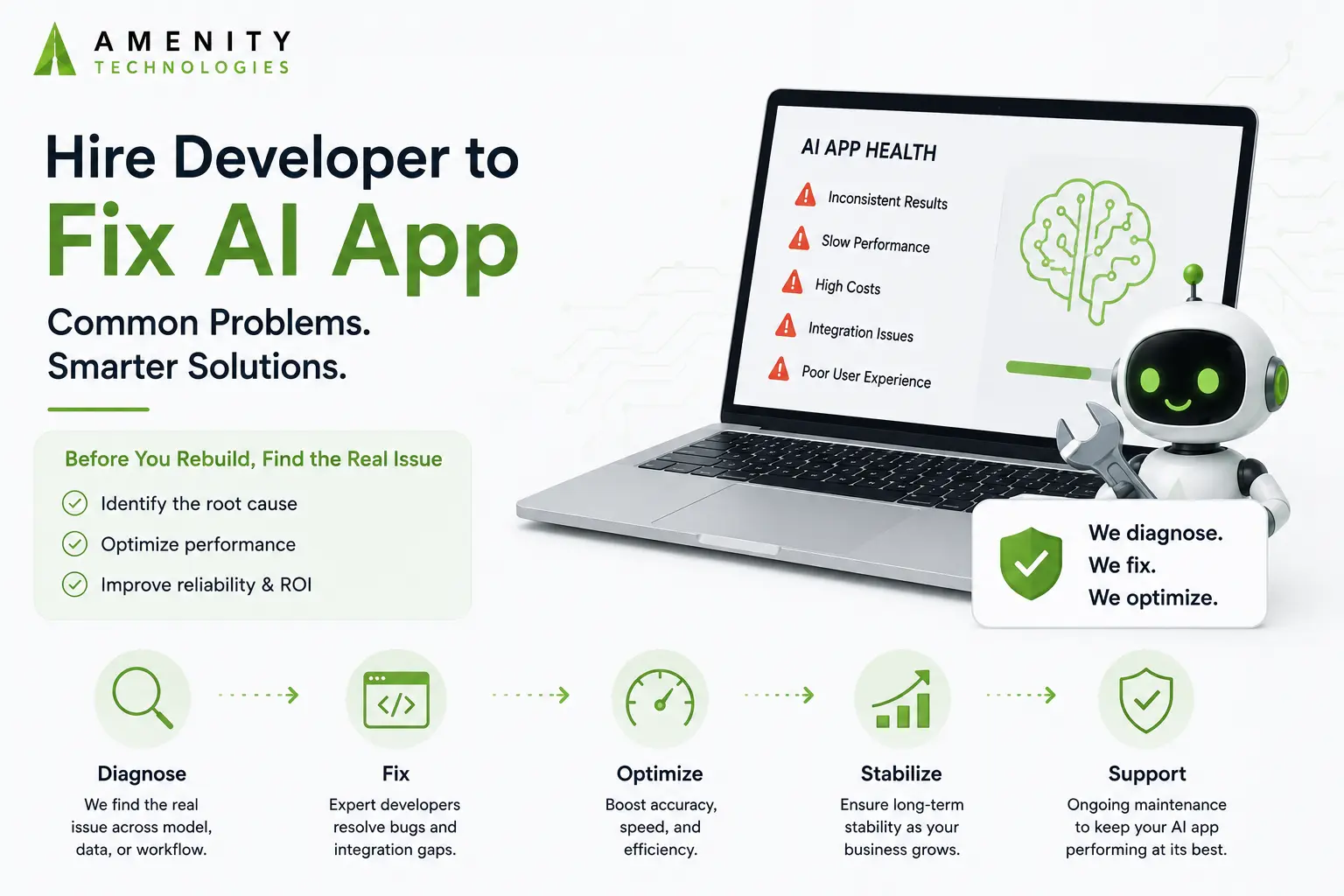



The AI application worked well enough to get approved. Then real users arrived.
Response quality became inconsistent. Processing slowed down. Costs increased. Teams started spending more time explaining the system than benefiting from it.
At that point, many businesses jump straight to a rebuild. In reality, most underperforming AI applications do not fail because the idea was wrong. They fail because a problem somewhere in the workflow was never identified properly.
Before deciding to hire developer to fix AI app performance issues, it is worth identifying whether the issue stems from the model, the data, the infrastructure, or the way the application was implemented in the first place.
Before Hiring a Developer, Identify the Type of Failure
Most teams don’t start by searching for AI software troubleshooting. They start by noticing something has changed.
People Started Questioning the Results
The application still produced answers, recommendations, or predictions. Confidence in those outputs simply wasn’t what it used to be.
Workarounds Began Appearing
When employees start creating spreadsheets, manual checks, or alternative processes, it is often a sign that something deeper needs attention.
The System Felt Different, But Nobody Knew Why
Nothing appeared completely broken. The application simply stopped delivering the same value it delivered a few months earlier.
The Conversation Shifted to Fixing the Problem
At that point, businesses usually stop asking whether something is wrong and start asking how to fix AI application issues before they affect customers, operations, or revenue.
For many organizations, that is when the decision to hire a developer to fix AI app performance becomes a serious discussion rather than a future consideration.
The Model Is Often Not the Problem
A surprising number of AI projects get blamed for the wrong thing. The conversation usually starts with the model because it is the most visible part of the system. In practice, the investigation often heads somewhere else.
The Data Changed Before Anyone Noticed
One team spent weeks discussing model quality. The real issue turned out to be incoming data that no longer looked like the data used when the workflow was first launched.
The Integration Became the Weak Link
An application can generate perfectly reasonable outputs and still create frustration if information stops flowing correctly between systems. Users rarely distinguish between an AI problem and an integration problem.
The Workflow Outgrew the Original Design
What worked for a few hundred requests each week may struggle when volume doubles or triples. The application technically works, but the experience around it starts breaking down.
This is one reason experienced teams approach AI software troubleshooting carefully. Fixing the visible symptom is not always the same as fixing the underlying issue.
Not Every AI Problem Needs a New Application
An expert development team spent weeks looking at model performance because document extraction accuracy had started slipping.
The assumption seemed reasonable. Invoices were arriving with different layouts, multiple tax fields, embedded images, and formatting variations. The first instinct was to focus on the AI itself.
The investigation eventually moved elsewhere.
Part of the challenge came from how information was being identified, validated, and passed through the workflow. Once those pieces were revisited, accuracy improved noticeably and processing delays became far less common.
Situations like this appear more often than many teams expect. The application may be receiving the blame, while the real problem sits inside data handling, workflow design, or system integration.
That is why organizations looking to fix AI application issues are often surprised by what the investigation uncovers.
When the Obvious Problem Isn’t the Real Problem
A search feature can return irrelevant results even when the AI is doing exactly what it was designed to do.
A support workflow can feel slow despite generating accurate responses.
A document-processing system can miss important information because of what happened before the data ever reached the model.
These situations show up more often than many teams expect.
In one project involving thousands of business documents, the challenge was not finding information. The challenge was making that information searchable, structured, and easy to retrieve when people actually needed it. The work eventually focused on document classification, entity extraction, and search quality rather than replacing the underlying AI components.
A similar pattern appears in customer-facing applications. Teams sometimes assume the chatbot is failing when the real problem sits inside content organization, retrieval logic, or how information is being supplied to the system.
That is why AI system optimization rarely starts with assumptions. The first goal is understanding where friction is actually being created.
When It Makes Sense to Bring in Outside Expertise
Some teams know exactly what is wrong. Others spend weeks debating it. The second situation is usually the more expensive one.
The Same Issue Keeps Returning
A fix works for a while. Then the same complaint shows up again. After a few rounds of that cycle, the conversation usually shifts from fixing symptoms to finding causes.
Nobody Agrees on What Broke
One person points at the model. Another blames the data. Someone else thinks the integration is responsible. When every meeting ends with a different theory, many businesses decide to hire AI developers who spend their time investigating these situations.
The Team Started Avoiding the System
This sign is easy to miss. People stop relying on the application and quietly return to manual checks, spreadsheets, or alternative processes.
Weeks Pass Without Clarity
The issue remains. The explanations change. That is often the moment organizations decide to hire a developer to fix AI app performance problems rather than continue guessing where the failure actually lives.
Fixing the Issue Is Only Part of the Job
A surprising number of AI applications work well right after a fix. The real test comes later.
New Data Changes the Environment
The application may be processing different customer requests, documents, products, or workflows than it handled six months earlier. What performed well during one period may need adjustments during the next.
Small Problems Tend to Return Quietly
Performance issues rarely announce themselves. A slight drop in accuracy, a slower response time, or an increase in manual corrections often appears long before somebody raises a concern.
Stability Requires Ongoing Attention
This is where AI app maintenance services become relevant. The goal is not constant rebuilding. It is making sure the application continues delivering reliable results as usage, data, and business requirements evolve.
Many long-term improvements come from AI system optimization rather than major redevelopment efforts. Small adjustments made at the right time often prevent much larger problems later.
Get More Value From the AI Application You Already Have
Many teams start looking for help because something feels off. The outputs are less reliable, the workflow feels slower, or confidence in the system has started to fade.
The challenge is not always fixing the AI. Sometimes it is figuring out where the friction actually began.
If that sounds familiar, the team at Amenity Technologies can take a closer look, identify what is holding the application back, and help determine the next step.
FAQs
Q.1. How do we know if an AI app needs fixing or a complete rebuild?
A: Most applications do not need a rebuild immediately. The answer usually depends on whether the issue comes from the model, data flow, integrations, or the surrounding workflow.
Q.2. Can poor AI results be caused by something other than the model?
A: Yes. Retrieval logic, OCR quality, APIs, databases, prompts, and integrations often contribute just as much to the final outcome as the model itself.
Q.3. When should a company hire AI developers instead of relying on internal teams?
A: Usually when the same issue keeps returning, nobody agrees on the cause, or the team lacks visibility into how the application is behaving in production. It could be the sign to utilize resources in hiring AI developers.