
 ALL ARTICLES



Walk into almost any production facility and you’ll see screens everywhere. HMIs. Control panels. Maintenance systems. Production counters.
In the manufacturing industry, data is never the problem. Making sense of it is.
A machine starts behaving differently long before it fails: energy consumption shifts, and cycle times creep upward. Quality issues appear intermittently and then disappear before anyone can investigate them properly.
Most of those signals already exist somewhere inside the operation.
The discussion around AI in manufacturing has less to do with replacing machines and more to do with exposing patterns hidden inside day-to-day production data. That’s often where the first meaningful manufacturing automation wins come from.
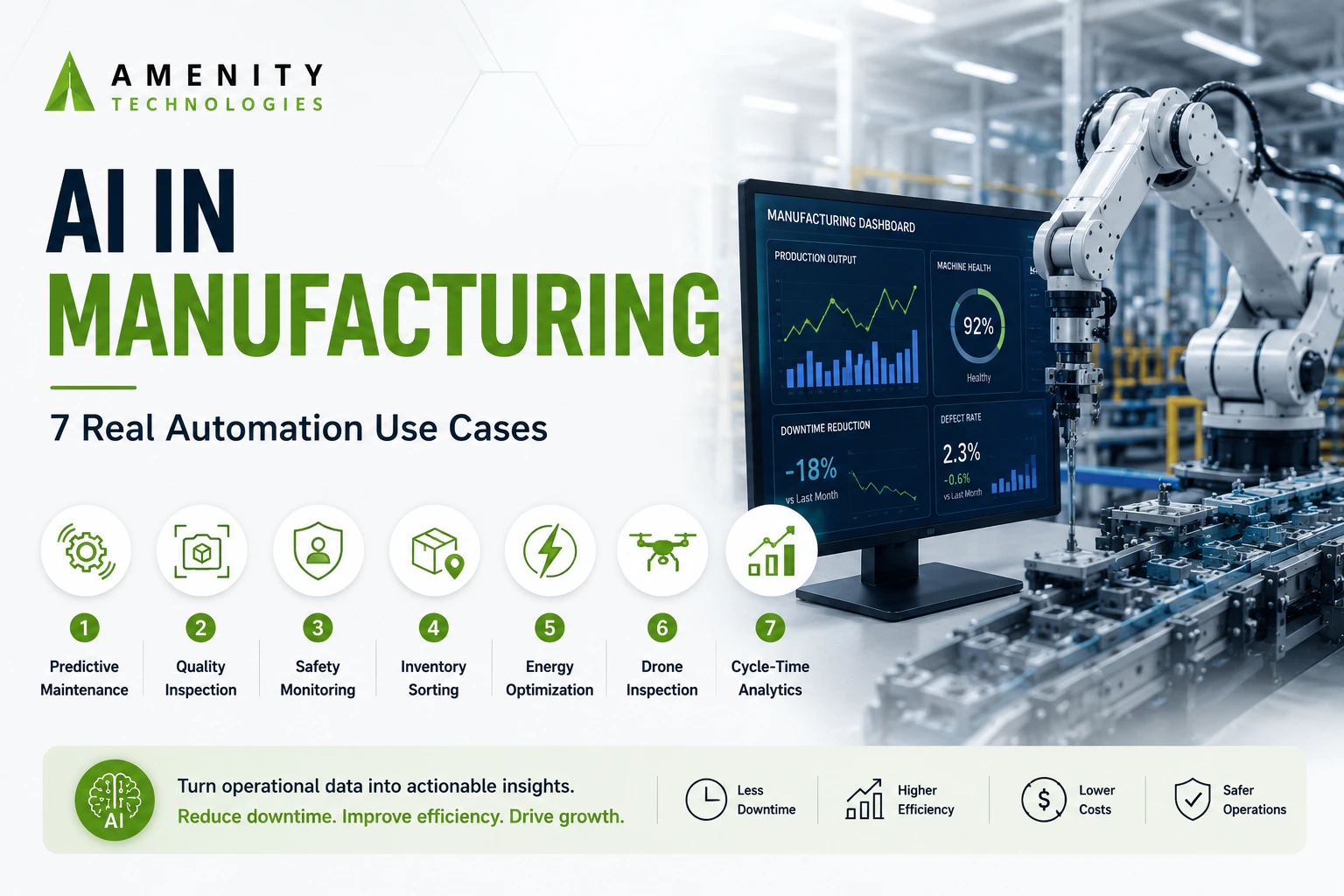
Here, we’ll explore 7 real-world use cases from manufacturing environments that show how businesses are reducing downtime, improving efficiency, and unlocking more value from operational data.
High-Yield AI Manufacturing Use Cases Delivering Immediate Return
Most factory teams are not finding a replacement for entire production environments. What they’re trying to solve is particular operational problems. A recurring defect. A machine that fails unpredictably. A safety concern near a high-risk work zone.
Those problems usually appear long before anyone starts talking about digital transformation initiatives. And that’s why many successful manufacturing AI solutions are designed by focusing on narrowly defined objectives rather than large-scale system overhauls.
Instead of rebuilding existing infrastructure, organizations can deploy focused models around maintenance, quality control, safety monitoring, energy consumption, and production efficiency. Small improvements in those areas often compound quickly because the systems generating the data are already in place.
The following AI manufacturing use cases are some of the most practical examples currently being deployed across industrial environments.
1. Predictive Asset Maintenance and Rotary Analytics
Ask a maintenance supervisor what causes the most frustration, and you’ll rarely hear ‘the breakdown itself’; the majority of the time, it will be the unknown.
Equipment can run for weeks while small warning signs accumulate in the background. A pump starts vibrating differently. A motor pulls slightly more current than usual. Temperatures drift upward little by little. Things might not appear urgent at the moment, but they can rapidly escalate into a major problem.
Monitoring systems can watch those signals continuously and surface unusual patterns before they become production problems.
Monitored Variables:
- Vibration patterns
- Bearing temperature
- Pressure readings
- Motor current draw
Target Machinery:
- Pumps
- Compressors
- Rotary equipment
- Conveyor systems
Operational Trigger:
- Threshold breaches
- Pattern deviations
- Maintenance alert generation
Python, Django, Celery, and Redis can support recurring diagnostics, alert delivery, and background monitoring workflows while production continues as normal.
2. Deep-Learning Quality Gates for Visual Defect Inspection
Defects are not always obvious. Sometimes they’re visible for a fraction of a second. Sometimes they appear so inconsistently that different operators classify the same issue differently during separate shifts.
That inconsistency becomes expensive when production volumes increase.
Computer vision systems approach the problem differently. Every item is evaluated against the same inspection criteria regardless of shift schedules, fatigue levels, or production speed.
Inspection Components:
- PyTorch-based image inference
- OpenCV preprocessing pipelines
- Lighting normalization
- Edge enhancement filters
Common Defect Categories:
- Surface cracks
- Scratches
- Missing components
- Dimensional inconsistencies
The objective isn’t replacing quality teams. It’s helping them focus attention where it matters most.
3. Real-Time Floor Safety and Hazard Zone Tracking
Factory floors rarely stay static for very long. A forklift passes through one area. Maintenance work begins in another. Temporary workspaces appear around equipment that wasn’t being serviced an hour earlier.
Keeping track of those changing conditions is challenging, especially in larger facilities.
Camera Feed → Worker Tracking → Safety Check → Alert
Manufacturing facilities already have RTSP cameras monitoring different parts of the operation. Those video feeds can be used to identify when someone moves into a restricted zone or gets too close to a hazardous area. Instead of relying on wearable devices, alerts can be triggered automatically as soon as a safety boundary is crossed.
4. Automated Part Localization and Inventory Sorting
Every manufacturing facility has that moment. A production line is waiting for parts. The system might show that the material is available. But, when someone checks the rack, it isn’t there. A few phone calls later, the missing pallet turns up in a temporary holding area where it was placed several hours earlier.
Nobody made a mistake. The floor was simply moving faster than the records. That challenge becomes more common as material volumes increase and products move through multiple handoff points during the day.
Key Inputs:
- Camera feeds
- Part labels
- Movement activity
System Outputs:
- Part coordinates
- Location updates
- Inventory records
Computer vision models can continuously track material movement, giving factory automation teams better visibility into where parts actually are rather than where they were last recorded.
5. Energy Grid Balancing and Thermal Peak-Load Throttling
Energy consumption rarely increases in a straight line.
A production line starts earlier than usual. Cooling systems work harder during warmer shifts. Several high-demand machines begin operating at roughly the same time. Individually, those events seem minor. Together, they can create short periods of unnecessary energy strain.
The difficulty is not collecting the data. Most facilities already have it.
Monitored Inputs:
- Equipment utilization
- Thermal readings
- Ambient temperature
Optimization Actions:
- HVAC balancing
- Peak-load reduction
- Energy forecasting
AI-driven manufacturing models can continuously evaluate operating conditions and highlight consumption trends that would be difficult to spot through periodic reviews alone.
6. Automated Structural Asset Auditing via Computer Vision Drones
Large facilities contain assets that rarely receive the same level of attention as production equipment.
Roofs, elevated pipe networks, storage structures, and exterior infrastructure can go months without inspection simply because accessing them takes time, equipment, and specialized personnel.
Drone-based inspections change that process considerably.
- Aerial footage is collected across designated inspection zones.
- Images and video are processed through AWS S3-based analysis workflows.
- Structural anomalies, thermal irregularities, and visible deterioration are mapped for review.
For many industrial automation programs, the objective is not replacing inspectors. It’s allowing them to spend less time reaching inspection points and more time evaluating findings.
7. Real-Time Cycle-Time Bottleneck Isolation
A line that normally runs smoothly starts finishing a little later than expected. There is no concern raised, as the delay is only a few minutes; however, the next day, it happens again.
A week later, supervisors are discussing missed output targets without being completely sure where the lost time is coming from. The issue isn’t always a major equipment failure. Sometimes it’s a collection of small delays spread across multiple stations.
IoT gateways can gather machine and sensor telemetry through MQTT and CoAP protocols, turning disconnected signals into a shared operational view.
That visibility helps teams identify developing constraints before they become larger production issues. For organizations exploring AI for manufacturers, this is often one of the fastest ways to uncover inefficiencies already hidden inside day-to-day operations.
Where Smart Manufacturing AI Actually Gets Its Data
Most production facilities are already generating the information needed to support automation initiatives. In many ways, that data foundation is what makes smart manufacturing possible in the first place.
Machine controllers, PLCs, SCADA systems, sensors, inspection cameras, and maintenance platforms continuously produce operational data throughout the day. The challenge is that those signals often remain isolated inside separate systems.
A maintenance team may be looking at one screen while production supervisors rely on another. Useful information exists, but it rarely arrives in a format that is easy to compare or act upon.
That is where many industrial automation initiatives begin. Existing machine data can be collected, standardized into JSON streams, and moved through MQTT or CoAP channels, giving teams a clearer view of what is happening across the operation without changing how the equipment itself runs.
Partner With Us to Engineer Scalable Industrial Automation Systems
Most production teams are not searching for more technology. They’re trying to solve problems that already exist: unexpected downtime, recurring quality issues, rising energy costs, or limited operational visibility.
The good news is that many of the answers are already hidden inside the data your equipment generates every day.
If you’re exploring artificial intelligence in manufacturing and want to understand where automation can make the biggest impact, let’s have a conversation about your operation and the challenges you’re trying to solve.
FAQs
Q.1. Do we need to replace existing PLCs or SCADA systems?
A: No. Most projects are initiated by gathering all critical data from existing PLCs or SCADA systems instead of replacing them.
Q.2. How accurate are computer vision inspections compared to manual checks?
A: Consistency is usually the biggest advantage. Models apply the same inspection criteria across every shift and production run.
Q.3. Can AI help with worker safety without requiring wearables?
A: Yes. Camera-based monitoring systems can track movement and safety boundaries using existing video infrastructure.