
 ALL ARTICLES
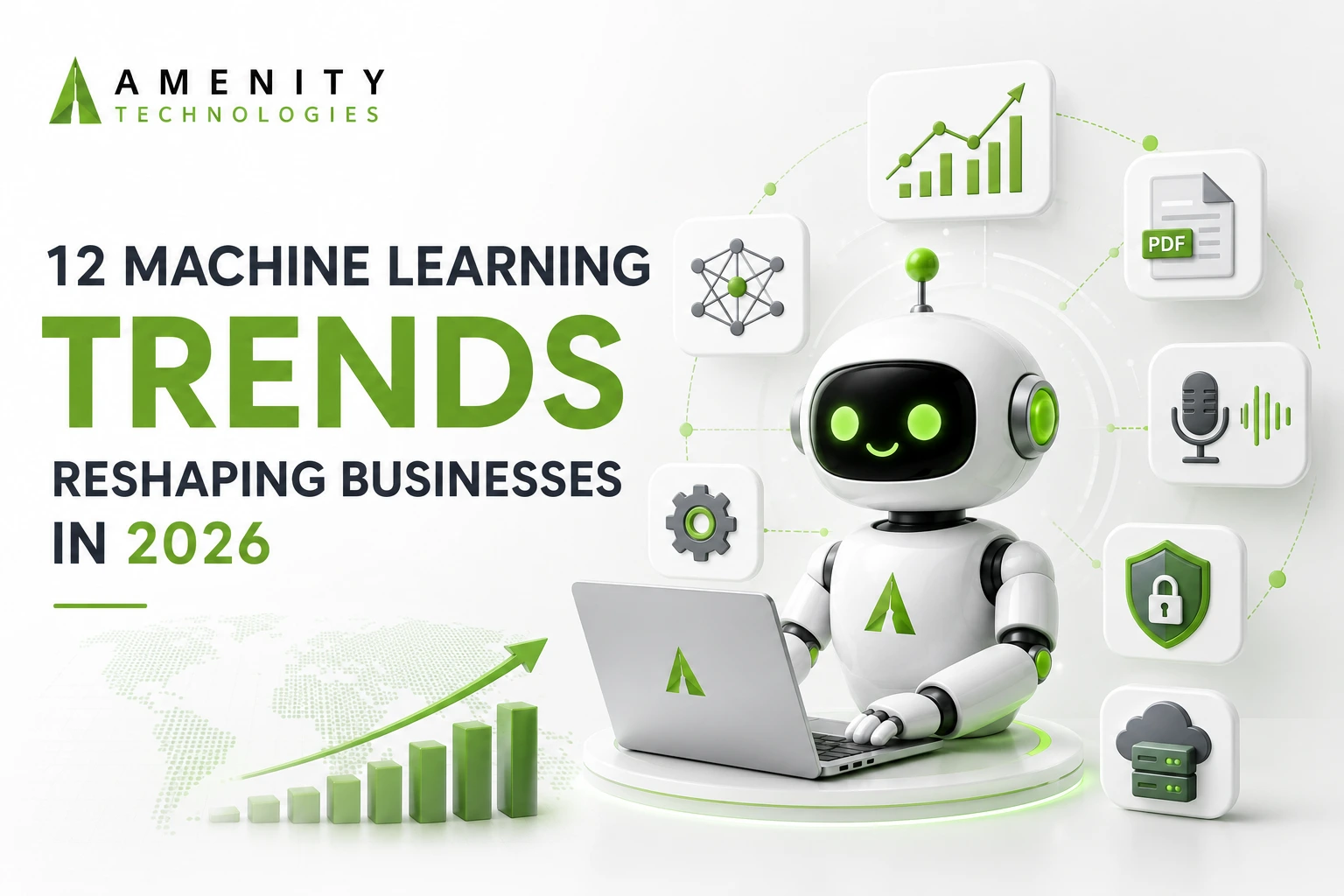



The corporate world is officially done with generative AI hype. Companies have stopped pouring cash into speculative tech experiments and simple wrapper chats. The focus has completely shifted toward building predictable, targeted machine learning setups that actually protect profit margins.
Driving digital transformation with AI now requires looking past marketing buzzwords to understand how software architectures are changing under the hood. Standard, isolated data pipelines are giving way to multi-modal systems, localized edge processing, and autonomous software agents.
For growth-minded organizations, understanding these structural movements is the only way to build software that lasts. Here is a look at the 12 emerging machine learning trends driving actual enterprise value this year.
Machine Learning Trends Reshaping Modern Businesses
1. The Rise of Agentic AI and Autonomous Workflows
Old automation systems were incredibly fragile. They relied entirely on strict, rules-based triggers where if one piece of the chain broke, the whole process failed. Agentic AI drops that playbook entirely by giving machine learning models an internal execution loop, native memory, and direct access to corporate tools.
These modern autonomous agents don’t just answer questions; they complete long corporate projects. Give an agent access to your warehouse databases and it can cross-reference shipping anomalies, track down missing inventory across third-party software, and issue corrected purchase orders on its own.
Shifting to agentic setups is allowing companies to cut down the massive manual hours traditionally wasted on basic administrative backend work.
2. Advanced Multi-Modal Machine Learning Architectures
For years, machine learning development forced businesses to build separate silos for different types of data. You had one model for text mining, a different pipeline for vision systems, and an entirely separate asset for handling voice files.
Modern ML innovation changes that completely with multi-modal architectures. These systems process radically different data streams simultaneously. Imagine a remote industrial monitoring system.
Instead of checking single logs, a unified multi-modal network reads live thermal video feeds, listens to real-time acoustic signatures from the factory floor, and scans error codes all at once to catch catastrophic breakdowns before they happen.
3. Next-Generation Document Parsing via NLP and LLMs
Mountains of enterprise data stay trapped inside messy PDFs, SOPs, and manuals because legacy search tools completely scramble layout context. Modern document parsing uses natural language processing to extract actual meaning rather than just scanning text shapes.
At Amenity Technologies, we built a system exactly like this to streamline employee training. Using Python, OpenAI, Docker, and offline models like Mistral and Falcon 7B, the software turns static files into a conversational asset. Instead of digging through hundreds of pages, teams query internal data in plain English, slashing training costs and making support significantly faster.
4. Decentralized Edge AI and On-Device Processing
Pushing gigabytes of raw business data to a central cloud server creates a lot of operational drag. You run into massive bandwidth bills, high latency, and constant compliance worries. Because of that, enterprise machine learning is moving out of the cloud and directly onto local hardware.
Running small, compressed models right on localized devices means decisions happen in a fraction of a second. It is a critical change for field operations, automated assembly lines, and medical devices where waiting for a round-trip cloud response simply isn’t an option.
5. Convergence of IoT Ecosystems with Smart ML Pipelines
Industrial machines have been generating operational data for years. The problem was never data collection. Most companies simply weren’t using that data fast enough to prevent issues before they escalated. That’s changing now with emerging machine learning trends. Many manufacturing units are connecting sensor data directly with tracking systems to map core machine learning trends 2026 during live operations.
Many manufacturing units are connecting sensor data directly with ML-based monitoring systems that track machine behavior during live operations.
As a result, teams can:
- Identify irregular machine activity earlier,
- Avoid sudden equipment stoppages,
- Reduce maintenance guesswork,
- Manage production schedules more smoothly
For businesses running continuous production environments, that level of monitoring can make a noticeable difference in day-to-day operations.
6. Small Language Models and Domain-Specific Architectures
Trillion-parameter models are incredible for writing creative copy, but they are a massive waste of resources for targeted corporate tasks. They cost a fortune to run, require intense compute power, and add unnecessary latency to simple internal applications.
This efficiency gap has made Small Language Models (SLMs) incredibly popular as macro AI trends shift toward practical applications. Leaner models like Mistral or Falcon 7B, when fine-tuned on a company’s clean internal data, deliver identical accuracy on specific tasks for a tiny fraction of the infrastructure cost.
7. Retrieval-Augmented Generation for Verifiable AI Outputs
Algorithmic hallucinations are the primary reason compliance teams block generative AI deployments. If a model fabricates data, you cannot put it in front of clients. Retrieval-Augmented Generation (RAG) completely fixes this by locking responses to a single source of truth.
The system searches your private vector databases first, forcing the model to construct answers using only verified corporate records. If the data isn’t there, it simply tells the user.
8. Automated Machine Learning and Democratized AI Development
There are simply not enough elite data scientists on the market to build every single piece of software an enterprise needs. Automated Machine Learning (AutoML) solves this scaling issue by letting standard software engineers build and validate models safely.
AutoML tools automate the repetitive, deeply mathematical phases of AI creation, like cleaning dirty datasets and tuning hyper-parameters. This shifts the focus from academic theory to rapid product development, letting internal teams ship production-ready models months ahead of schedule.
9. Hyper-Personalization Engines Transforming B2B and B2C
Most users no longer respond to one-size-fits-all digital experiences. Businesses are increasingly using machine learning systems that adjust content, recommendations, and user journeys based on how people interact with a platform in real time.
These systems study things like:
- Pages users spend time on
- Search behavior
- Browsing patterns
- Product interest during active sessions
Based on that activity, the platform can instantly change what users see next.
For ecommerce brands, this often improves conversions. In B2B platforms, it helps users find relevant products, services, or information faster without navigating through unnecessary pages.
10. Privacy-Preserving Machine Learning and Federated Learning
Data laws are getting tighter everywhere, and moving sensitive customer files into a single master database for AI training is a massive security risk. Federated learning completely bypasses this issue by keeping the data exactly where it was generated.
The master model sends its architecture out to local devices or regional nodes. The local hardware processes its own data locally, changes the model weights, and ships back tiny mathematical updates to the central server. The actual user data never travels, keeping you fully compliant with global privacy laws.
11. Sustainable Green AI and Energy-Efficient Computing
Running massive machine learning setups burns through an incredible amount of electricity. With data center energy costs skyrocketing, green AI has changed from a basic public relations talking point into a strict financial metric for engineering departments.
Dev teams are driving down infrastructure costs by pruning inactive neural connections, reducing bit-precision through quantization, and using massive models to train lightweight “student” networks. This lets you run clean, fast code on cheaper, lower-power hardware setups.
12. Robust Continuous Learning and Dynamic Model Adaptation
Most conventional machine learning models suffer from data drift. An algorithm trained on data from two years ago will struggle to make accurate predictions today because consumer habits and market dynamics change constantly.
The latest systems utilize continuous learning loops that update incrementally as new data rolls in. You no longer have to pull a model offline for a massive, multi-week retraining cycle. The software adapts to changing economic conditions on the fly without breaking live production environments.
Moving Past the Hype
A lot of companies experimenting with machine learning eventually hit the same wall. The models work in demos, but integrating them properly into existing workflows becomes the real challenge.
That’s usually where off-the-shelf implementations start falling apart. Different businesses have different datasets, approval flows, compliance requirements, and operational dependencies. The infrastructure needs to reflect that reality.
At Amenity Technologies, most projects begin by understanding how data actually moves inside the business first, then building systems around those operational requirements instead of forcing generic AI layers into existing processes.
FAQs
Q.1. With machine learning trends changing so fast, how do we know where to invest without wasting budget?
A: One should focus strictly on your largest operational bottlenecks. Begin with a small, targeted proof-of-concept such as automated document parsing to solve one specific problem and prove ROI before scaling your infrastructure.
Q.2. What is the actual difference between the standard automation that’s already in use and “Agentic AI”?
A: Standard automation works on a rigid, fragile script. Agentic AI possesses native decision-making capabilities, allowing software to self-correct errors, use corporate tools, and complete multi-step projects without human intervention.
Q.3. Why shouldn’t we just buy a cheaper, off-the-shelf software package instead of building custom ML models?
A: Off-the-shelf software cannot adapt to your unique proprietary data or specialized workflows. Custom architectures craft a defensive, uncopyable market advantage tailored entirely to your specific operational goals.