
 ALL ARTICLES
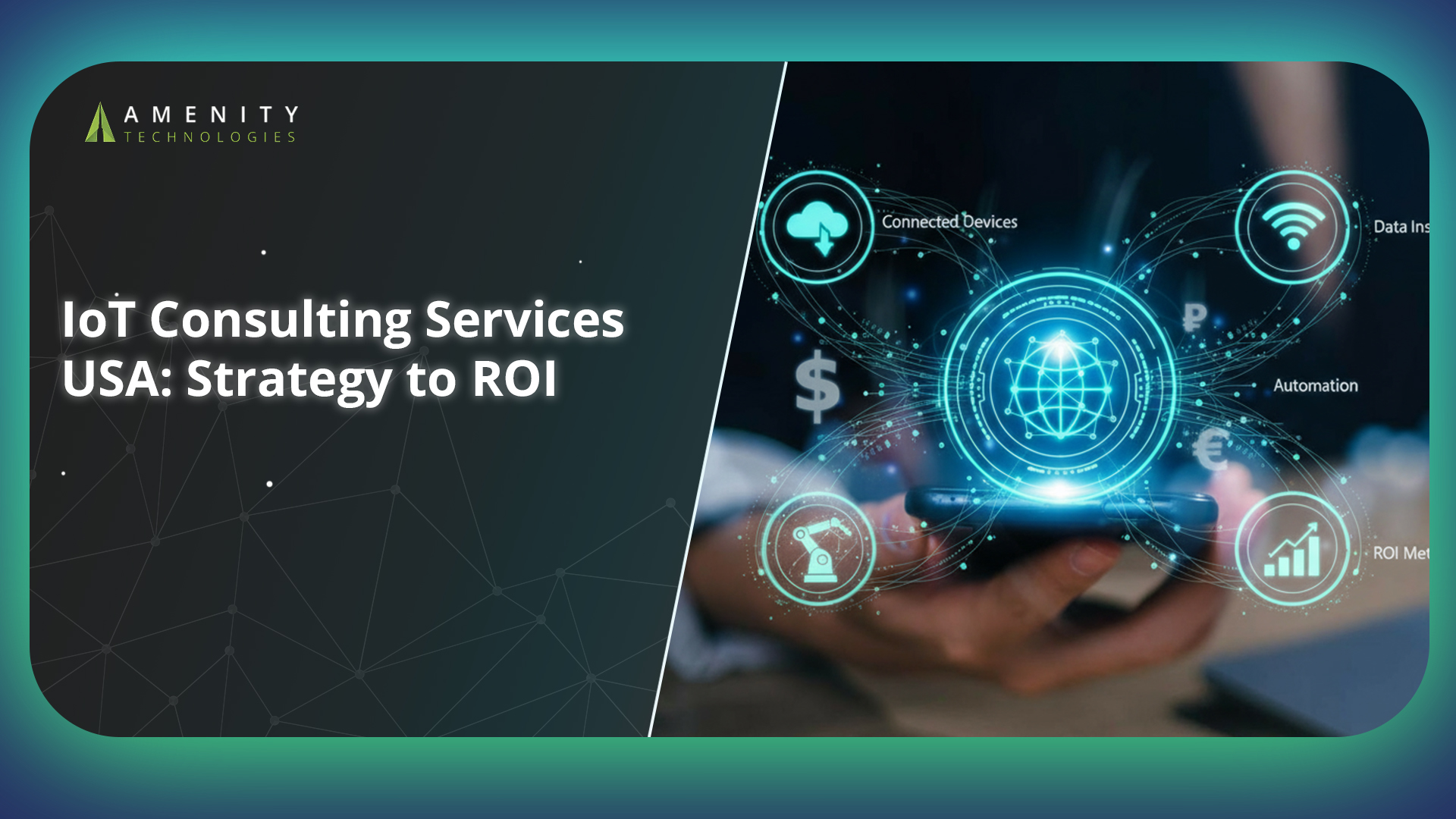



How many businesses truly understand the power of connected intelligence? By 2025, the global IoT market is expected to witness a surge in revenue, reaching a staggering $1.06 trillion, driven by enterprises racing to turn sensor data into smarter decisions. Yet, many still ask the same question: how do you move from connected devices to connected value?
That’s where expert IoT consulting comes in. From defining a clear IoT deployment strategy to building secure IoT architecture, consultants bridge the gap between concept and execution. Whether you’re planning smart device integration, exploring digital twins, or strengthening IoT security, strategic guidance can transform disconnected systems into scalable, connected solutions consulting ecosystems.
With IoT advisory services, you will not just be adopting devices, but unlocking the intelligence of Industry 4.0.
Market Growth and Enterprise Adoption Trends in IoT Consulting
The U.S. IoT consulting market is experiencing one of its strongest growth phases yet. According to recent reports, the market is anticipated to grow at an CAGR of 9.67%, and it will lead to market volume of $1.68 trillion by 2023. Enterprises across manufacturing, healthcare, logistics, and retail are accelerating their investments, recognizing that connected systems drive measurable operational value.
In United States, the IoT market is rapidly expanding as companies and residents are heavily investing in smart home devices and connected cars. If we compare globally, the U.S. generates the highest revenue from IoT, which is $379.91 billion in 2025.
Key Drivers Behind Enterprise Adoption
Before exploring how businesses are applying IoT consulting, it’s essential to understand what’s driving this momentum. Here are the main factors shaping the 2025 market:
1. Shift Toward Predictive and Preventive Operations
Organizations are implementing IoT data analytics and predictive maintenance to reduce downtime and extend equipment life. Consultants play a key role in designing sensor-driven strategies that make real-time monitoring possible.
2. Expansion of Edge and Cloud Integration
With edge computing consulting gaining traction, enterprises now process data closer to the source. This approach minimizes latency, cuts bandwidth costs, and improves responsiveness across connected systems.
3. Security and Compliance Focus
As networks grow more interconnected, IoT security has become a boardroom concern. Expert IoT consulting teams help enterprises design security-first architectures, manage compliance, and protect sensitive data flows.
4. The Push for Industry 4.0 Transformation
Manufacturers are building smarter production lines through IoT platform integration and sensor network consulting. By adopting digital twins, they’re improving product design, maintenance, and performance tracking at scale.
Strategic Value of IoT Consulting for Enterprises
Adopting IoT is not just a technology decision, but a business strategy that reshapes how enterprises operate, optimize, and grow. As organizations face rising data volumes and fragmented device ecosystems, structured IoT advisory services bring direction, clarity, and measurable ROI.
Before implementing large-scale systems, companies seek guidance from experienced Internet of Things consultancy partners who can align business goals with the right architecture, analytics, and integration roadmap.
1. Building a Scalable IoT Architecture
Consultants design frameworks that connect sensors, gateways, and analytics tools under one unified IoT architecture. This structured approach ensures smooth interoperability and simplifies future scaling.
2. Aligning Data with Decision-Making
With connected devices generating massive datasets, IoT data analytics becomes essential. Consultants establish models that turn operational data into actionable insights for smarter production, logistics, and service delivery.
3. Integrating Smart Devices into Business Operations
Smart device integration remains a key challenge for many organizations. Through structured IoT consulting, companies can connect legacy systems with new IoT platforms, improving efficiency without overhauling existing setups.
4. Enabling Secure and Compliant Networks
Security is a recurring priority in connected ecosystems. Consultants implement IoT security layers that ensure data integrity, control device access, and align systems with industry compliance standards.
5. Driving Industry 4.0 Transformation
Through connected solutions consulting and digital twins, manufacturers enhance visibility across production lines, reduce downtime, and increase operational intelligence. The result is a more adaptive and data-informed enterprise model.
How IoT Consulting Streamlines Implementation and Integration?

Executing an IoT project often involves complex interconnections across devices, data pipelines, and enterprise systems. Without structured IoT consulting, many projects face delays or fail to scale beyond pilots. Consultants bridge this gap through a combination of IoT advisory services, proven frameworks, and hands-on implementation expertise.
Enterprises benefit when every technical phase, design, deployment, and optimization, follows a coordinated plan. The following aspects show how consulting accelerates implementation success:
1. Clear IoT Deployment Strategy
A defined IoT deployment strategy ensures that devices, networks, and data flows align with business goals from the start. Consultants help set measurable milestones, allocate budgets, and select technologies suited to the project’s scale and purpose.
2. Seamless IoT Platform Integration
Integrating IoT platforms with existing enterprise systems can be challenging. With expert guidance, companies streamline IoT platform integration, avoiding duplication and ensuring consistent data transfer across applications and devices.
3. Optimized Edge and Cloud Coordination
Modern edge computing consulting enables organizations to balance data processing between local devices and the cloud. This reduces latency, improves response times, and strengthens data control within connected operations.
4. Unified Sensor Network Consulting
Consultants design reliable sensor network consulting frameworks that ensure compatibility and stable communication between devices. This foundational step supports real-time monitoring and analytics across industrial or consumer applications.
5. Continuous Performance Monitoring
Implementation doesn’t end with deployment. Ongoing evaluation through IoT consulting helps teams track uptime, response speed, and data accuracy, ensuring long-term efficiency and ROI.
Key Outcomes Businesses Achieve with IoT Consulting
Working with an expert IoT consulting partner helps enterprises go beyond technical enablement. It turns connected operations into measurable performance gains and financial results. A well-structured consulting engagement brings clarity to operations, enhances agility, and sets a foundation for scalable growth.
1. Stronger Operational Efficiency
Through structured IoT advisory services, companies identify inefficiencies and automate repetitive tasks. Smart connectivity and IoT data analytics deliver continuous insight into asset performance, leading to faster response times and reduced downtime.
2. Reliable Predictive Maintenance
Consultants use predictive maintenance frameworks to monitor equipment health, predict failures, and schedule maintenance only when needed. This minimizes unplanned outages and extends asset life without excess cost.
3. Smarter Decision-Making with Real-Time Data
Integrating smart device integration and connected sensors gives teams live visibility across facilities, vehicles, or supply chains. Continuous IoT data analytics ensures decisions are based on real metrics, not assumptions.
4. Secure and Compliant Connected Ecosystems
A robust IoT security model protects data across devices and networks. Consultants establish encryption, access control, and compliance protocols for regulated sectors like healthcare, energy, and logistics.
5. Scalable IoT Architecture for Future Growth
An optimized IoT architecture allows organizations to scale operations without redesigning systems. Consultants ensure interoperability, efficient resource allocation, and modular design principles that adapt to new technologies.
Strategic Phase: Defining IoT Strategy & Roadmap
A successful IoT consulting engagement begins with a clear strategy. Without a defined roadmap, even advanced solutions risk poor adoption or inconsistent ROI. This phase helps U.S. enterprises translate business objectives into actionable, connected initiatives through structured planning and measurable goals.
1. Business Use-Case Discovery & Prioritization
The foundation of an effective internet of things consultancy lies in identifying the right use cases. Consultants conduct workshops, stakeholder interviews, and value mapping exercises to uncover opportunities where IoT can improve efficiency or reduce costs.
Each potential initiative is ranked by feasibility, investment level, and business impact. This prioritization prevents wasted effort and directs budgets toward projects that can prove value within defined timeframes.
2. Architecture & Platform Strategy
Choosing the right IoT architecture defines scalability and performance for years ahead. Consultants evaluate whether workloads should run on the edge or cloud, assess bandwidth and latency requirements, and design a modular architecture.
They also help organizations select compatible IoT platforms and gateways to ensure seamless connectivity and interoperability. The result is a structure ready for continuous evolution, supporting everything from smart device integration to enterprise-grade analytics.
3. Risk Assessment & Governance Model
Every IoT consulting engagement includes a detailed risk audit. This ensures that IoT security, compliance, and governance measures are built into the design phase, not added as afterthoughts.
Consultants evaluate data ownership, vendor dependencies, encryption standards, and industry-specific regulations such as HIPAA or ISO 27001. A strong governance model keeps sensitive information safe, reduces legal exposure, and enables transparency across internal and external stakeholders.
4. ROI & Business Case Modeling
The IoT advisory services team develops ROI models that link technical outcomes to financial goals. KPIs include cost reduction, asset uptime, and new revenue streams enabled by connected solutions consulting.
Using CapEx and OpEx projections, sensitivity analyses, and payback models, consultants provide a clear view of expected returns before a single device is deployed. This helps organizations justify investments and plan realistic scaling milestones.
Implementation Phase: Building & Deploying IoT Solutions
Once the strategy is finalized, IoT consulting shifts to execution. This is where architecture, data flow, and device networks become operational. Consultants guide teams through pilot validation, integration, and rollout to ensure technical reliability and measurable outcomes.
1. Proof of Concept (PoC) / Pilot Execution
Consultants begin with a limited-scale PoC to validate assumptions and confirm technical feasibility. The goal is to test connectivity, data accuracy, and system performance before wider deployment.
Short feedback cycles allow continuous improvement, ensuring the solution works in real-world conditions before scaling further.
2. Device & Sensor Integration
Effective smart device integration forms the foundation of any connected ecosystem. Consultants oversee hardware selection, firmware development, and sensor calibration to ensure precise data capture.
Protocols such as BLE, LoRa, Zigbee, and NB-IoT are chosen based on range, bandwidth, and energy requirements. OTA (over-the-air) updates are also implemented to simplify long-term maintenance.
3. Connectivity & Network Layer
This phase determines how devices communicate. Consultants design resilient connectivity architectures that combine edge computing consulting with cellular, Wi-Fi, or LPWAN networks.
Fallback modes guarantee uninterrupted operation during outages, while edge processing reduces latency and bandwidth costs. The goal is efficient, secure communication between sensors, gateways, and platforms.
4. Data Platform & Analytics Deployment
The IoT consulting team builds data ingestion pipelines for streaming, batch, and event-driven workloads. ETL processes ensure data is clean and structured before analysis.
Analytics and machine learning models detect anomalies, enable predictive maintenance, and turn raw metrics into actionable insights. Dashboards display KPIs in real time, helping businesses monitor performance across devices and locations.
5. System Integration & APIs
IoT solutions rarely operate in isolation. Consultants integrate systems with ERP, CRM, SCM, and MES environments to unify business operations.
APIs and middleware connect various software components, ensuring seamless interoperability. This allows executives to view IoT metrics alongside core business data for informed decision-making.
6. Quality Assurance, Testing & Validation
Before full deployment, consultants run performance, security, and failover tests. Field validation ensures stable connectivity, accurate readings, and resilience under stress.
Comprehensive QA minimizes downtime risks and confirms that the system performs as modeled in the PoC phase.
Optimization & ROI Realization Post-Deployment
Deployment marks only the beginning. After systems go live, IoT consulting focuses on optimization, keeping performance consistent, reducing costs, and ensuring measurable returns. Consultants continuously refine data models, monitor infrastructure, and align the solution with changing business priorities.
1. Monitoring, Maintenance & Model Drift Handling
Ongoing monitoring ensures IoT systems remain accurate and secure. Consultants set up telemetry dashboards and alerts to detect anomalies or sensor malfunctions early.
For AI-based analytics models, drift detection and retraining cycles maintain prediction accuracy. Controlled versioning and A/B testing help compare models and improve performance over time.
2. Scaling & Phased Rollouts
After a successful pilot, scaling requires a structured rollout plan. Consultants expand deployments by geography, business unit, or device category to maintain quality.
A modular approach allows organizations to add new features, devices, or data layers without disrupting operations. This ensures sustainable scaling with minimal downtime.
3. Cost Optimization & Infrastructure Efficiency
Through IoT advisory services, businesses learn how to reduce infrastructure costs while maintaining uptime. Consultants analyze edge vs cloud workloads to find the best balance for latency, bandwidth, and cost.
Techniques like serverless deployment, resource pooling, and automated load balancing drive higher efficiency.
4. Business Impact Tracking & Feedback Loop
True ROI comes from consistent measurement. Consultants help define and monitor metrics such as energy savings, fault reduction, and asset uptime.
Feedback loops connect operational outcomes with financial data, allowing executives to track progress and justify ongoing investment in IoT initiatives.
Key Metrics & ROI Benchmarks for IoT Projects

Every organization investing in IoT consulting wants tangible proof of performance. ROI benchmarks help evaluate progress, measure outcomes, and identify improvement opportunities. Consultants define metrics that align both operational and financial perspectives, ensuring stakeholders see clear value.
Typical ROI Timelines & Payback Periods
Most IoT projects target measurable ROI within 12 to 24 months. Predictive maintenance, smart energy management, and supply chain visibility often show the quickest paybacks.
Consultants use detailed baseline assessments to track early performance improvements and refine deployments for faster returns.
Hidden Costs & Risks to Monitor
Even well-planned initiatives can face unexpected costs. Common risk areas include sensor calibration, device replacement, network failures, or rising connectivity charges.
Cybersecurity incidents and IoT security breaches can also impact ROI if preventive controls are weak. Ongoing Internet of Things consultancy ensures that organizations anticipate these issues early and minimize impact.
Leading Metrics to Track
Consultants help define and monitor the most relevant indicators for success.
- Operational metrics: Asset uptime, mean time between failures (MTBF), and production throughput
- Cost metrics: Energy savings, maintenance costs, and cost per insight
- Performance metrics: Latency, fault reduction, and data accuracy
These metrics provide a complete picture of how well an IoT system performs against expectations and how much value it delivers over time.
How Amenity Technologies Helps Enterprises with IoT Consulting Services?
Enterprises across the U.S. face constant pressure to deliver connected solutions that scale efficiently and generate measurable outcomes. Amenity Technologies provides end-to-end IoT consulting designed to bridge the gap between strategy and performance. Our approach ensures every stage, from design to deployment, drives operational and financial results.
1. Strategic Discovery & Planning
We start by identifying high-value IoT opportunities aligned with business goals. Our workshops and stakeholder interviews help define the right mix of technology, process, and data strategy.
Through structured IoT advisory services, we design practical roadmaps that outline clear milestones, measurable KPIs, and cost projections for each phase.
2. Architecture Design & Technology Selection
Amenity’s consultants architect scalable and secure IoT platforms for enterprise-grade reliability. We design modular systems that balance edge computing consulting and cloud workloads for optimal performance.
This includes defining IoT architecture, network layers, and data flow frameworks that support long-term expansion across sites and business units.
3. Seamless Integration & Implementation
Our engineering teams handle full smart device integration, covering sensor calibration, connectivity setup, and firmware configuration.
We also manage IoT platform integration with ERP, CRM, and analytics systems, ensuring consistent data exchange and operational visibility across the enterprise.
4. Security & Compliance by Design
Amenity integrates IoT security principles from day one. We apply encryption, role-based access control, and secure firmware updates to safeguard device-to-cloud communication.
For regulated sectors, our consultants ensure compliance with U.S. industry standards, creating a secure foundation for ongoing operations.
5. Continuous Optimization & ROI Tracking
Once live, our Internet of Things consultancy focuses on sustainability and value realization. We monitor data pipelines, optimize resource usage, and measure key performance metrics against baseline values.
Dashboards provide executives with real-time insights on uptime, efficiency, and ROI, ensuring every deployment continues to deliver measurable gains.
Conclusion
Success in IoT depends on more than technology. It requires structured execution, measurable goals, and continuous optimization. A reliable IoT consulting partner ensures each step, from planning and architecture to integration and scaling, translates into real business value.
With Internet of Things consultancy expertise from Amenity Technologies, enterprises can design secure, data-driven systems that improve asset utilization and deliver visible ROI. From early strategy sessions to ongoing performance monitoring, our approach helps U.S. organizations transform IoT investments into sustainable, growth-oriented outcomes.
FAQs
Q1: What types of businesses benefit most from IoT consulting?
Manufacturing, logistics, energy, healthcare, and smart building operators benefit the most, as these sectors rely heavily on connected assets and automated monitoring.
Q2: How long does a typical U.S. IoT consulting engagement last?
Engagements typically last between 6 and 18 months, including strategy, pilot testing, deployment, and post-launch optimization.
Q3: How is ROI measured for IoT projects?
ROI is measured through downtime reduction, maintenance savings, energy optimization, process throughput improvements, and new data-driven revenue streams.
Q4: What are the biggest risks in IoT projects?
Security breaches, network instability, data overload, device malfunction, and underestimated maintenance costs pose the greatest risks.
Q5: Do you need both edge and cloud computing?
Yes. Edge computing reduces latency and improves responsiveness, while cloud infrastructure handles analytics, storage, and centralized control.
Q6: How should I choose an IoT consulting partner in the USA?
Choose a partner with proven domain experience, deployment success stories, strong compliance awareness, and expertise in IoT architecture and analytics integration.