




Lack of documentation is not a concern for most large organizations. They struggle due to fragmented data.
The company in this case is a U.S.-based managed IT and cloud services provider with an enterprise workforce of 5,000+ employees. Their teams support enterprise-level clients in infrastructure management, cybersecurity, DevOps, and cloud migration. Internally, they are distributed across multiple regions and time zones.
By early 2025, something subtle but expensive was happening. Internal teams were spending too much time answering questions that should never have required human intervention.
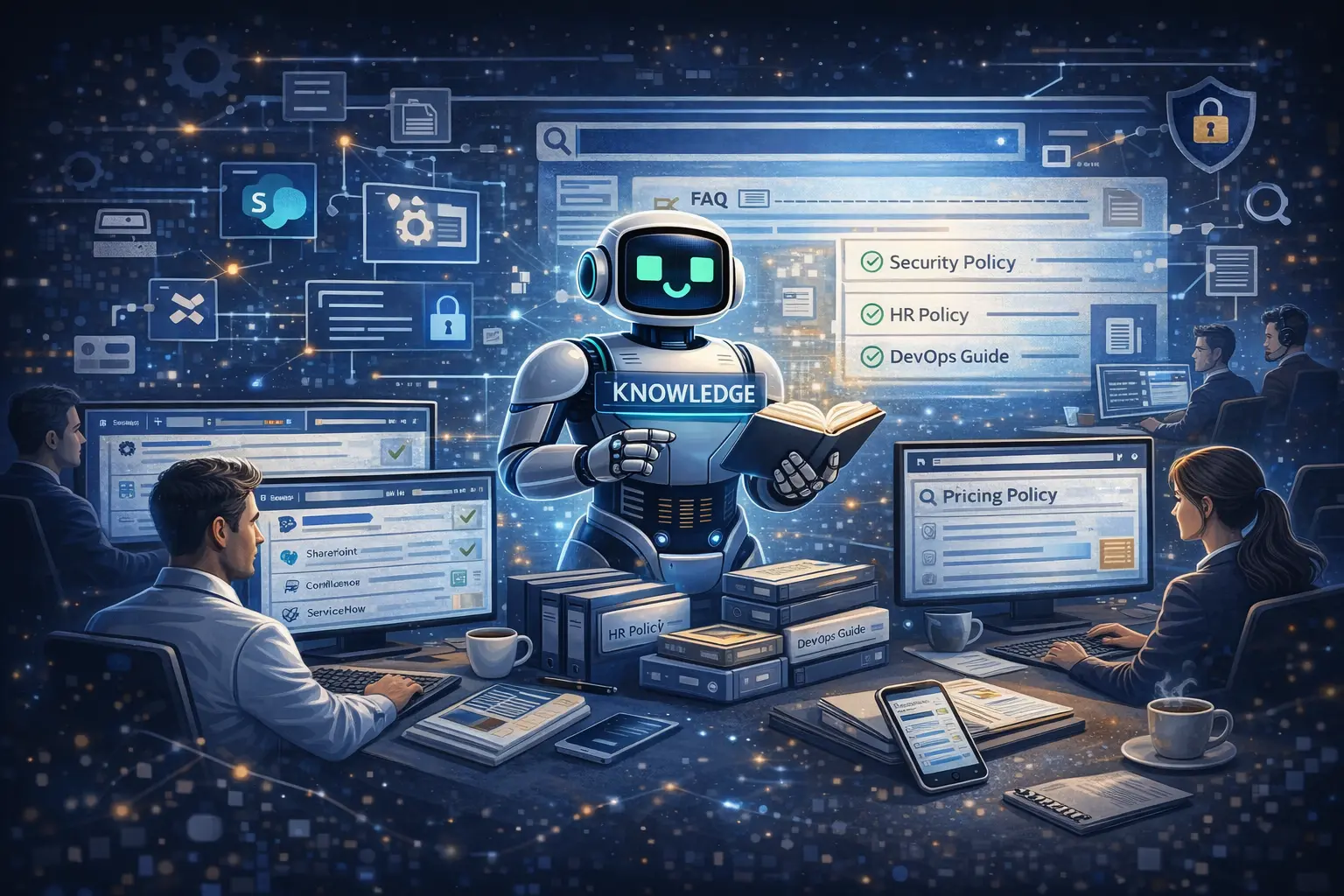
The organization had grown quickly. Documentation had grown even faster. Over 2.8 million files were spread across SharePoint libraries, Confluence spaces, ServiceNow knowledge articles, and archived compliance folders. Policies were updated quarterly. Runbooks changed often. Security guidelines evolved continuously.
Information existed. But finding the right version was time-consuming. This slowdown was actually costing real money.
Amenity Technologies was brought in to address the issue before it became a structural inefficiency.
The Unpleasant Situation: Operational Latency at Scale
The firm’s internal metrics told the story clearly. Their IT helpdesk handled roughly 3,400 tickets each month. After review, leadership discovered that 40% of help desk volume were not system failures. They were clarification requests.
HR teams were handling more than 1,000 emails monthly. The majority of them were about travel policies, reimbursement limits, leave eligibility, and onboarding processes.
Employees admitted something simple yet important during interviews. When they could not find an answer in under 10 minutes, they usually opened a ticket.
Legacy keyword-search tools yielded high noise-to-signal ratios. Searching for “remote expense policy” often returned outdated versions or loosely related documents. In compliance-heavy departments, retrieving the wrong version created risk.
In short, the support teams were working harder, not smarter.
The Core Problem: Growth Outpaced Organization
The situation in front of them was not because of a technology shortage. It was actually a Vector Embeddings and retrieval latency issue.
Different departments managed documentation differently. Naming conventions varied. Archived files were never fully retired. Keyword search operated without context awareness.
An employee in cybersecurity might search for “incident escalation process” and receive three versions from different years. No one trusted search results completely.
Leadership understood that the next step had to go beyond another portal redesign. They needed a retrieval layer that could interpret natural language, locate the correct content, and respect internal permissions. And it had to stay inside their private infrastructure.
The Solution: An Internal AI Knowledge Bot Built for Security and Accuracy
Amenity Technologies designed an AI knowledge bot that connected directly to verified internal repositories. The deployment ran entirely within Azure Virtual Private Cloud. No document data left the company’s controlled environment.
Instead of indexing everything, we worked with department leads to identify authoritative sources. From 2.8 million files, approximately 600,000 were confirmed as current and approved. Those files were prepared for semantic indexing.
We used Azure OpenAI large language models only after retrieval logic was proven reliable. The model’s responsibility was summarization, not policy interpretation.
Pinecone served as the vector database, storing over 14 million contextual content segments. Hybrid search combined semantic similarity with keyword reinforcement to mitigate false positives in retrieval.
Active Directory integration ensured that an HR associate could not retrieve compliance documents restricted to governance teams. The knowledge bot did not ‘hallucinate’; it retrieved.
How We Designed the AI Knowledge Bot
The process unfolded in stages. First came cleanup. Duplicate policies were removed. Archived content was separated. Department heads reviewed ownership of high-impact documents.
Next came contextual chunking. Instead of splitting documents at fixed lengths, content was segmented based on logical structure. Policy clauses stayed intact and procedural steps remained grouped.
Then we tested retrieval before activating any generative responses. Initial accuracy during internal testing was 81 percent. That was insufficient for production standards. Over four weeks, ranking logic and chunk structuring were refined until accuracy consistently exceeded 90 percent for high-frequency queries.
Only then was the summarization layer introduced. Performance testing followed. Simulated usage reached 4,000 concurrent employees across peak hours. Average retrieval time stabilized around 650 milliseconds. Under heavy load, it remained below one second.
Why Expanding the Support Team Was Not the Answer
Before committing to an AI knowledge bot, leadership briefly explored a simpler option. Hire more support staff. On paper, that looked easier than rebuilding retrieval architecture.
But the Total Cost of Ownership (TCO) did not justify headcount expansion.
Adding more agents would have increased operational cost without fixing the source of the problem. Employees would still search manually. Outdated documents would still circulate. The volume of tickets would still go up whenever documentation was unclear.
Without changing retrieval logic, the company would have continued facing:
- Higher annual staffing expenses with limited efficiency gain
- Ongoing confusion around policy updates
- Increased compliance exposure due to version mismatches
- Longer onboarding cycles for new hires
- Slower internal response times during peak workload periods
The issue was structural, not capacity-related. Scaling headcount would have masked the problem temporarily. It would not have solved it completely.
Deployment Across 5,000 Employees
IT and HR were chosen first since they usually were dealing with the most repetitive queries.
Within the first month of deployment:
– IT reported a 25 percent drop in clarification-based tickets.
– HR saw a 21 percent reduction in policy-related inquiries.
Employees began relying on the AI knowledge bot before opening tickets. After the company-wide release, usage increased steadily.
Then, within three months of deployment, they saw:
– 38 percent reduction in repetitive IT tickets.
– 29 percent reduction in HR documentation requests.
– Average knowledge query resolution time fell from over 9 hours to under 3 minutes.
Support staff reported fewer interruptions. Employees reported greater confidence in retrieving correct policy versions.
The shift wasn’t sudden but was clear and steady.
Results: Measurable Operational Change
Financial modeling estimated annual savings of approximately $1.2 million in support workload redistribution. The most important thing was the significant decrease in internal friction.
Engineers spent more time on infrastructure improvements. Compliance teams fielded fewer repetitive requests. New hires accessed onboarding documentation independently.
The knowledge bot became embedded in daily operations rather than sitting as a novelty tool.
Long-Term Impact
Six months later, additional document categories were indexed. DevOps runbooks, vendor contracts, and training materials were added to the retrieval framework.
The system now manages over 18 million contextual segments while maintaining consistent performance benchmarks. Adoption rates steadily increased across departments, and internal search dependency on legacy systems declined significantly. The organization started viewing retrieval infrastructure as foundational, not optional.
What began as a ticket-reduction initiative became an enterprise knowledge modernization effort.
Build an Enterprise AI Knowledge Bot with Amenity Technologies
If your organization is scaling quickly and internal support teams are absorbing avoidable workload, the issue may not be staffing. It may be a retrieval structure.
Amenity Technologies designs secure AI knowledge systems that integrate directly with your internal infrastructure and support thousands of employees without compromising control.
Connect with our team today to explore how we build AI knowledge bots that use structured retrieval to transform internal efficiency.