




For growing businesses, customer support isn’t a part of daily operations that becomes challenging overnight. The situation gradually entangles when call volumes increase and customer expectations rise. What once felt manageable gradually evolves into daily operational strain.
The same situation was faced by a mid-sized home services company operating across three states, handling 1,200–1,500 inbound calls per day.
With over 85,000 active customers and a 22-agent call center team, the company relied heavily on phone-based support for appointment confirmations, service updates, and general inquiries.
As customer demand increased, response times slowed and operational strain became visible during peak hours.
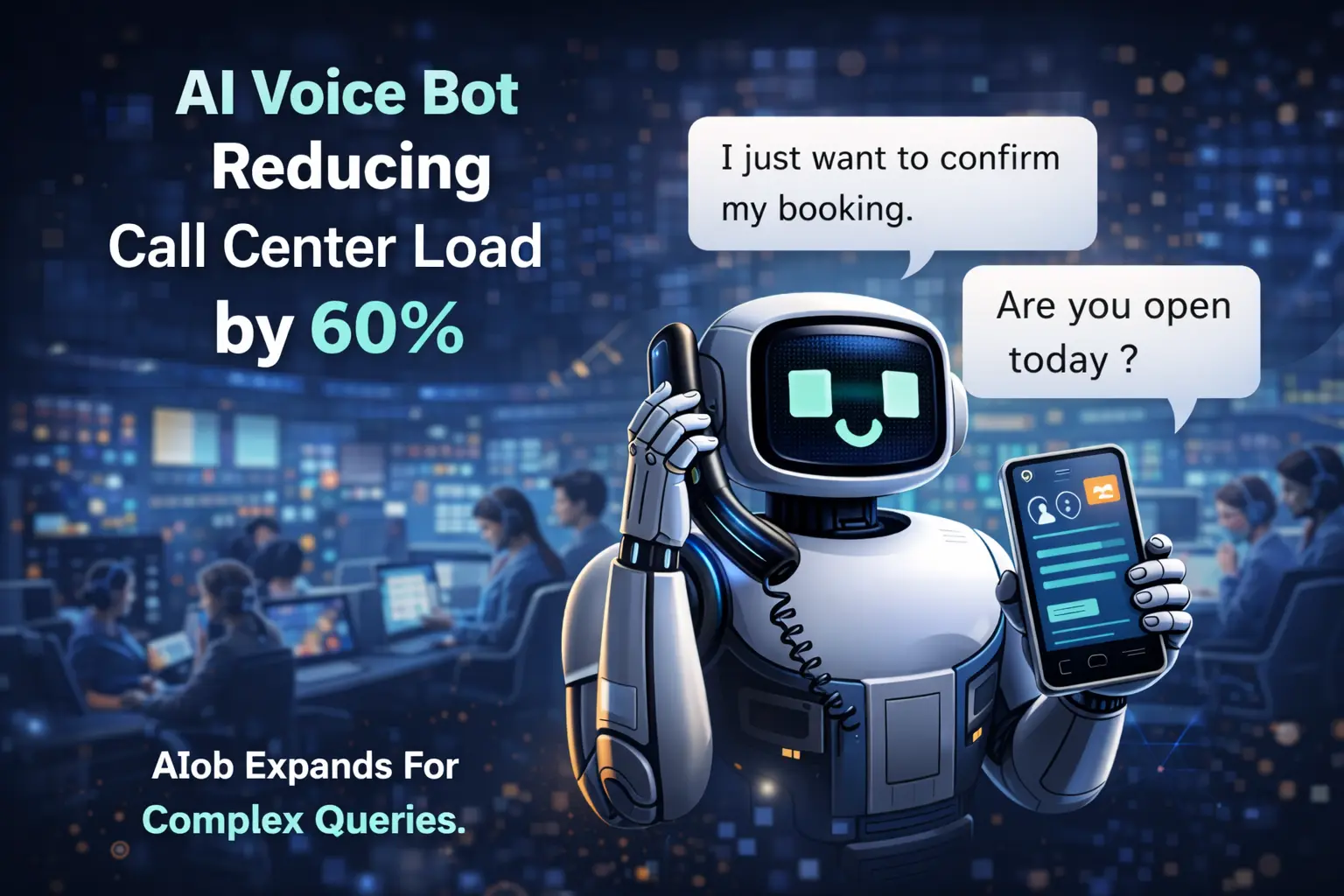
In this case study, we’ve explained how that home service company leveraged AI voice bot developed by Amenity Technologies and reduced call center load by 60%. They succeeded in delivering a noticeably better experience for both customers and agents.
The Unpleasant Situation: Where the Business Faced Support Bottlenecks
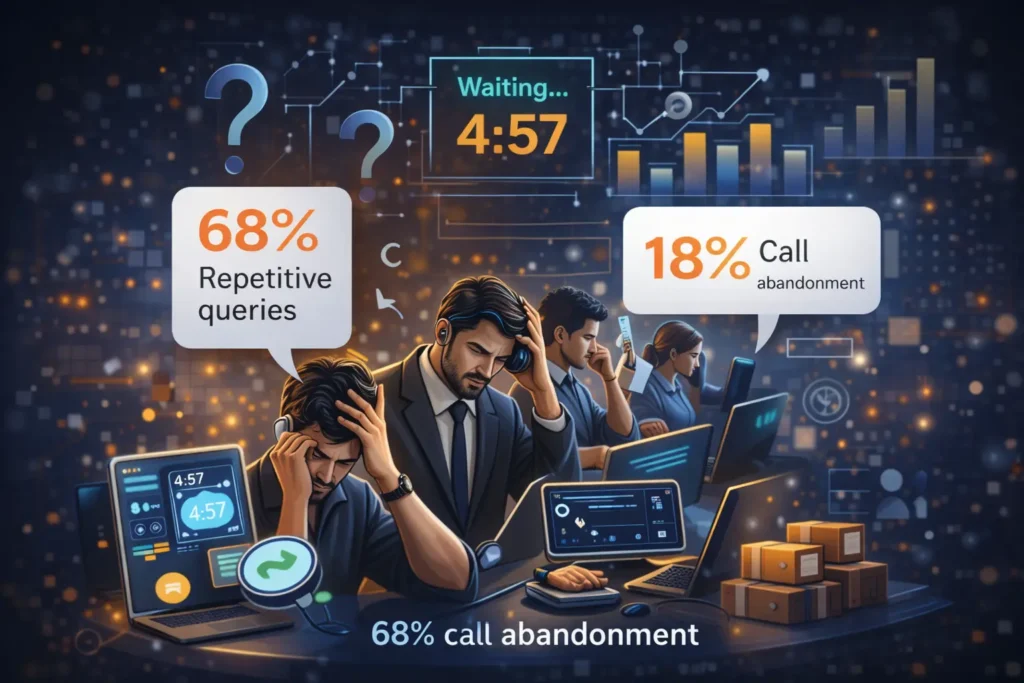
Over 68% of inbound calls were repetitive, low-complexity queries.
During peak hours (10 AM–2 PM), average wait times exceeded 4.5 minutes.
Call abandonment rates reached 18%.
The team was overwhelmed. Not because of the challenges, but because their effort felt inefficient. Skilled agents were stuck answering questions that didn’t actually need human involvement.
The Core Problem: Call Friction at the First Point of Contact
The bottlenecks became visible when the business looked closely at call data. One thing stood out pretty clearly.
Most calls followed predictable patterns.
– “Can you check my status?”
– “I just want to confirm my booking.”
– “Are you open today?”
– “I tried earlier and didn’t get through.”
None of these required troubleshooting or critical decision-making. They are just repetitive calls. However, every call still went into the same queue, making it challenging for the call center teams to treat them differently. That meant longer waits for everyone, including those customers with more complex issues.
Adding more agents was discussed. So was expanding IVR menus. Neither was a viable long-term solution. IVRs were already annoying customers, and hiring would only push costs higher.
What they needed was faster resolution at the very start of the call.
Why Traditional Fixes Failed
The company explored three options:
Hiring more agents
Increased payroll costs by 28% without solving peak congestion.
Expanding IVR menus
Led to longer navigation paths and higher caller frustration.
Outsourcing overflow calls
Created inconsistent service quality and higher per-call costs.
However, none of these addressed the root issue, which was not a staffing shortage or call routing limitation, but the inability to intelligently understand and resolve customer intent in real time.
The Solution: AI Voice Bot Support for Incoming Calls
Instead of changing the entire support setup, the business introduced an AI voice bot as the first layer of call handling.
The goal was simple. Let the bot deal with routine calls immediately, and let human agents focus on conversations that actually needed them.
The voice bot answered incoming calls, understood what the caller was trying to do, and responded in plain, clear language. If the request went beyond that, the call was transferred to an agent with the context already available. It didn’t try to sound clever or better than human agents. It just tried to be useful for better communication.
How We Developed the AI Voice Bot
Voice automation struggles to live up to the expectations if it feels robotic or confusing. That was a major concern early on.
The model was trained using 9 months of anonymized call transcripts (over 42,000 conversations).
We structured the system around:
- 18 high-frequency call intents
- Confidence scoring thresholds for escalation
- CRM integration for real-time data access
- English and Spanish language support
If confidence dropped below 82%, the call was automatically transferred with full transcript visibility for the agent.
Deployment & Rollout Strategy
Instead of encouraging them to shift to automation overnight, we helped them deploy the voice bot in phased stages. During the first two weeks, it handled only appointment confirmations and business hour queries while performance metrics were closely monitored.
After validating accuracy levels above 90% and maintaining smooth escalation handling, additional intents were gradually activated. This controlled rollout minimized operational risk and allowed the support team to adapt without disruption.
A real-time monitoring dashboard was implemented to track:
- Bot containment rate
- Escalation triggers
- Average handling duration
- Caller sentiment trends
This data-driven deployment approach ensured that automation enhanced support operations rather than complicating them.
Operational Capabilities That Reduced Call Volume
We design AI voice bots using a practical, use-case-driven approach focused on handling high call volumes efficiently while maintaining clarity, accuracy, and control. The key features you can expect are:
First-Line Resolution for Predictable Queries
Handled 72% of total inbound calls without agent intervention.
Real-Time CRM Data Access
Delivered accurate appointments and status updates instantly.
Intelligent Escalation Logic
Transferred only low-confidence or complex calls with full context.
24/7 Automated Call Handling
Reduced after-hours backlog by 46%.
Results Within 90 Days of AI Voice Bot Deployment
- 60% reduction in agent-handled calls
- Average call waiting time reduced from 4.5 minutes to 1.2 minutes
- Call abandonment dropped from 18% to 6%
- 72% of inbound calls fully resolved by the voice bot
- Agent productivity increased by 35%
- Customer satisfaction improved by 22%
Impact Beyond Call Metrics
This significant transformation in customer communication affected more than call volume.
Agent utilization shifted toward higher-value conversations, reducing burnout and improving resolution quality.
Management gained structured insight into call trends through analytics dashboards, improving forecasting and staffing decisions.
Most importantly, the system could scale. As demand increased, the support team didn’t immediately feel the pressure the way they used to.
Build Smart AI Voice Bots With Our Expert Development Team
If your call center feels busy but inefficient, voice automation can make a real difference when done carefully. To put it simply, if you find this case study relevant, your call center support teams may be facing the same challenges including high call volumes of predictable inbound calls and long wait times.
Amenity Technologies helps businesses implement AI voice bots that reduce repetitive workload without breaking the customer experience.
If you’re exploring ways to take pressure off your support team, this approach is worth a closer look. Contact us for inquiries related to our AI voice bots or to book our services.