
Voice Bot Development: How a Voice Bot Is Built
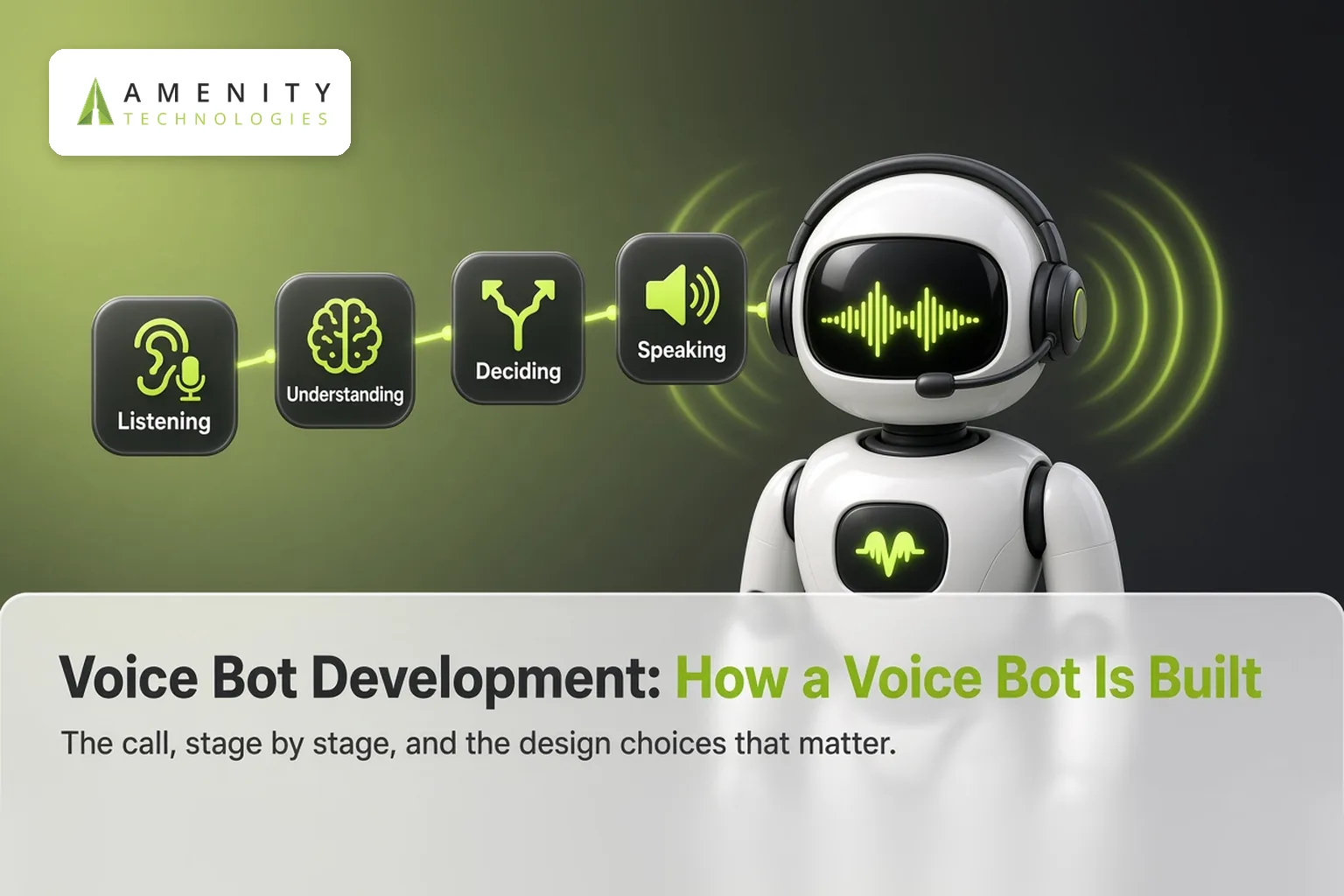
A caller says, "I need to move my appointment to Thursday." Before the sentence has settled in the air, a voice bot has to decide that the caller has finished speaking, convert the sound into text, work out what was meant, check a calendar, choose a reply, and say it aloud in a natural voice. Voice bot development is the craft of making that sequence quick, accurate, and graceful when something goes wrong.
Here is the call, stage by stage, followed by the design choices that decide how the result feels.
Stage One: Listening
The first component is speech-to-text, which turns the caller's audio into written words. Audio from a phone line is generally lower in quality than sound captured by a good microphone, and callers speak from cars, kitchens and busy streets. The recogniser has to cope with all of it. During testing, keep the transcripts alongside the audio, so that errors can be traced to the stage that caused them.
Three details matter. The first is end-pointing, meaning how the system decides that a person has stopped talking. Cut in too early, and the bot interrupts mid-sentence. Wait too long, and the silence feels broken. The second is vocabulary. Names, product terms, street names, and reference numbers are difficult for general-purpose recognisers, and many systems allow a custom word list to improve accuracy. The third is confidence. Good recognisers report how sure they are of each word, and the rest of the system should use that information instead of treating every transcript as certain.
Stage Two: Understanding
Text alone is not meaningful. The next component works out what the caller wants, which usually involves two elements: the intent, such as moving an appointment, and the details, such as Thursday. It also tracks context across turns. If the caller then says "actually, make it Friday," the system must know that "it" refers to the appointment.
Older designs matched sentences to a fixed list of intents. Newer ones often use large language models, which cope better with unusual wording and corrections. The trade-off is control. A fixed list is predictable and easy to test, while a language model is flexible but needs boundaries to keep it within the task. Many production systems combine the two, using flexible understanding inside a framework of defined steps.
Stage Three: Deciding
Once the intent is clear, the bot needs logic to decide what happens next. It may need to fetch information from another system, such as free slots in a calendar. It may need to ask a clarifying question, confirm a change before making it, or pass the call to a person.
This logic is also where limits are enforced. It defines what the bot may do on its own authority and what requires a human. A sensible design treats changes to records with more care than answers to questions, and asks the caller to confirm before anything is altered. Keep the logic readable by the people who own the service. If a supervisor cannot see how the bot decides, they cannot judge whether it decides correctly.
Stage Four: Speaking
Text-to-speech turns the chosen reply back into sound. Choose the voice deliberately, since it shapes how callers perceive the service. Pace matters, and so does pronunciation. Names, dates, amounts, and codes are easy to get wrong, and most speech systems offer markup that controls pauses and how a word is said.
Write replies for the ear. Short sentences work better than long ones, because a caller cannot scan back over what was said. Where possible, the system should begin speaking as soon as the first part of the reply is ready, instead of waiting for the full text, which shortens the silence.
Voice and Character
A voice bot has a personality whether you design one or not. Choose a tone that fits your service, keep it consistent, and write the dialogue to match. Callers should know they are speaking with an automated system, and many people respond better to a bot that is plainly helpful than to one that tries to pass as human. Decide also how formal it should be, how it greets callers and how it ends a call, because those moments are heard by every caller.
Design Choices That Shape the Call
Several decisions cut across the stages.
Separate Stages or a Combined System
The description above treats each stage as separate, which gives you places to inspect, test and tune. Some newer systems handle speech more directly, which can feel smoother but offers less visibility into what happened. Either route can work, and providers of voice bot development services differ on which they favour, so ask which approach is proposed for your calls and how it will be tested against real recordings.
Interruptions
Callers talk over bots. Decide whether the bot should stop speaking the moment it hears the caller, and how it distinguishes a real interruption from a cough or background noise. Poor handling here makes a bot feel stubborn.
Delay
Each stage adds a little time, and a lookup in a slow database can make the whole call feel broken. Count the delay across the full chain, and decide how the bot behaves during longer waits, perhaps with a short spoken acknowledgement.
Failure Paths
Plan for the moments when something goes wrong. If the bot did not understand, it can rephrase once. After a second failure, it should offer another route, such as a transfer to a person with the conversation so far. Critical details like dates, amounts, and numbers deserve a read-back for confirmation. For long numbers, a keypad entry option may be more reliable than speech.
Sensitive Details
Spoken conversations can contain information that should be handled with care: account numbers, dates of birth, payment details. Decide which details the bot should never ask for aloud, and whether another channel suits those steps better. Check what each stage stores, including recordings and transcripts, and whether any stage passes audio or text to an outside service. Mask or avoid capturing what you do not need, and keep the list of what is stored short.
Testing and Tuning
A voice bot is never tested properly in a quiet office. Use recordings of real calls, with varied accents, noise levels, and phrasing. Track where recognition fails, which intents are confused, where callers hang up, and which calls reach a person. Review actual calls regularly, and feed what you learn back into the vocabulary, the dialogue and the voice settings. Keep a library of difficult calls and replay it after every change, so that an improvement in one area is not quietly damaging another.
Every provider will describe its own tools and methods, but the stages above are common to most designs. Ask for a walk-through of each one for your use case.
To discuss a voice project, start a conversation with Amenity Technologies.
FAQs
What are the main parts of a voice bot?
Speech-to-text to hear the caller, language understanding to interpret the request, decision logic to choose the action, and text-to-speech to reply. Telephony connects the bot to the phone network.
Is a language model required?
No. Some designs use fixed intents and scripted flows. Language models add flexibility with varied wording, but they need clear boundaries.
What happens when the bot cannot help?
A good design offers a rephrase once, then a route to a person, ideally with the conversation so far passed along.