

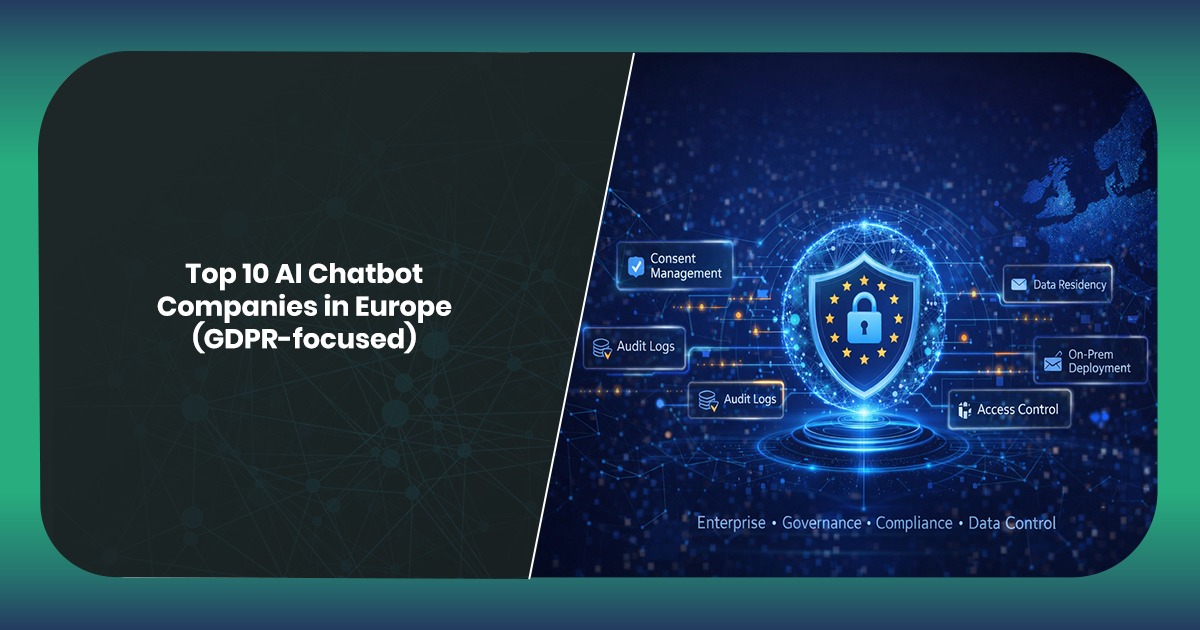



GDPR-compliant AI chatbots have become an integral part of everyday business operations across Europe, especially for enterprises operating in regulated environments. These automated tools smoothly handle repetitive customer queries, support internal staff, qualify high-intent leads, and surface knowledge at scale. However, apart from all of these, there’s an extra responsibility that Europe-based businesses can’t ignore, and that is GDPR compliance.
European enterprises evaluating AI chatbot providers must balance automation benefits with strict GDPR requirements around data residency, consent, auditability, and long-term governance.
In this guide, we have listed, carefully chosen top 10 AI chatbot companies in Europe that are trusted for enterprise, internal, and customer-facing conversational AI deployments.
List of the Top 10 AI Chatbot Companies in Europe
1. Amenity Technologies
Amenity Technologies is often trusted by Europe-based enterprises that seek AI chatbots to feel less experimental and more operational.
The development team focuses on building practical, GDPR-aware chatbot solutions. It is always ensured that the chatbot integrates smoothly into existing workflows instead of isolated silos that lack operational context.
Amenity Technologies focuses on controlled AI chatbot development, with emphasis on governance, deployment flexibility, and GDPR-aligned architecture.
Common Use Cases / Strengths
- GDPR-compliant customer support tools
- Internal knowledge and RAG chatbots
- Secure lead qualification and automation
- On-prem, private cloud, or hybrid deployments
Amenity Technologies can usually be a good fit for your firm if you are aiming to implement controlled AI chatbot systems that help reduce workload without introducing regulatory liability.
Best Suited for:
– European enterprises looking for GDPR-first, custom AI chatbots with flexible deployment and strong access control.
2. Boost.ai
Boost.ai is one of the most reputed service providers across Europe that delivers enterprise-grade conversational AI agents. Enterprises that prioritize industry-tailored chatbots can benefit by partnering with Boost.ai.
They have experience in developing intelligent AI assistants keeping regulated industries in mind and their solutions are already used in banking, insurance, and public services.
Boost.ai stands out with its AI solutions in regulated European industries where predictability, explainability, and governance matter more than creative AI behavior.
Common Use Cases / Strengths
- Customer service automation
- Financial and insurance conversational AI agents
- Public sector conversational systems
- Strong GDPR and data governance tooling
Best Suited for:
– Banks, insurers, and public-sector organizations in Europe.
3. Rasa
Rasa is widely known for its open-source, developer-centric approach to conversational AI.
Many growing European businesses prefer investing in AI chatbot development services from Rasa because they enable complete control over organizational and customer data, infrastructure, and model behavior.
Rasa provides an open-source conversational AI framework that gives enterprises full control over data, infrastructure, and chatbot behavior.
Common Use Cases / Strengths
- Fully on-prem chatbot deployments
- Highly customized conversational flows
- Privacy-first AI architectures
- Internal and external chatbots
Best Suited for:
– Teams that require full data ownership and on-prem GDPR-compliant chatbot deployments.
4. Cognigy
Cognigy positions itself squarely in the enterprise space, offering conversational AI platforms designed to scale across regions while maintaining compliance.
AI-first solutions from Cognigy are widely used in large-scale European contact centers where multilingual support and governance are non-negotiable.
Common Use Cases / Strengths
- Contact center automation
- Multi-channel enterprise chatbots
- Voice and chat AI
- GDPR-ready enterprise deployments
Best Suited for:
– Multilingual, high-volume enterprise contact center automation.
5. Mindsay
Mindsay’s expert AI development staff focuses on conversational AI to drive customer engagement, particularly in travel, transport, and customer service-heavy European industries.
Their approach emphasizes smooth user experience while staying aligned with European data protection standards. They’re often chosen when conversational quality and customer experience matter just as much as compliance.
Common Use Cases / Strengths
- Customer support chatbots
- Transactional conversational flows
- Multi-language European deployments
- GDPR-aligned data handling
Best Suited for:
– Customer experience-focused chatbot deployments in service-led industries.
6. Botpress
Botpress delivers an open, modular platform that appeals to teams wanting control without starting from scratch.
Botpress sits between fully custom development and closed platforms, offering flexibility with faster implementation. Technical teams in many organizations across Europe prefer them for their value of transparency and extensibility.
Common Use Cases / Strengths
- Custom-tailored AI chatbot development
- On-prem and private cloud deployments
- Developer-friendly tooling
- GDPR-conscious architecture
Best Suited for:
– Technical teams needing customizable chatbot platforms without building from scratch.
7. Kore.ai
Kore.ai is typically introduced as part of larger enterprise transformation initiatives. The AI solutions are often adopted when enterprises look to standardize chatbot experiences across departments under a single governance model.
Europe-based organizations partner with Kore.ai to standardize how conversational AI operates across IT, HR, and customer engagement.
Common Use Cases / Strengths
- Enterprise virtual assistants
- IT and HR chatbots
- Secure customer engagement
- Compliance-ready AI frameworks
Best Suited for:
– Large European enterprises deploying chatbots across IT, HR, and customer engagement.
8. OneReach.ai
OneReach.ai positions itself as a low-code conversational AI platform for enterprises. It’s used by organizations that want speed without losing control over deployment and data handling.
Their visual approach makes collaboration between technical and non-technical teams easier.
Common Use Cases / Strengths
- Rapid chatbot deployment
- Enterprise workflow automation
- Secure data orchestration
- GDPR-aligned chatbot systems
Best Suited for:
– Enterprises seeking faster GDPR-compliant chatbot deployment with low-code tooling.
9. Teneo.ai
Teneo is often a strong choice for enterprises operating across multiple European regions and languages. Their customer support bots are built to handle nuanced, multilingual conversations while maintaining structured control over responses.
This makes them particularly reliable for European organizations operating across multiple regions and languages.
Common Use Cases / Strengths
- Multilingual customer support chatbot tools
- Knowledge-driven AI assistants
- Structured conversational flows
- Enterprise-grade compliance
Best Suited for:
– Multilingual customer support chatbots requiring precision and control.
10. IBM Watson Assistant
IBM Watson Assistant possesses strong expertise in AI chatbot development. It continues to offer AI assistants used by enterprises that prioritize governance, predictability, and long-term support.
While the bots may not offer the flexibility of newer platforms, they provide reassurance for organizations already operating within IBM’s ecosystem. For regulated industries, that stability often outweighs the need for rapid iteration.
Common Use Cases / Strengths
- Enterprise customer support
- Internal virtual assistants
- Strong data governance controls
- GDPR-compliant deployments
Best Suited for:
– Enterprises already operating within the IBM technology ecosystem.
Final Perspective on GDPR-Compliant AI Chatbots in Europe
In Europe, the best AI chatbot partner is rarely the one that sounds the most human. It’s the one that understands where AI must stop, not just where it can go. Companies like Amenity Technologies, Rasa-based providers, and enterprise-focused platforms continue to stand out because they treat GDPR as a design constraint, not an afterthought.
When European businesses invest in AI chatbots, success depends less on innovation speed and more on governance, control, and long-term GDPR compliance.
If you’re evaluating GDPR-compliant AI chatbot vendors in Europe and want to avoid architectural or compliance missteps, we can help you define requirements and shortlist the right deployment model. Talk to our team to map your chatbot use case to a compliant AI setup.
FAQs
Q.1. Who inside our organization should own a chatbot initiative?
A: Usually, chatbot initiatives fail due to lack of clear ownership. You shouldn’t repeat the same mistake and have joint ownership. In this, business teams can define outcomes, IT experts manage integration and security, and compliance validates data handling. With joint ownership, AI adoption turns out structured, accountable, and far more likely to deliver measurable outcomes.
Q.2. How do we keep a GDPR-compliant chatbot compliant over time?
A: GDPR compliance is not a one-time checkbox. As a business leader, you should ensure the chatbot partner supports ongoing monitoring, access controls, content updates, and audit trails. Remember, a conversational AI assistant that isn’t actively governed will eventually drift out of compliance and will become a shelfware.
Q.3. Does choosing a GDPR-first chatbot limit flexibility or innovation?A: Significantly less than expected. GDPR-first chatbots from providers like Amenity Technologies don’t limit innovation, they restrict uncontrolled behavior. In practice, businesses gain flexibility because these AI autonomous agents are scalable, auditable, and adaptable without rework.