




Let’s call it what it was. The old chatbot era? Scripts. Buttons. Decision trees attempt to mimic conversation though they aren’t.
“Press 1 for sales.”
“Select your issue.”
In this case, there is usually a common pattern: users click, get stuck, and drop off.
Now compare that with what’s in store in 2026. People don’t appreciate dealing with menus. They type like they speak and all while they expect the system to keep up.
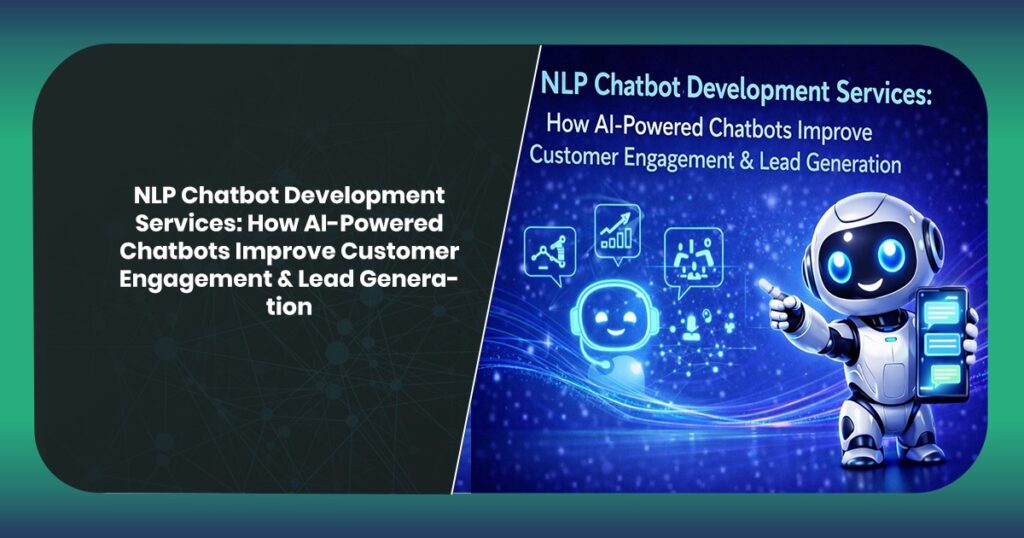
That shift from structured flows to intent-driven interaction is where NLP chatbot development services start to matter. It is not merely an upgrade, but a fundamental paradigm shift. Because once intent enters the picture, scripts stop scaling.
The “Dumb” Bot Tax: Why Your Current Chatbot is Killing Your Lead Pipeline
Here’s the uncomfortable truth. Most chatbots don’t lose leads, they leak them quietly.
Let’s look at how things usually go wrong. A user shows interest. Ask a question slightly outside the script. The bot fails to respond properly. Conversation ends without any measurable outcome.
There’s no alert or escalation. Just silence.
That’s the “Dumb Bot Tax.”.
What you might not be aware of is that you’re paying for traffic, then getting intent, and losing it at the interaction layer. You might not even track this flaw through the metrics. Because drop-offs inside conversations rarely get tracked properly.
If your digital assistant can’t handle variation in phrasing, what you’re doing is not automating, it’s filtering out actual leads.
From Pattern Matching to Semantic Understanding: The DNA of High-Intent NLP
So what changes? Everything starts with Intent recognition.
Instead of matching keywords, the system interprets meaning. A user says, “I need pricing for 50 users,” or “What would it cost for a mid-sized team?” The wording differs, but the intent remains the same.
Then comes entity extraction. Numbers. Locations. Use case details. All pulled from the conversation without forcing the user into a form.
Behind that, you’ve got RAG pipelines pulling context from your knowledge base. Not static answers, relevant ones.
And yes, you need Hallucination guardrails. Because if your assistant shapes answers in a sales conversation, trust drops instantly.
At this point, this isn’t a conversational agent anymore. It’s a decision layer.
The Anatomy of Engagement: Why CES Drops When NLP Gets It Right
Let’s talk about effort. Not yours but the customer’s.
Every extra step in a conversation adds friction. Every clarification request increases drop-off probability. That’s where the NLP chatbot changes the dynamic.
Instead of guiding users through a path, it meets them where they are. Fewer steps. Less repetition. Faster resolution. It directly impacts Customer Effort Score (CES). And CES isn’t just a support metric, it’s a revenue signal.
Lower effort → higher engagement → better conversions.
A simple chain.
If your chatbot requires users to “adapt” to it, engagement drops. If it adapts to them, things move.
The Revenue Architecture: How NLP Chatbots Identify “Hot” Leads in Under 30 Seconds
Here’s where things get interesting. Lead qualification isn’t about asking more questions. It’s about asking the right ones, and interpreting the answers correctly.
A high-intent NLP system looks at:
- Language urgency (“need this ASAP”)
- Budget indicators
- Use-case clarity
- Sentiment signals
All in real time.
Combine that with behavioral signals including pages visited and session duration, and you get a lead profile forming within seconds. Not minutes.
That’s how you boost lead generation without increasing traffic.
You’re not just capturing leads. You’re ranking them.
Lead Qualification on Autopilot: The Logic Behind the Scoring
Let’s break it down. Every response feeds into a scoring model.
Positive sentiment? Score up.
Clear use case? Score up.
Budget alignment? Higher again.
Ambiguity? Score holds.
Negative sentiment? Score drops.
This isn’t guesswork, it’s a structured process.
And when done right, your system routes high-scoring leads directly to sales—while lower-intent users stay in automated flows.
That’s where real efficiency shows up. Because your team isn’t chasing every conversation. They’re focusing on the right ones.
Integration Reality: Where Most “Smart” Bots Fail
Here’s where things usually fall apart. The chatbot works fine. But it lives in isolation.
No CRM sync. No pipeline update. No lead tracking. That’s a dead end.
A real system connects directly to tools like HubSpot or Salesforce. Every interaction updates the lead record. Every signal gets stored. But integration isn’t clean.
APIs behave differently. Data structures clash. And then there’s token latency, small delays that stack up across systems.
We’ve seen “smart” bots fail simply because the backend couldn’t keep up. This is where architecture matters more than features.
The Hidden Cost Is Not the Bot, It’s the Lost Opportunity
Most teams ask the wrong question. “How much does this cost?” This is a flawed premise.
The real question should be: “How much does a lost high-intent lead cost?” Because that’s what’s happening today.
Prospects arrive with high purchase intent. They engage. And when the system fails to respond properly, they leave. No follow-up. No recovery. Once you see it this way, the conversation changes.
You’re not investing in an automated chat assistant. You’re protecting revenue.
The Implementation Roadmap: What Actually Works (Not Theory)
Let’s keep this grounded.
Audit:
What conversations are happening today? Where are the leads dropping?
Dataset Curation:
Clean data. Real conversations. Not synthetic examples.
Training:
Focus on intent clarity first. Not coverage.
Human-in-the-loop testing:
Real users. Real queries. Real edge cases.
Because here’s the thing. You won’t get it perfect on day one. And that’s fine. But if you skip testing, you’ll never get it right.
Mid-Point Reality Check: A Smarter Bot Matters More Than a Bigger One
At this stage, most teams try to expand. More flows, responses, and coverage.
That’s not the answer. You need better interpretation.
When your current system struggles with real conversations, adding more scripts won’t fix it.
If you’re unsure where your setup stands, a technical discovery call helps map gaps, before you scale the wrong thing. Because scaling inefficiency just makes the problem bigger.
Why “Automating Interactions” Is the Wrong Goal
Automation sounds good. But blind automation often leads to bad experiences.
The real goal is controlled autonomy. Let the system handle what it understands. Escalate when it doesn’t. That balance matters. Because over-automation leads to frustration. Under-automation leads to inefficiency.
The middle ground? That’s where NLP systems operate best.
Final Thought: Scripts Don’t Scale. Understanding Does.
Users expect systems to understand them, not guide them through menus.
If your chatbot still depends on structured flows, it will fall behind.
Not because it’s broken. Because expectations have changed. And in lead generation, timing and relevance matter more than ever.
If you’re serious about improving conversion instead of just adding automation, it starts with the right foundation.
Work with Amenity Technologies to build a working prototype before full deployment. Because once you see how a high-intent system behaves in real conversations, the difference becomes obvious.
FAQs
Q.1. How do NLP chatbots improve customer engagement?
A: You can improve customer engagement by reducing friction. It can be done by enabling smooth communication, without making users adjust their language or follow structured paths. This will keep interactions smooth and increase engagement.
Q.2. What is the biggest risk in NLP chatbot implementation?
A: The biggest risk here is the lack of guardrails. Without proper controls, systems can generate incorrect responses, which directly impacts trust and conversion.
Q.3. How long does it take to deploy an NLP chatbot system?A: Initial deployment can happen in weeks, but refinement takes ongoing iteration. The real value builds over time as the system learns from interactions.