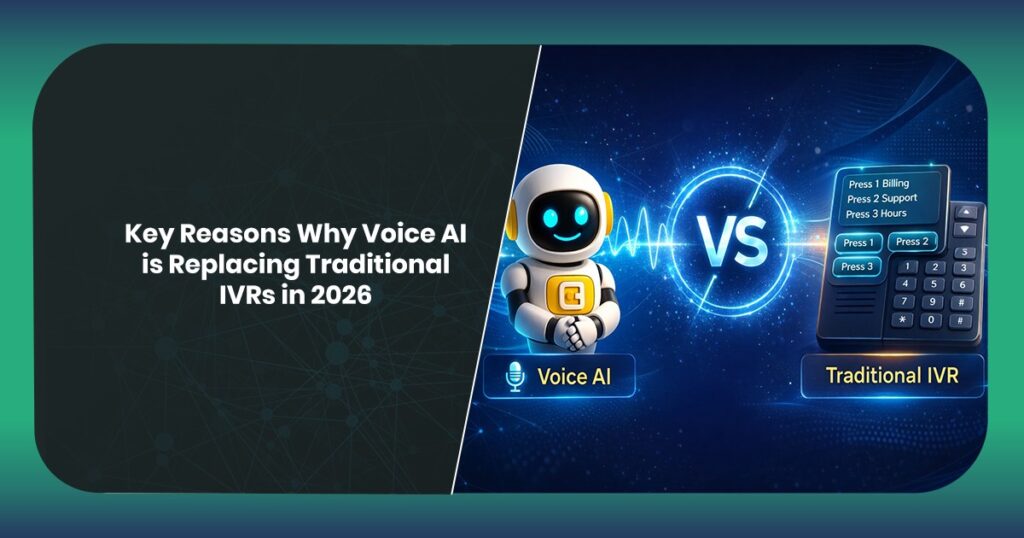


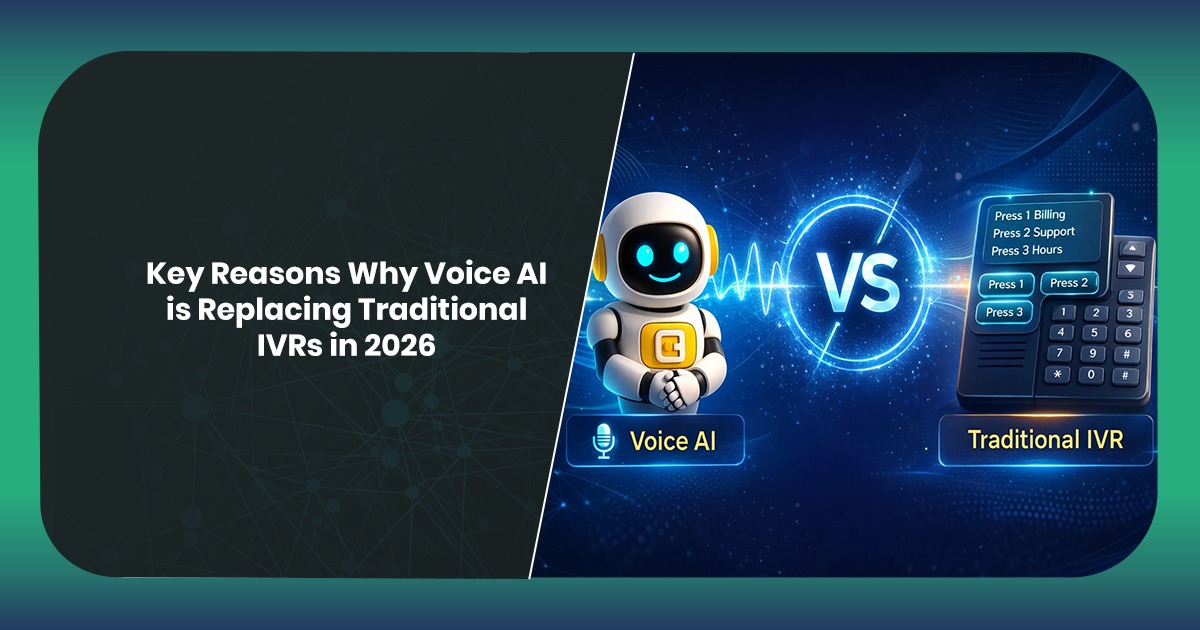



Press 1 for sales.
Press 2 for support.
Press 3 to repeat these again.
This is what we’ve been used to for years when it comes to traditional IVR systems and automated call routing. The structure was considered efficient. It filtered calls and reduced operator dependency. It gave businesses a way to handle scale without hiring endlessly.
But in 2026, the frustration became more noticeable. Customer patience level declined as call volumes increased and services grew more complex. Here, a rigid phone tree now feels like friction, not structure.
That is why businesses are replacing traditional IVRs with Voice AI. It is not that IVRs failed, but that they reached their functional ceiling. But because they stopped keeping up with growing demands.
IVRs Were Built for Control, Not Conversation
Traditional IVR systems were designed around control. They guide the caller down predefined branches. Each option is mapped in advance. Every response assumes predictable input.
This usually works efficiently when choices are limited. But, it can invite trouble when real life intervenes.
People do not always describe their problem the same way. They do not think in menu categories. They speak naturally. And when the system forces them into narrow options, misalignment happens.
The outcome is repeat navigation, transfers, or call abandonment. This deeply affects business’s credibility and reliability in the long run.
IVRs appear efficient on the surface. But look deeper.
A caller spends two minutes navigating prompts. When they press the wrong number, they have to restart the whole process. By the time they reach a human agent, irritation has already built.
That emotional friction shows up in subtle ways:
- Shorter conversations
- Reduced trustworthiness
- Lower patience
- Increased escalation
From an operational standpoint, the agent now inherits a slightly frustrated person. That affects resolution quality.
Why the Enterprise is Migrating from IVR Menus to Agentic Voice
Voice AI Changes the Starting Point
Voice AI does not begin with pre-defined options. It listens to the caller first.
Instead of saying “Press 1,” the system says, “How can I help you today?” This makes the conversation feel more natural.
The callers can respond in their own words. The system understands the intent behind the conversation, extracts relevant details, and responds accordingly.
Traditional IVRs rely on keyword spotting. If a caller does not say the exact programmed phrase, the system fails or redirects incorrectly. Modern Voice AI uses intent extraction. It understands meaning rather than isolated words, even when phrasing, dialect, or sentence structure varies. That ability to handle unstructured input is one of the biggest shifts in 2026.
There is no forced categorization. No rigid pathway.
For example, if someone says, “I need to change my delivery address because I’ll be out tomorrow,” the system understands both the action and the timeline. The system understands what the caller actually wants and why it matters, then moves the conversation forward smoothly.
That difference is subtle on paper. It is significant in practice.
Routing vs Resolution
Traditional IVRs route the call. Meanwhile the Voice AI resolves the situation.
An IVR might send you to the scheduling department. A Voice AI system can check the calendar, suggest new time slots, confirm the change, and update the record instantly.
This reduces the number of human interactions required for routine tasks. The shift is from directing traffic to completing transactions.
That distinction is why the replacement trend is accelerating these days.
Call Volumes Are Not Decreasing
Businesses are not replacing IVRs because call volumes shrank. The opposite is true.
They require voice AI when the situation involves more services, more customers, more channels, and more expectations from the other side of the calls.
Hiring more agents indefinitely is not sustainable. Static menus merely postpone the queue; they don’t resolve the query. It does not remove it.
Voice AI absorbs repetitive calls at scale. It does not tire. It does not queue in the traditional sense. It processes structured tasks consistently. During peak hours, stability matters.
Voice AI also introduces what many now call a Zero-Queue architecture. Unlike human agents or limited IVR ports, AI can scale instantly. During a localized service outage or peak promotion, it can handle hundreds or even thousands of concurrent calls without creating a waiting room. That fundamentally changes how businesses think about peak capacity planning.
Customers Now Expect Natural Interaction
There was a time when pressing numbers felt normal.
Now, conversational interfaces are everywhere. People speak to their phones, their cars, their home devices. They expect systems to understand context.
When they call a business and encounter a rigid phone tree, the contrast feels outdated.
Voice AI aligns with modern communication habits. It adapts to language rather than forcing language to adapt to it. This alone improves perceived responsiveness.
Internal Operations Benefit Quietly
Shifting from IVR is not merely about improving customer experience.
Voice AI performs real-time CRM Write-Backs. It logs call intent accurately. It standardizes policy explanations. It reduces manual entry errors.
Sales and support agents receive context when escalation happens. They do not start conversations from zero. On the other hand, managers gain better visibility into call patterns because intent is captured more accurately.
Operational improvements often outweigh the visible customer experience gains.
Automation Without Losing Human Oversight
A common concern with traditional IVR systems is the loss of empathy.
In practice, modern Voice AI systems are configured with clear transfer logic. If frustration, urgency, or complexity is detected, the system routes the call immediately to a human agent. This minimizes call abandonment and negative customer experience.
The human agent will have a clear idea of the caller’s intent, along with what was already attempted and what details were captured.
When Voice AI escalates, it passes a context metadata packet to the human agent. Instead of asking, “How can I help you?”, the representative can say, “I see you’re trying to reschedule your plumbing appointment for Tuesday. Let’s check those afternoon slots.” That continuity removes one of the biggest frustrations in traditional IVR transfers.
What Voice AI does is: it handles repetition and allows humans to handle nuance. That balance makes replacement practical rather than risky.
Where Voice AI Is Replacing Traditional IVR Systems Most Quickly
These advanced systems aren’t working the same for all industries. Some sectors are moving faster than others.
– Home services companies are replacing IVR for appointment booking and confirmations.
– Healthcare providers are automating prescription refills and routine scheduling.
– E-commerce businesses are handling order tracking conversationally instead of routing through menus.
– Financial institutions are using Voice AI for balance inquiries and basic account updates.
In each case, a similar pattern emerges: repetitive calls are resolved instantly rather than routed.
The Transition Path: From Menus to Intelligence
This is not an overnight shutdown of traditional IVR systems. This won’t happen because some businesses are still using IVR systems since investing in Voice AI requires planning, budget allocation, and integration with existing systems.
While many organizations are layering Voice AI on top of existing telephony infrastructure and others are phasing out IVR menus gradually.
The direction here is clear. Menu trees were designed for a time when structured input was necessary. And now conversational AI is removing that limitation.
By 2026, businesses are not asking whether Voice AI works. They are evaluating how quickly they can transition without disrupting operations.
Final Perspective
The replacement of traditional IVRs is not some kind of trend that comes and goes. It is driven by accumulated friction.
Every extra prompt. Every misrouted call. Every repeated account number. Over time, those small inefficiencies become visible. Voice AI removes many of those layers without completely removing human involvement.
This shift does not eliminate structure. It changes how structure is applied. That is why it is happening now.
If you are planning to shift to Voice AI from IVR menus, Amenity Technologies can help you with developing a reliable system.
FAQs
Q.1. Is Voice AI just an advanced IVR?
A: The reality is more complex. IVRs systems follow fixed menu trees. On the other hand, Voice AI interprets natural language, extracts intent, and can complete tasks directly through system integration.
Q.2. Is it risky to replace an existing IVR system?
A: Most transitions happen gradually. Businesses often deploy Voice AI alongside existing systems before fully replacing menu-based IVR navigation to ensure operational consistency and minimize disruption during the shift.
Q.3. What industries benefit most from replacing IVR?A: Industries with high volumes of predictable inbound calls, like healthcare, home services, finance, and retail, typically see immediate efficiency gains.