
Is AI Good for Healthcare? Benefits, Risks, and What It Means in Reality
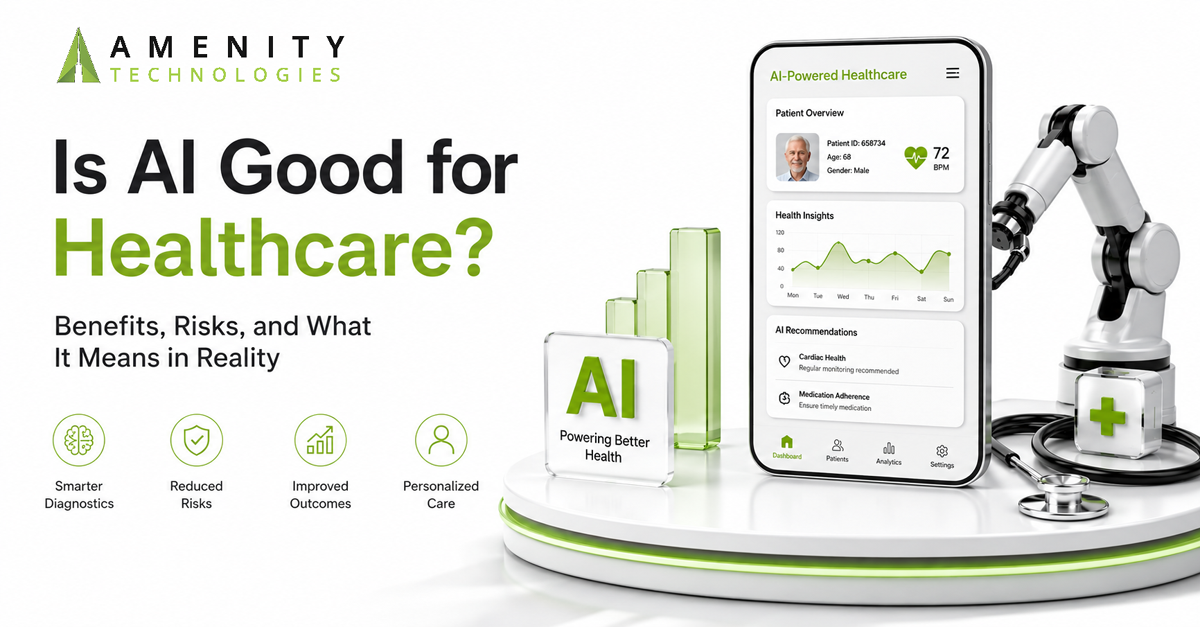
“Is AI good for healthcare?” sounds like a straightforward question, right? But, it isn’t.
Some businesses see it as a breakthrough that drives faster diagnoses, reduced workload, and better patient outcomes. Others approach it with caution, and for good reason. Healthcare doesn’t leave much room for trial and error.
What makes this conversation complicated is that both sides are right.
AI is already influencing how healthcare operates. But whether it’s good depends less on the technology itself and more on how it’s used, where it’s applied, and how carefully it’s introduced into real environments.
Where AI Is Already Making a Difference
AI solutions in healthcare aren’t just in papers anymore. They’ve already become a part of daily operations; sometimes quietly.
In hospitals, agentic AI for healthcare assists with reviewing medical images. In clinics, they help manage appointment flows. In administrative settings, they reduce time spent on repetitive documentation.
One area where its presence is growing quickly is AI for healthcare diagnosis. These systems don’t replace doctors, but they support decision-making by identifying patterns that may not be immediately visible.
There’s also growing use of generative AI for healthcare, particularly in summarizing clinical notes or structuring patient records. It doesn’t replace expertise; but it reduces the time required to process information.
That said, the impact isn’t always dramatic.
Often, it shows up in smaller ways that involves less waiting, quicker responses, fewer manual steps. The kind of improvements you notice only when they’re missing.
The Real Benefits: Where AI Actually Helps
The real benefits of AI tend to show up in places that feel almost routine.
Small improvements. Repeated often.
- Less time spent on administrative tasks
- Quick access to patient information
- Reduced back-and-forth in communication
For example, introducing an AI agent for healthcare into patient communication systems can handle initial queries, guide users, and reduce waiting time. Not revolutionary on its own; but highly effective over time.
Similarly, tools like an AI voice agent for healthcare reduce pressure on call handling by managing high volumes of routine interactions.
The benefit of these advanced conversational agents isn’t just efficiency; it’s consistency.
It Changes Workflows More Than It Replaces People
There’s a common misconception spread across markets that AI will replace roles. In healthcare, that rarely holds any potential.
What AI actually changes is how time is used.
With smart systems in place, administrative staff spend less time answering repetitive questions. Clinicians spend less time searching for information. Support teams spend less time managing routine coordination.
The work doesn’t disappear; it shifts. And in many cases, that shift improves focus.
Instead of managing small, repetitive tasks, teams can spend more time on situations that require attention, judgment, and interaction.
That’s a quieter kind of improvement; but an important one.
There are Risks Involved in AI Implementation
It’s easy to focus on what AI enables and overlook where it can fail.
Healthcare systems rely heavily on data. If the data feeding the system has gaps or inconsistencies, the output reflects those same issues. And those issues aren’t always obvious at first.
There’s also a chance of people trusting automated results too quickly.
That’s exactly where risk is involved.
AI tools can back important decisions, but it shouldn’t replace human oversight. The moment it becomes unquestioned, small inaccuracies can scale into larger problems.
And then there comes privacy.
Healthcare data is confidential, and it needs a higher level of responsibility. Any AI system working with that information needs clear boundaries, strong safeguards, and transparency around how information is handled.
Without that, trust becomes difficult to maintain.
The Real-World Impact Feels Subtle
When a healthcare organization decides to implement AI solutions the deployment may seem like a smooth transition. But, it’s not.
Another thing that is often misunderstood by decision makers in healthcare organizations about AI is the pace of change. It’s not sudden. It’s gradual.
A clinic might start by automating appointment scheduling. A hospital might introduce AI support in diagnostics. Over time, these changes start connecting.
Patients don’t usually notice the technology itself.
They notice what changes around it:
- Shorter waiting times
- Fewer delays
- Smoother communication
That is the real impact: no disruption, just refinement.
Where Implementation Often Slows Down
Even strong AI solutions can struggle after deployment.
Not because the technology is flawed; but because the environment is complex.
Healthcare systems are layered. There are existing solutions, well-established workflows, and teams already working under pressure. Introducing something new into that mix requires careful alignment.
Sometimes, the issue is expectations.
AI is introduced with the idea that it will solve multiple problems at once. When that doesn’t happen immediately, adoption slows.
Other times, the problem is integration. If the system fails to connect properly with existing systems, it creates additional steps instead of removing them.
And once that happens, resistance follows.
How the Role of Generative AI Is Evolving
There’s growing interest in how generative AI for healthcare can be implemented beyond basic automation.
Right now, much of its value lies in handling information such as summarizing notes, organizing information, assisting with documentation. These are time-consuming operations that benefit from structured support.
But it’s still evolving.
There are questions around accuracy, reliability, and how much responsibility should be assigned to these systems. Healthcare environments tend to move carefully here, and for good reason.
The technology is promising.
But it’s being adopted in layers; not all at once.
So, Is AI Good for Healthcare?
It completely relies on how the question is framed.
AI-driven solutions function well when they:
- supports existing workflows
- simplifies processes
- improves access to information
They struggle when they:
- introduces complexity
- operates without oversight
- tries to replace critical decision-making
The difference isn’t in the technology itself. It lies in how it’s applied.
What Healthcare Organizations Should Keep in Mind
For organizations exploring AI, a few patterns tend to make a difference.
Start with clarity.
Not every process needs automation.
Focus on areas where delays or inefficiencies already exist. Those are usually the best entry points.
Pay attention to integration.
A system that doesn’t fit into existing workflows will create friction, regardless of how advanced it is.
And treat AI as something that evolves.
It improves with use, feedback, and adjustment. The first version is rarely the final version.
Final Thoughts: A Shift That’s Still Unfolding
AI isn’t redefining healthcare overnight. It’s adjusting it, step by step.
Some changes are visible. Others happen quietly in the background.
The real value shows up over time. In smoother operations. In better coordination. In fewer delays.
So, is AI good for healthcare? Well, it can be.
But only when it’s introduced with a well-defined purpose, realistic expectations, and an understanding of where it actually fits. That’s what makes the difference.
If you need further assistance related to selection of the right AI tools for your particular requirements, reach out to Amenity Technologies. Our support team will guide you with making the right decision without unnecessary drama.
FAQs
Q.1. What is the biggest risk of using AI in healthcare?
A: The most significant risk here isn’t the technology itself; it’s over-dependence. When teams start to accept results from AI tools without verification, slight inaccuracies might often be overlooked. Over time, that leads to bigger problems. This is why the most successful AI integration involves treating AI solutions as smart assistants, not decision-makers.
Q.2. Can small clinics benefit from advanced AI solutions, or is it only for large hospitals?
A: AI is no longer restricted to large healthcare systems. Smaller clinics often see immediate value in areas like appointment handling, patient communication, and administrative chores. Modern AI solutions like AI-driven reception or communication assistants can bring down workload without a need for major infrastructure changes.
Q.3. What makes an AI implementation successful in healthcare?A: Successful implementations usually have three things in common: a clearly defined use case, strong integration with existing systems, and continuous monitoring after deployment. When these things are in place, AI is capable of blending into operations rather than disrupting them.