

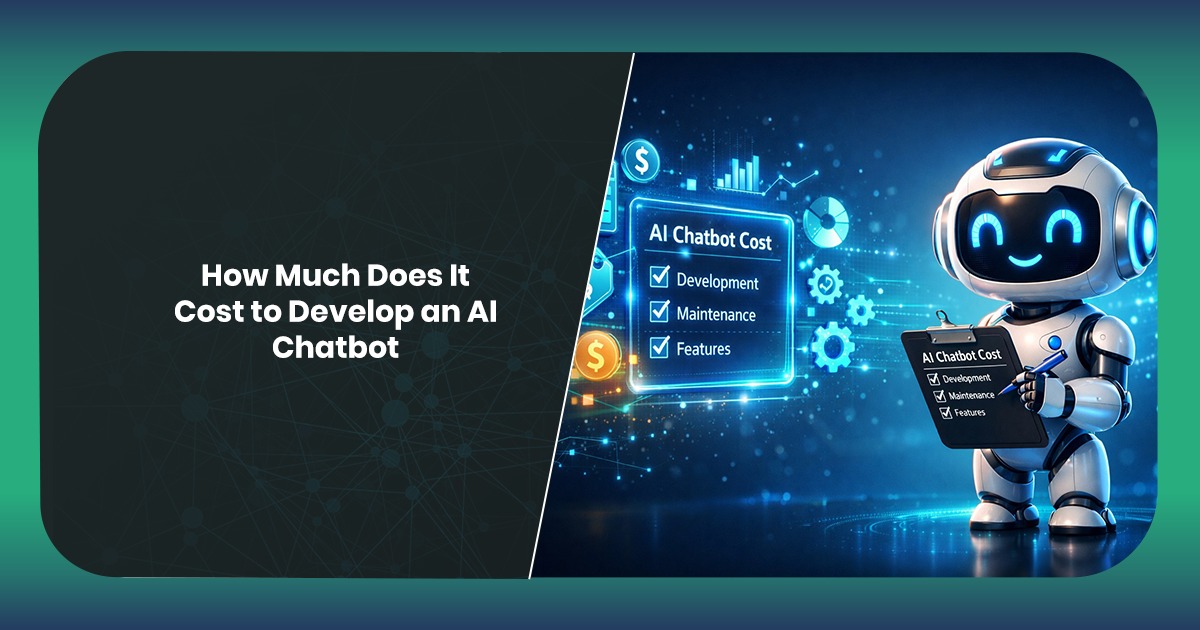



The actual cost of an AI chatbot varies widely, and that’s often where confusion begins. Some businesses launch one for a few thousand dollars, while enterprise systems cost far more. The difference usually comes because of integrations, infrastructure, and long-term maintenance, not the chatbot interface itself.
In this post, we’ll address this question “how much does it cost to develop an AI chatbot?” to help you get a clarity to estimate the development expense. This way you can smartly calculate return on investment (ROI) without relying on rough assumptions or incomplete budget estimates during the planning stage.
The Strategic Shift: Why Chatbot “Cost” Is Really an Investment
A few years ago, most companies viewed chatbots as simple support tools. They answered common questions, routed visitors to help pages, or collected contact information. Their value was mostly operational convenience.
That perspective has changed dramatically.
Modern conversational AI systems are capable of understanding context, retrieving information from multiple sources, and generating responses that resemble human conversation. Instead of following rigid scripts, they analyze user intent and provide relevant answers based on knowledge bases, documentation, and operational data.
Because of this shift, conversations about AI chatbot development cost now resemble strategic planning discussions rather than simple software purchases.
Businesses evaluating AI assistant projects are increasingly asking questions like:
– How much operational workload can automation handle?
– How rapidly can the Conversational AI tool respond compared to human teams?
– Can the system qualify leads or assist internal employees?
When businesses approach conversational AI deployment companies with these questions in mind, the technology becomes more than a support feature. What it becomes is a part of the operational infrastructure that manages communication at scale.
In practical terms, this generally means that conversational AI investment decisions are linked to efficiency metrics, customer experience improvements, and long-term automation goals.
The Three Factors That Shape AI Chatbot Development Cost
When organizations prioritize planning a digital assistant project, they often assume the main expense lies in building the interface users interact with. In reality, most of the effort occurs behind the scenes.
Three elements usually decide the scale and complexity of AI assistant development: infrastructure, development architecture, and ongoing improvement.
1. Infrastructure: The Foundation of Conversational AI
Every Conversational AI tool relies on underlying technology capable of processing language, generating responses, and retrieving information.
This infrastructure often includes:
- Large language models (LLMs)
- Cloud computing environments
- Data storage systems
- Knowledge retrieval frameworks
One of the first strategic decisions companies face is picking between LLM API services vs. custom AI chatbot development services.
Some businesses go ahead with AI models through external APIs. This approach reduces initial complexity and allows development teams to deploy digital assistants quickly.
Others choose to host AI models within their own infrastructure. Although this approach requires more technical resources, it comes with impressive control over data privacy, performance optimization, and long-term scalability.
Infrastructure decisions rarely affect the user experience directly, yet they have direct impact over almost every aspect of AI implementation expenses over time.
2. Development: Where the Real Complexity Emerges
Once the infrastructure is engineered, development teams begin focusing on how the conversation bot will interact with users and internal systems.
Advanced AI assistants rarely operate as isolated solutions. They are, nowadays, designed to bridge the communication gaps while staying connected to multiple business platforms.
Typical integrations include:
- CRM systems
- Customer support platforms
- Internal knowledge bases
- Order management tools
- Analytics systems
Through these integrations, you will have smart AI assistants that actually perform useful actions rather than simply providing text responses. A well-designed conversational AI will be helpful in retrieving order information, creating support tickets, updating records, or guiding users through complex processes.
Building these capabilities requires thoughtful architecture, and that can only be done by experienced AI development companies.
Conversation flows should always feel natural while the underlying system securely exchanges information between platforms. Developers should also expect edge cases, misunderstandings, and unusual user behavior.
Teams having expertise in conversational AI often highlight designing responses that feel natural while ensuring the bot aligns with operational workflows and existing tools.
This balance between conversational design and technical integration is one of the most important factors influencing development complexity.
3. Maintenance: The Long-Term Cost Driver
Most businesses assume the hard part ends once the AI agent goes live. In practice, that’s usually the point where the real learning begins.
Once customers start interacting with the system, you quickly notice things that never appeared during testing. People ask questions in unexpected ways. Some responses work perfectly, while others clearly miss the mark. An automated chat assistant that sounded intelligent during development suddenly reveals its blind spots.
This isn’t a flaw in the technology. It’s simply the nature of real conversations.
Teams managing the conversational AI usually spend time reviewing interaction logs and identifying patterns. Certain questions appear repeatedly. Others reveal gaps in the information the virtual support bot was trained on. Sometimes a response technically answers the question but still leaves the user confused.
Those small observations lead to adjustments like new responses, clearer explanations, and additional knowledge sources. Over time, these updates add up.
The conversational agent gradually learns how customers actually phrase their questions rather than how developers expected them to. That difference matters more than most companies realize.
Maintenance, therefore, is less about fixing problems and more about aligning the chatbot with real-world communication.
When businesses commit to this process, the chatbot becomes noticeably more useful after a few months than it was on launch day.
Different Levels of Chatbot Complexity
One key reason for the discussion around AI chatbot development cost to feel confusing is that not every AI assistant is designed for the same purpose.
Some are intentionally simple for particular purposes. Others operate more like digital assistants embedded across business systems.
Basic Chatbots
The most basic chatbots are engineered to handle predictable interactions. Think of situations where users ask common questions such as store hours, delivery timelines, or account setup instructions.
These tools are typically trained to follow structured conversation paths. They work well when there are predefined problems. In this case, the response rarely changes.
For businesses taking their first step toward automation, this approach often makes sense. It introduces conversational tools without requiring major operational changes.
Still, these systems have limits. When conversations become complex, structured bots can struggle to keep up.
Integrated AI Co-Pilot
Above the basic AI co-pilot, there comes context and system integration. Rather than relying entirely on predefined responses, the conversational AI tool connects to internal platforms like support systems, knowledge bases, and CRM tools. The integration allows the tool to retrieve information dynamically rather than solely depending on scripted replies.
This is where conversational AI tools start delivering noticeable operational benefits.
Support teams often find that a large portion of incoming questions are repetitive. Once the messaging bot is able to handle those inquiries automatically, human agents gain more time to focus on complicated cases.
For many companies, this shift helps reduce SaaS support automation costs while maintaining consistent communication across digital channels.
Enterprise Conversational Systems
Larger enterprises tend to push chatbot capabilities further.
Instead of restricting the assistant to customer support only, they expand its role across departments. Employees might use the digital assistant to retrieve internal documentation, request IT support, or find policy-related information.
Designing systems like this requires a deeper level of planning.
Multiple platforms must work together. Security requirements become stricter. Data accuracy becomes critical.
That is why many organizations eventually work with an enterprise AI chatbot development service that understands how to build conversational systems inside complex enterprise environments.
In these cases, the chatbot becomes part of the company’s digital infrastructure rather than a simple website feature.
Measuring Custom Chatbot ROI
In the end, every organization asks the same question: is the chatbot investment worth it?
The answer usually becomes clear once the chatbot starts handling real interactions.
Support Efficiency
Customer support teams spend a surprising amount of time answering similar questions again and again.
When a customer support bot handles those conversations automatically, the workload changes almost immediately. Support agents can focus on complicated issues while routine questions are resolved instantly.
Customers notice the difference as well. Waiting for a reply is rarely necessary.
Lead Engagement
Chatbots also play an unexpected role in sales conversations.
Visitors often browse websites with small questions that determine whether they continue exploring or leave. A quick answer at the right moment can make a difference.
Online retailers see this effect clearly. Many stores now rely on an AI chatbot development service for ecommerce to guide visitors through product discovery, order tracking, and purchase questions.
Instead of waiting for email responses, customers receive assistance immediately. That alone can influence purchasing decisions.
Building a Future-Ready Chatbot Strategy
Technology advances rapidly, but a few patterns can be easily noticed.
Businesses that gain the most value from conversational AI rarely treat chatbots as isolated tools. Instead, they integrate them into existing systems so the assistant can access meaningful information.
Another common trait you can find is patience.
The best chatbot implementations improve gradually. Teams watch how people usually interact with the system, refine responses, and expand capabilities over time.
Eventually the chatbot stops feeling like a new experiment and starts behaving like a reliable part of daily operations.
Seen from that perspective, AI chatbot development cost becomes easier to understand.
It’s not about building a tool and more about creating a communication layer that helps businesses respond quickly, assist all customers better, and scale conversations without increasing operational complexity.
When the AI chatbot development cost doesn’t surprise you much, it’s the time you’re all set for investment. If you find it challenging to find and partner with a reliable chatbot development company, Amenity Technologies is here for you. We offer tailored automated chat assistants that help reduce human support team workload and enhance overall communication.
FAQs
Q.1. Is a custom chatbot better than using a pre-built chatbot platform?
A: It usually depends on your requirements. Pre-built platforms can be a good starting point for basic automation. However, they have restricted customization and integration options. Organizations that require deeper automation, brand-specific conversations, or complex workflows usually benefit more from a custom-built solution tailored to their operations.
Q.2. How can ecommerce businesses use automated chat assistants effectively?
A: In the ecommerce industry, automated chat assistants can assist with product discovery, resolve queries about orders, provide shipping updates, and guide customers through purchasing decisions. They can also help capture potential customer inquiries and support buyers throughout the purchasing journey.
Q.3. What should businesses prepare before starting a chatbot project?A: Organizations should initiate the process by identifying their primary goals for investing in AI assistants. This may include improving support efficiency, capturing leads, or guiding users through complex processes. Preparing documentation, frequently asked questions, and internal knowledge resources also helps accelerate development.