
How Businesses Are Evolving into AI-First Organizations
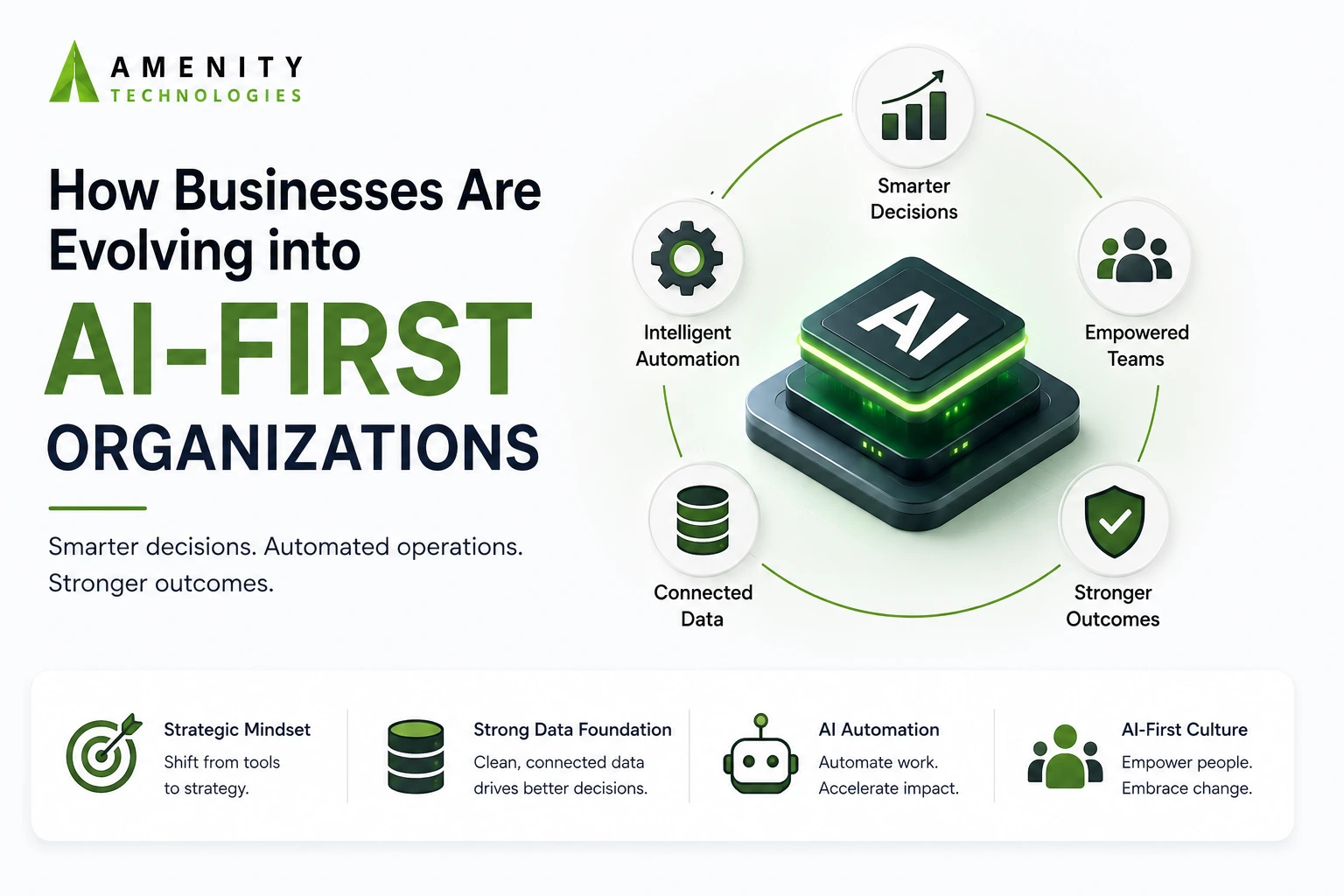
For years, businesses chased a simple goal: make tasks faster. We bought software to click the buttons, route the emails, and copy data between spreadsheets. It worked well enough to save time, but speed alone is no longer enough to win.
Today, a massive shift is happening. Forward-thinking businesses are moving past basic task execution. They are building organizations where artificial intelligence does not just support the work; it drives the strategy.
Some companies are no longer treating AI automation as another tool in the software stack. They’re beginning to rely on it as part of the way the business operates. As that happens, decisions become less dependent on fixed rules and more informed by the information available at the moment.
The Mindset Shift: From Tools to Strategy
Most businesses begin by solving one problem at a time. A new tool gets added for customer support, another for reporting, and something else for operations. Over time, those systems pile up, often without working particularly well together.
The businesses seeing the biggest impact from AI tend to approach it differently. Instead of treating it as another piece of software, they look at how it fits into the bigger picture of how the company operates.
That usually leads to a different set of questions. Rather than asking where AI can save a few hours, leaders begin asking how decisions are made, where information gets stuck, and what slows teams down in the first place.
As that thinking spreads, the focus starts to shift. Less attention goes into managing individual tasks, and more goes into improving the way work moves across the organization.
Building a Strong Data Foundation
Many companies discover the same problem when they start expanding AI efforts. The information they need already exists, but it lives in different places. Sales has one view of the customer, operations has another, and important details are often buried in spreadsheets, emails, or aging systems.
That may not cause major issues day to day, but it becomes harder to ignore when teams start relying on data to make faster decisions.
The businesses making the most progress are usually the ones that have spent time getting their information organized. Teams can find what they need, trust what they’re looking at, and work from the same version of events.
- Make it easier for information to move across departments.
- Set clear expectations around ownership and access.
- Fix the inconsistencies that create confusion later on.
Once that groundwork is in place, the business becomes far easier to understand, operate, and improve.
Reshaping Operating Models with AI Automation
Ask employees where they lose time during the workday and the answers are rarely surprising. Chasing updates. Following up on approvals. Looking for information that exists somewhere but isn’t easy to access. None of these tasks are particularly difficult, yet they consume a significant amount of attention across the organization.
AI Automation helps reduce some of that operational overhead. When routine actions and information flows are handled more intelligently, teams spend less time coordinating work and more time moving it forward. As a result, businesses can operate with fewer bottlenecks, better visibility, and a stronger ability to adapt when priorities change.
Departmental Evolution: Specialized AI Agents
The real power of an AI-first company becomes visible when you look at individual departments. Generalized software is being replaced by highly specialized digital workers designed for specific corporate functions.
Scaling Legal Workflows with an AI legal assistant
Using a dedicated AI legal assistant allows corporate legal teams to automate contract reviews instantly. This specialized tool flags compliance risks, analyzes complex clauses, and accelerates contract lifecycles without human error.
Elevating Customer Support with an AI customer service agent
Deploying an AI customer service agent transforms how your business interacts with clients. This intelligent system resolves complex customer inquiries instantly, manages backend account updates, and provides seamless 24/7 support.
Fostering an AI-First Culture
Tools are only one piece of the puzzle. The hardest part of changing how a company works is dealing with the human side of things. If your team thinks new software is a threat to their job security, they will quietly resist using it.
Building the right culture takes open communication and clear direction from the top. Your employees need to see these systems as tools that help them grow, not things that compete with them. This means changing roles so people can focus on bigger projects, creative ideas, and decision-making.
It also means helping your team learn how to use these new tools effectively. Teach them how to guide the software, check its work, and manage automated setups. Once people see that tech takes away the most boring, repetitive parts of their day, they get excited to use it.
The Ultimate Competitive Advantage
Business moves incredibly fast now, and being able to adapt quickly is everything. Companies that get slowed down by manual work and long approval chains simply can’t keep up with faster competitors.
A smart business operates with total clarity. Because your data connects directly to intelligent tools, you get a real-time view of what your customers want and where your market is heading.
- Faster updates: Roll out new features based on what your users actually do.
- Smoother workflows: Fix bottlenecks before they back up your operations.
- Better customer experiences: Give every single client a personalized experience without slowing down.
This isn’t just a way to shave a few dollars off your budget. It is about building a business that gets smarter and more resilient every day.
Turning Intelligence into Impact
Moving past basic setups to build a smart, modern company isn’t an idea for the distant future. It is a practical strategy you need right now to stay competitive. By changing your leadership approach, cleaning up your data, and using targeted digital tools, you set your business up for steady growth.
At Amenity Technologies, we create custom AI agents, chatbots, and generative AI software built around your specific business steps. We help you turn your daily operational data into your biggest business advantage.
Want to upgrade how your business runs? Get in touch with Amenity Technologies today to see how our custom setups can help you scale.
FAQs
Q.1. How do we prevent an AI agent from hallucinating or giving clients the wrong information?
A: The easiest way to reduce hallucinations is to stop the AI from guessing in the first place. Instead of letting it search the web or pull information from unknown sources, we connect it only to approved company documents and internal knowledge. If someone asks something outside that information, the system can simply say it doesn’t know or pass the conversation to a team member. That’s usually far safer than letting it generate an answer just for the sake of responding.
Q.2. Will we need to retrain our entire workforce to become AI-first?
A: No, because modern systems are engineered to understand regular, conversational speech. Your team interacts with the software just like they would text a coworker, meaning the learning curve is practically nonexistent. We design intuitive, natural-language interfaces that make onboarding seamless for any department.
Q.3. How secure is our corporate data when using AI systems?
A: Your data remains entirely yours because the workflows are built within an isolated, private cloud environment that never uses your information to train public models. Strict encryption ensures that sensitive operational files are processed securely without leaving your corporate perimeter. Reach out to our technical team to review our security protocols and architecture options.