




Conversational AI has transitioned from a technical experiment to a strategic capital allocation priority. By implementing AI assistants, businesses expect faster support, lower costs, and always-on availability. The pitch is straightforward, but the operational reality is more complex.
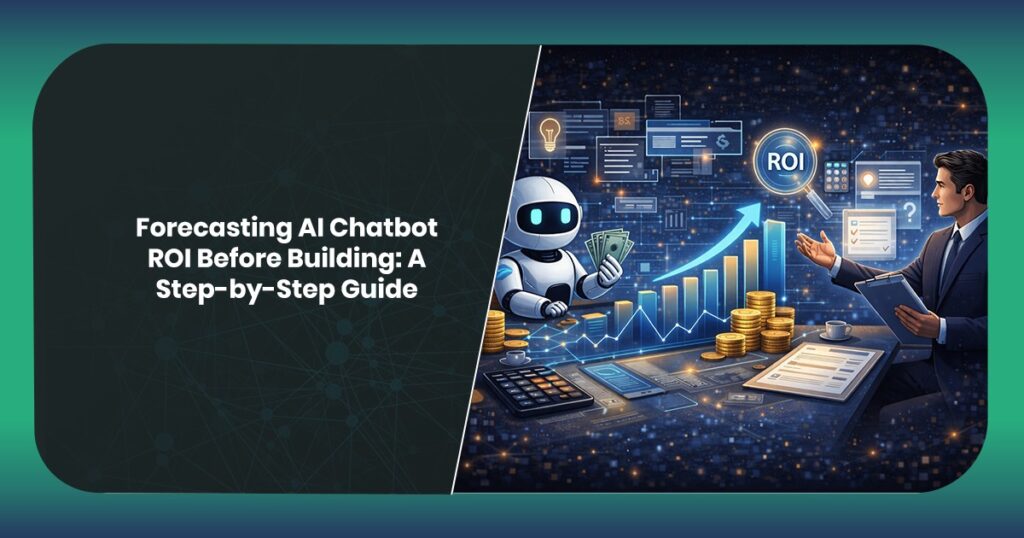
An AI chatbot can absolutely reduce operational pressure. But, without financial planning, it can quickly become an underperforming expense. The difference between success and disappointment often comes down to forecasting AI chatbot ROI before development begins. Treat it as a financial decision, not just a technical project.
Let’s explore easy-to-follow and proven steps to approach it properly.
6 Steps to Forecast AI Chatbot ROI Before Building
Step 1: Establish an Operational Cost Baseline
Before you jump straight to savings, it is important that you audit your existing operational metrics. Not estimates. Not assumptions. The real data.
You can start with volume. How many conversations does your team handle in a typical month? Break them down into categories. Order status. Password resets. Product questions. Billing issues. You will quickly notice patterns.
Support teams are often burdened by high-frequency, low-complexity inquiries. That is where AI assistants will be the best to involve.
Next, look at handling time. How long does one ticket really take? Now, instead of just looking at chat time, focus on documentation, follow-ups, and internal coordination. Small inefficiencies add up when multiplied by thousands of interactions.
Calculate the fully burdened labor rate. Divide that by the number of tickets handled per hour. Now, you have a real baseline.
Without this step, any ROI projection is just guesswork.
Step 2: Identify What a Chatbot Can Realistically Handle
You can’t automate everything in your organization. Attempting to automate high-judgment tasks is an operational risk that compromises operational stability, employee morale, and decision quality. Only specific operations can be automated to ensure smooth workflows and overall productivity.
This is where many ROI calculations become overly optimistic. You should look for queries that are:
- Repetitive
- Structured
- Predictable
- Low in complexity
For example, order tracking is usually a smooth process if integrated with backend systems. Password reset guidance is usually rule-based. Business hours do not require human creativity.
If 40% of your workload fits these categories, that is your realistic starting point. You should completely avoid aiming for full automation. Focus first on what is stable and defensible.
Setting realistic boundaries at this stage protects your investment.
Step 3: Be Honest About the Investment
This is where most ROI discussions quietly lose credibility. It is easy to focus on what the chatbot will save. Accurately modeling the Total Cost of Ownership (TCO) requires rigor
The upfront expense is only one part of the equation. Yes, you will invest in AI system design, AI development cost, and integration. But that is not the full picture yet.
An AI assistant that actually performs well requires thoughtful setup. Conversations must be mapped carefully. Backend systems need to connect properly. Testing consumes time. None of this should be overlooked if you are really aiming for reliable results.
Then there is the part many teams underestimate. After launch, the work continues.
Conversations evolve. Customer behavior shifts. Products and policies change. Without structured updates, performance levels gradually decline.
Budgeting for optimization is not an optional process. It is necessary. There may also be internal adjustments. Your support team might need training. Workflows may shift. Someone will be responsible for monitoring performance.
If you ignore these elements earlier, ROI projections become inflated without anyone realizing it. So, invest some time in listing every little realistic cost. This will create better decisions later.
Step 4: Estimate Impact Without Overpromising
Once you understand your baseline and your investment, you can begin thinking about returns. Begin cautiously.
Identify the specific percent of your queries that are repetitive and structured. This will be your logical starting point.
In early stages, performance should be treated as something that improves over time. Multiply your realistic automated resolution rate by your total ticket volume. Then apply your cost per ticket.
You can express this in a simple way:
Monthly OpEx Reduction =
(Total Ticket Volume × Automated Resolution Rate) × Average Cost per Ticket
To project annual impact:
Annualized ROI = Estimated Monthly Savings × 12
Ensure your ROI model tracks true resolution rate rather than surface-level deflection. If a user exits the AI assistant only to return later through phone or email, that is not efficient. It is a hidden cost.
The savings become clearer when you see them across twelve months instead of one week.
There is also a quieter benefit that often gets overlooked. Even when an AI assistant does not fully resolve an emerging issue, it collects useful information before transferring the conversation. That alone shortens resolution time. This reduces handling time and improves resolution efficiency.
If the AI assistant performs better than your expectations, that is a positive surprise. Overestimating, however, builds pressure. Avoid it.
Step 5: Look Beyond Cost Reduction
If ROI is calculated only through support savings, there is something important that you’re already missing, which is availability.
How many potential customers visit your website after working hours? Without automation, those visitors may leave without asking a question. An AI assistant changes that interaction.
Even small improvements in conversion rates can shift the financial outcome meaningfully.
There is also scalability that you must consider. As your customer base grows, support demand increases. Without automation, growth usually means hiring. With automation in place, you may absorb higher volumes without expanding payroll at the same rate. That flexibility has long-term financial value.
Then there is the internal impact. When repetitive queries are removed from daily workloads, support agents can focus on complex conversations. Service quality improves. Burnout reduces. Productivity increases.
These effects may not appear instantly in spreadsheets, but they have a stronger influence over operational stability.
Step 6: Run the Numbers More Than Once
One projection is rarely enough. Create a conservative forecast using lower automation rates and slightly higher ongoing costs. Then create a balanced version.
Finally, model a stronger performance scenario. When you compare them side by side, you get a better perspective. The investment either makes sense across multiple scenarios or it does not. This clear approach replaces excitement with clarity, allowing you to discover the accurate ROI of the AI assistant.
Conclusion
Forecasting AI chatbot ROI before development is less about complex formulas and more about disciplined approaches.
– Begin with real operational numbers.
– Define what can actually be automated.
– Acknowledge the full cost.
– Project gains carefully.
When you take this approach, the decision becomes straightforward. You are no longer building a chatbot because automation sounds modern.
If you’re evaluating whether a conversational AI platform initiative makes financial sense for your organization, the support team at Amenity Technologies can help you assess it with structure and transparency. We work with businesses to define scope, model achievable outcomes, and design AI systems that are justified by evidence, not assumptions.
FAQs
Q.1. What is a realistic AI chatbot deflection rate for a new implementation?
A: For most businesses, a realistic early-stage deflection rate ranges usually between 30% and 50%. Not more than that. However, mature implementations with strong backend integrations and continuous training can exceed these numbers. Assuming 70% containment at launch is rarely realistic for most organizations.
Q.2. What are the biggest mistakes businesses make when forecasting chatbot ROI?
A: Some common mistakes involve overestimating automation capability, ignoring ongoing maintenance costs, excluding integration expenses, failing to model conservative scenarios, and assuming immediate performance optimization. You should avoid all of these mistakes to forecast realistic chatbot ROI.
Q.3. Should we calculate ROI before choosing a chatbot development partner?A: Yes. Having an internal ROI estimation allows you to evaluate vendor proposals more effectively. This way you can prevent overspending and ensure that development discussions are grounded in measurable business goals.