

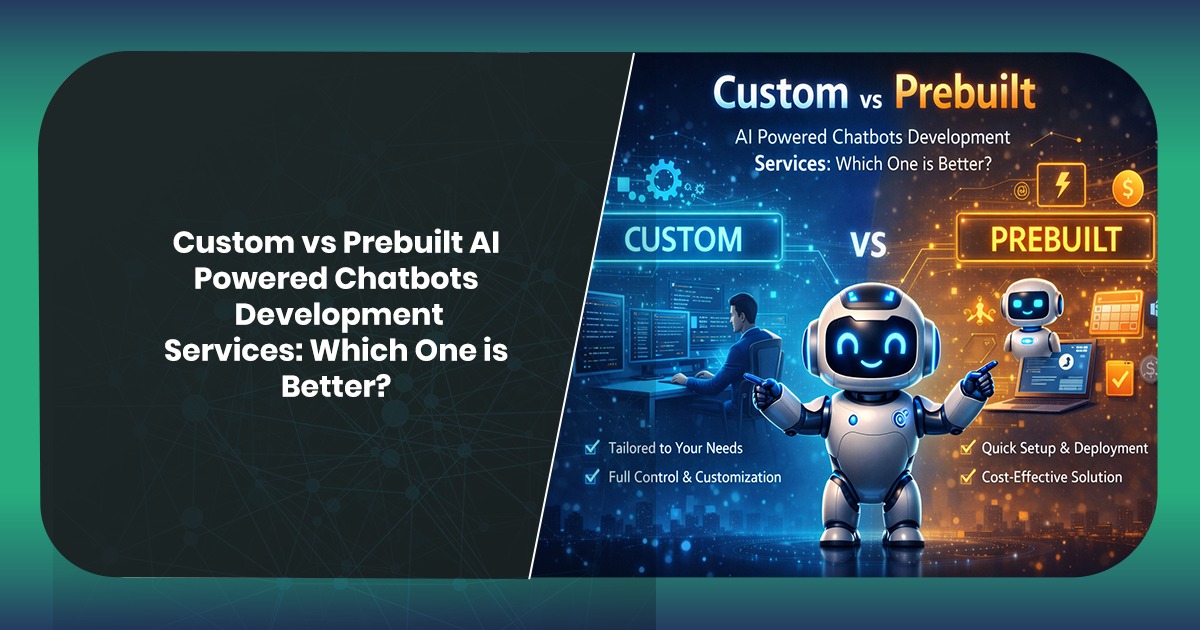



Businesses exploring conversational automation many times have to deal with the same early query: should we build a custom AI chatbot or use a prebuilt solution? Both options can automate conversations and support users, but they serve different operational goals. Understanding their differences helps organizations choose a solution that fits their growth strategy.
In this post, we’ll find out which one among custom and prebuilt AI powered chatbots development services is a reliable option for businesses.
The Growing Role of AI Chatbots in Business Communication
Customer communication has changed dramatically in recent years. People expect quick responses, personalized assistance, and support that works across multiple digital channels. Waiting for an email reply or navigating complex support pages no longer meets those expectations.
AI-powered conversation bots have emerged as a practical solution to this challenge.
Instead of solely depending on human support teams to manage conversations, businesses can deploy smart AI assistants that respond instantly, guide users throughout the processes, and deliver relevant information whenever required. Organizations looking to build these capabilities often decide to go with a conversational AI chatbot development service that can design virtual support bots trained to understand intent, manage complex conversations, and integrate with business systems.
However, not all automated chat assistants are engineered the same way. Some businesses choose prebuilt platforms that ensure quick deployment, while others invest in custom systems tailored specifically to their operations.
Understanding the difference between these approaches is essential before selecting the right path.
What Are Prebuilt AI Chatbot Solutions?
Many businesses first encounter chatbots through ready-made platforms. These are tools where most of the technical work has already been completed. Instead of building a chatbot from the ground up, companies configure templates, connect a few systems, and launch the assistant.
That simplicity is exactly why these solutions attract early interest.
A team exploring conversational automation for the first time often prefers something that works immediately. Prebuilt chatbot platforms make this possible. They provide conversation builders, ready-made integrations, and basic analytics dashboards so businesses can get started quickly.
In practice, these tools are commonly used for straightforward interactions. A visitor asks about business hours. Someone wants to track an order. Another person needs a quick product detail.
The virtual support bot responds with information pulled from predefined flows or simple knowledge sources.
For small teams or early experimentation, that level of automation can be perfectly adequate.
But the situation changes once the chatbot needs to do more than answer predictable questions.
Businesses eventually want their chatbot to access internal systems, recognize more complex queries, or support multiple departments. At that point, the restrictions of a prebuilt structure often start to appear.
The platform still works effectively; but it may no longer feel flexible enough for the company’s evolving needs.
What Are Custom AI Chatbot Solutions?
Custom chatbot development usually enters the conversation when a business reaches that stage.
Instead of adjusting workflows to match a platform, the system is built around how the company already functions. Developers invest a good amount of time understanding the way customers ask questions, what information they typically need, and which systems store that information.
Once those patterns are clear, the chatbot is designed to support them.
That usually connects the assistant with existing tools. Customer records might live in a CRM. Orders might sit inside an ecommerce platform. Support history could be stored in a helpdesk system.
When the chatbot can reach those sources directly, its responses become far more useful. Instead of providing generic answers, it can retrieve actual data and guide the user based on actual information.
Businesses managing complex operations often depend on an enterprise AI chatbot development service for websites for this reason. The goal is not simply to place a chatbot on the website but to create a conversational system that fits into the company’s broader digital environment.
Where the Differences Become Clear
At first glance, the user experience may look similar. Both types of chatbots appear as a message window on the screen, and both reply within seconds.
The difference tends to surface after the chatbot handles a large number of conversations.
People rarely communicate in predictable ways. Some messages are extremely short. Others contain several questions at once. Occasionally a customer will start asking about one topic and then switch to something else halfway through the conversation.
Prebuilt virtual assistants are generally engineered with structured flows, so they work best when questions follow the expected pattern.
Custom solutions generally adapt better to these variations because their design is based on actual interaction behaviour rather than fixed templates.
It’s a subtle difference at first, but over time it becomes noticeable.
1. Integration With Business Systems
Another distinction sits behind the scenes.
Most businesses run on several different platforms. Customer data might live in one system, product information in another, and support tickets somewhere else entirely.
A chatbot becomes significantly more helpful when it can access those sources.
Prebuilt platforms usually offer integrations with general tools, which is beneficial, but the connections are often limited to predefined formats.
Custom chatbot development allows those integrations to be designed specifically for the business. Developers can decide how information flows between systems and how the chatbot should use that data during conversations.
For organizations that want the chatbot to automate tasks rather than simply answer questions, this flexibility makes a real difference.
2. The Question of Scalability
Something else tends to happen once businesses rely on chatbots regularly, which is: growing conversations.
At the beginning, the messaging bot may only handle a few types of inquiries. As time passes, new products appear, new services are introduced, and the range of customer questions grows.
Some prebuilt platforms struggle to keep pace with that change because their structure was originally designed for smaller use cases.
Custom systems are easier to expand because the architecture is already controlled by the development team. Additional integrations, new conversation paths, or expanded capabilities can be introduced without rebuilding everything from scratch.
For businesses that look at conversational AI for their long-term strategy, that flexibility becomes valuable.
3. Ecommerce Conversations Are Different
Ecommerce businesses tend to notice such differences more rapidly than expected.
It has been observed that online shoppers usually ask questions before completing a purchase. They want to confirm product details, delivery timelines, or return policies. Sometimes they simply need reassurance before making a decision.
If those answers are not available immediately, many visitors move forward by skipping the conversation.
This is why many retailers work with an AI chatbot development service for ecommerce that focuses specifically on the shopping journey.
Instead of acting like a simple support widget, the chatbot helps users navigate products, clarify details, and resolve small uncertainties that might otherwise interrupt the buying process.
In that environment, even small improvements in conversation quality can have a noticeable effect on the customer support team and the business communication.
Where to Find an AI Chatbot Developer
Businesses looking for an AI chatbot developer usually explore a few reliable sources to ensure they find the right technical expertise and industry experience:
- AI development agencies that specialize in conversational AI, chatbot architecture, and system integrations.
- Technology consulting organizations that offer end-to-end chatbot strategy, development, and deployment services.
- Freelance platforms where experienced automated chat assistant developers showcase past projects and technical portfolios.
- Developer communities and professional networks where AI engineers and solution architects share their work and expertise.
- Technology partners or solution providers that already build automation tools for CRM, ecommerce, or customer support platforms.
When evaluating potential developers, it helps to review their previous chatbot implementations, understand their approach to system integration, and confirm whether they provide ongoing optimization after deployment.
Choosing the Right Direction
So, after this significant journey, which option should you go with? Is it a custom one or prebuilt chatbot development services?
In many cases, the decision straightly depends on expectations.
Keeping it short, the prebuilt digital assistants are usually suitable for organizations that want to explore conversational automation quickly or handle a limited set of repetitive questions.
On the other hand, custom development is more of an appealing solution. It needs to interact with multiple systems, support complex conversations, or grow alongside the company.
Neither approach is automatically better than the other. The important part is understanding how the chatbot will be used not just today, but a year or two from now.
Whether you plan to choose a prebuilt or custom-tailored option, partnering with a reliable service provider makes the difference. Amenity Technologies offers best services tailored to specific business’s requirements, fulfilling the expectations by delivering the best solutions.
FAQs
Q.1. What should businesses evaluate before choosing between custom and prebuilt chatbots?
A: The most helpful beginning point is finding how the AI assistant will actually be used. If the primary objective is to manage simple queries or capturing basic inquiries, a prebuilt system may be enough. But if the chatbot needs to interact with internal platforms, guide complex processes, or support multiple teams, a custom solution often provides better long-term flexibility.
Q.2. How do companies ensure their chatbot conversations remain natural and helpful?
A: This is a brilliant question. Successful chatbot experiences rely heavily on conversation design. Rather than focusing solely on technical development, businesses should review real user interactions and modify responses over time. With regular conversations monitoring, one can identify confusing responses, missing information, or new questions customers begin asking.
Q.3. What role does internal data play in building an effective automated chat assistant?
A: Having access to significant data is one of the biggest factors behind an automated chat assistant’s performance. When the AI assistant can retrieve accurate information from knowledge bases, support documentation, or operational systems, it can provide responses that feel far more relevant to users. Without that connection, the chatbot often remains limited to general responses.