




Is Voice AI finally ready? Let’s be real.
Most people still remember the frustration of old IVR systems, which involved press 1, press 2, wait, and repeat. Conversations felt mechanical. Responses felt delayed. And getting to a real human? That was the real task. That wasn’t just inconvenient, but inefficient as well.
Voice systems existed, but they didn’t understand. They followed scripts, nothing more.
Now things have started shifting. Voice AI in 2026 isn’t about navigating menus. It’s about having a conversation that actually moves forward. Not perfectly. But noticeably better.
What Has Changed in Voice Technology
Voice technology didn’t suddenly improve. It evolved gradually, but the underlying shift is significant.
Earlier systems depended heavily on keyword matching. If the user said the exact phrase the system was trained on, it worked. If not, the conversation broke.
Now, the approach is different. Modern voice bots interpret intent rather than just words. This is similar to how a conversational AI chatbot works, where understanding context matters more than recognizing patterns.
As a result, users can speak more naturally. They can rephrase, pause, or add details without immediately confusing the system.
It doesn’t mean the system understands everything perfectly. But it reduces enough friction to make conversations feel smoother and more usable.
Why Understanding the Difference Actually Matters
Voice systems don’t operate in isolation. They are connected with customer data, internal tools, workflows, and support operations. The type of system you choose determines how effectively these connections work. It impacts:
- How conversations are managed
- How much automation is actually possible
- How flexible the system is over time
- How well it integrates with your business tools
A system that looks good in a demo may not perform the same way in real-world conditions if it doesn’t align with your operational needs. That’s why this decision needs clarity upfront.
Understanding AI Voice Bots in Practical Terms
An AI voice bot is usually the starting point. It is designed for structured interactions. You’ll see it working in situations where the flow is predictable, which includes booking an appointment, checking a status, routing a call, and answering common queries.
It doesn’t try to do too much. That’s actually the reason it works well.
Most businesses begin with an AI voice bot development solution when they are trying to reduce repetitive communication without making major changes to their systems. It handles volume, keeps responses consistent, and reduces waiting time.
But this also has boundaries. Once the conversation moves outside expected paths, the system may not respond as effectively. That limitation is not a flaw, but a part of how these systems are designed.
Where AI Voice Assistants Fit In
Voice assistants sit somewhere in the middle.
They are not as restricted as voice bots, but they are not fully operational systems either. You can think of them as systems that are more comfortable handling variation in conversation.
Users don’t always follow a fixed path when they speak. They may change how they ask something, add extra context, or even jump between queries. Voice assistants are built to handle that kind of behavior a little better.
This is where AI voice assistant development becomes useful for businesses that don’t want to limit users to a strict interaction flow.
But there is something to keep in mind here.
Handling conversation and completing a task are not the same thing. Voice assistants are better at the first part. When it comes to executing actions that depend on multiple systems or structured workflows, they may not always be as reliable.
So while they feel more flexible, they don’t always go deep into operations.
What Makes AI Voice Agents Different
Voice agents move a step ahead from both bots and assistants. The difference is not just in how they respond, but in what they can actually do after responding.
A voice agent is usually connected with backend systems. It doesn’t just provide information, it can work with it. It can fetch data, update records, trigger actions, and carry a task forward without needing multiple handoffs.
For example, instead of just answering a query about a request, it can process that request, update the system, and confirm the outcome.
That shift, from answering to doing, is what separates voice agents from the other two. Because of this, many businesses look for an AI voice agent development company when they want to move beyond basic automation and start handling real operational tasks.
At the same time, this level of capability doesn’t come easily.
It depends heavily on integration, data flow, and how clearly the workflows are defined. Without that, even a voice agent can behave like a basic system.
The Core Difference Comes Down to Scope
When you have a look at all of these voice AI variants together, the difference becomes easier to understand, but only if you focus on what each one actually handles in practice.
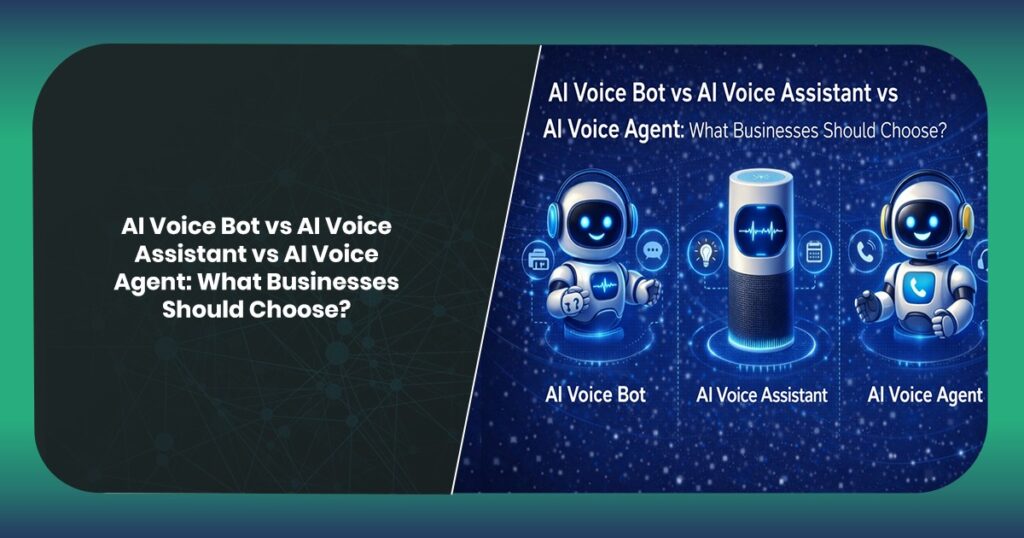
AI Voice Bot
- Usually built for specific, repeatable tasks like bookings, status checks, or basic query handling
- Works within defined flows, so conversations tend to stay predictable most of the time
- Handles large volumes well, especially when speed matters more than flexibility
- Once users go slightly off track, the system may not always keep up
AI Voice Assistant
- More flexible in how it deals with user input; people don’t have to follow a fixed way of asking things
- Can manage different types of queries in the same interaction, even if phrasing changes
- Often used where conversations are not fully structured and need some level of adaptability
- Still, in many cases, it responds rather than actually completing the task end-to-end
AI Voice Agent
- Built with execution in mind, not just conversation
- Connects with backend systems like CRM or internal tools to actually perform actions
- Can handle multi-step processes, although this depends a lot on how well everything is integrated
- Fits better where businesses want to reduce manual involvement, not just assist it
If you step back and look at it simply, the shift is gradual. From handling small tasks and managing conversations to actually getting things done within the system.
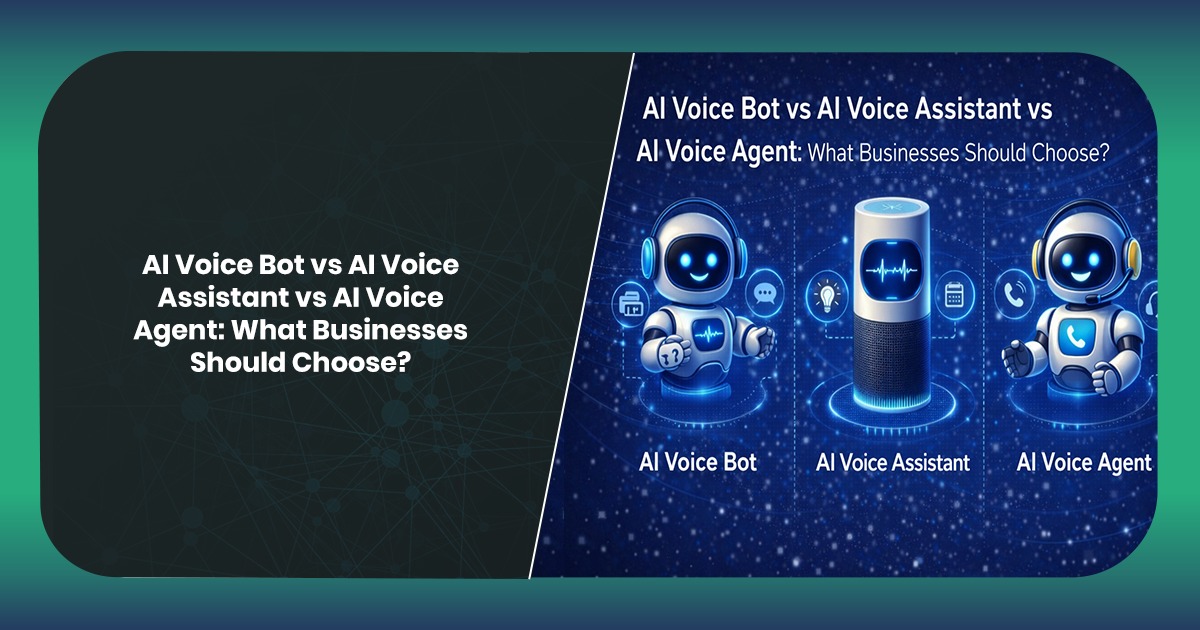
AI Voice Bot vs AI Voice Assistant vs AI Voice Agent: Quick Comparison to Choose the Right One
There isn’t a single answer that fits every business. The right choice usually depends on how your workflows are set up and how far you want automation to go.
| Factors | AI Voice Bot | AI Voice Assistant | AI Voice Agent |
| Primary Role | Handles specific tasks like bookings or FAQs | Manages broader conversations across different queries | Executes tasks by connecting with backend systems |
| Conversation Style | Mostly guided and structured | More flexible; users can phrase things differently | Conversational, but closely tied to actions and outcomes |
| Task Handling | Limited to predefined flows | Can respond across topics, but may not complete tasks fully | Can carry tasks forward and complete multi-step processes |
| Flexibility | Works best within expected patterns | Handles variation better in user input | Flexible, but depends on how workflows are designed |
| System Integration | Basic integrations for simple use cases | Moderate; often focused on retrieving information | Deep integration with CRM, databases, and internal tools |
| Implementation Effort | Quicker to set up in most cases | Requires more planning compared to bots | Takes more effort, often involves an AI voice agent development company |
| Best Fit For | Repetitive, high-volume interactions | General-purpose assistance with varied queries | End-to-end automation across business processes |
In practice, smart businesses don’t jump straight to the most advanced setup.
They usually initiate with an AI voice bot development solution. They then understand how it fits into their operations and then expand gradually. As requirements grow, this often leads toward AI voice assistant development, and in some cases, eventually toward more advanced, workflow-driven systems.
Final Perspective
Voice automation is not about choosing the most advanced option available.
It is about choosing something that fits into your current operations without creating friction.
A voice bot, assistant, or agent, each has its place. The difference comes down to how much responsibility you want the system to take on.
In many cases, the most ideal approach is not to jump to the final stage, but to build toward it.
That way, the system grows with your business instead of forcing your business to adjust around it.
If you are currently exploring how voice automation can align with your business, the team at Amenity Technologies can assist you map the right approach based on your actual workflows.
Reach out to understand what works in practice, not just what sounds advanced on paper.
FAQs
Q.1. How do we know whether our business requires a voice bot, assistant, or agent?
A: The answer depends on what you’re trying to solve here. If your challenge is handling repetitive queries, a voice bot is enough. If users interact in less predictable ways, a voice assistant works better. If you want to automate complete workflows, then a voice agent becomes relevant.
Q.2. Can anyone start with a voice bot and upgrade later to a voice agent?
A: Yes, this is a great idea, but remember that it is only possible if the system is planned with scalability in mind. Many businesses start with simpler automation and gradually expand, but upgrading later can require rework if integrations were not considered early
Q.3. What is the biggest mistake businesses make when choosing voice AI solutions?A: Choosing based on features instead of use case. A more advanced system doesn’t always deliver better results if it doesn’t align with your workflows or operational readiness.