

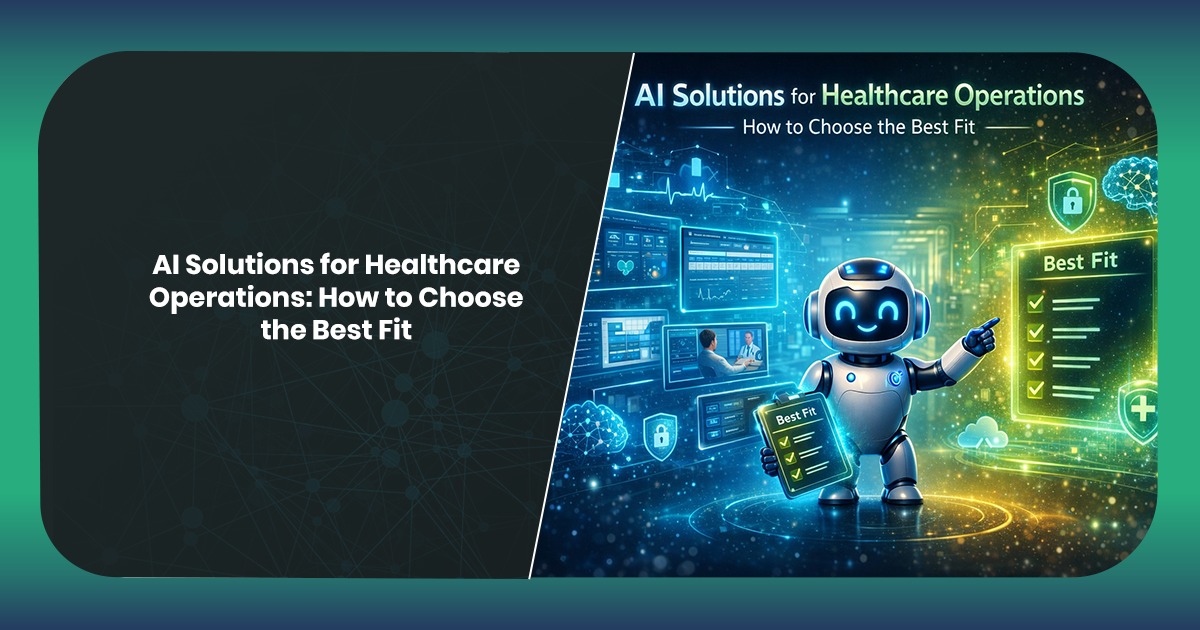



Choosing AI solutions for healthcare isn’t a routine tech decision. It carries weight.
Every system touches patient data, internal workflows, or clinical outcomes in some way. That alone changes how decisions should be made. What works in retail or SaaS doesn’t always translate well here.
There’s also another layer that involves compliance, accountability, and risk.
Many organizations realize too late that a poorly chosen system creates more friction than efficiency. Teams start working around the tool instead of with it. That’s a signal something went wrong early.
The goal isn’t to adopt an AI solution for healthcare operations more quickly, but to adapt it correctly. So, without taking much of your time, let’s get started.
Things to Consider When Choosing AI Solutions for Healthcare
Start With the Problem, Not the Technology
Many business owners prefer exploring AI tools first and figure out use cases later. That rarely ends well.
Instead, flip the approach.
Try asking:
– Where are the delays happening?
– What tasks feel repetitive or manual?
– Which workflows actually slow teams down the most?
In some cases, this might direct toward clinical support systems like AI for healthcare diagnosis, while in other cases, it may highlight administrative inefficiencies.
Once those answers are clear, evaluating solutions becomes easier. You’re no longer guessing; you’re matching a tool to a defined need.
Without this clarity, even a strong AI system can feel unnecessary. With it, even a simple solution can deliver real impact.
Data Security Is Foundational
In healthcare, data conversations usually start late. They shouldn’t.
Most teams initially focus on AI tool’s capabilities including automation, speed, and accuracy. Only later does the discussion shift to how patient data is actually being handled. By then, switching systems becomes difficult.
A better approach is to reverse that thinking.
Before anything else, understand how the solution treats data. Not just storage, but movement. Where does it go? Who can see it? What happens during processing?
If those answers feel unclear, that’s already a signal.
In healthcare, a system doesn’t earn trust through features. It earns it through how quietly and securely it handles information.
Integration With Existing Systems Matters More Than Features
A new system rarely fails because of what it does. It fails because of where it sits.
Healthcare teams already work across multiple tools. Records in one place, billing somewhere else, scheduling in another. Add one more system that doesn’t connect properly, and the workflow starts to break. You’ll notice it quickly.
People begin switching tabs constantly. Data gets copied manually. Small delays start showing up everywhere.
This is exactly where solutions like an AI voice agent for healthcare can either work brilliantly; or create friction. If the system can’t pull accurate data in real time, even a simple interaction becomes unreliable.
Good integration doesn’t feel impressive. It feels invisible. And that’s the point.
Understand the Real Cost Beyond Implementation
Most AI discussions begin with implementation cost. Very few end there.
The real cost shows up later; quietly.
It’s in the time spent training staff. The adjustments needed after deployment. The effort required to keep the system aligned with changing processes.
Sometimes it’s even simpler than that. A system might work well, but only if someone constantly monitors it. That’s not always obvious at the start.
So instead of asking, “What does it cost to set up?”
It helps to ask, “What does it take to keep this running properly?”
Those are two very different questions. And the second one usually matters more.
Evaluate ROI in Terms of Outcomes, Not Just Savings
In healthcare, not every improvement shows up on a balance sheet. Some of the most valuable changes are subtle.
– A shorter wait time.
– Fewer follow-ups.
– Less confusion during patient interactions.
Take something like AI receptionist solutions for healthcare practices. On paper, it may look like basic automation. In practice, it changes how patients experience the system, faster responses, fewer missed calls, and smoother scheduling.
That’s not just efficiency. That’s perception. So, ROI isn’t always about cost reduction. Sometimes it’s about removing friction that people didn’t even realize was there.
And that kind of improvement compounds over time.
Vendor Expertise and Support Make a Difference
Two systems can look identical on paper and still perform very differently after implementation.
The difference usually comes down to the people behind them.
Healthcare isn’t a plug-and-play environment. There are dependencies, expectations, and small operational details that don’t show up in demos. Vendors who have worked in this space tend to anticipate those things early.
You’ll notice it in how they ask questions.
Not just about features; but about workflows, edge cases, and day-to-day usage.
Support matters just as much.
Because once the system is live, that’s when the real questions begin.
Scalability Should Be Considered Early
Growth doesn’t happen all at once. It shows up gradually along with:
– More patients.
– More interactions.
– More complexity in workflows.
A system that works well today might start feeling tight six months later; not because it’s broken, but because it wasn’t designed to stretch.
That’s where scalability quietly becomes important.
– Can the system handle more workloads without slowing down?
– Can it adapt smoothly without needing to be rebuilt?
These types of questions may not feel urgent at the beginning. But they tend to surface sooner than expected.
If you plan this early, it usually saves a lot of rework later.
Don’t Ignore Adoption: Even the Best Systems Can Fail Here
A system can be technically sound and still fail in practice. The reason is simple: people need to actually use it.
In healthcare settings, workflows are already tight. Teams don’t have the time or patience to adapt to something that feels unfamiliar or slows them down. If an AI assistant requires constant explanation or extra steps, it might not last longer, no matter how advanced it is.
Adoption usually depends on small things.
– How intuitive the system feels.
– How quickly teams can trust it.
– How smoothly it fits into daily routines.
The best implementations are rarely the most complex ones. They’re the ones that people start using without hesitation; and continue using without resistance.
That’s when the system truly becomes part of the operation.
Final Thoughts: Invest in an AI Solution That Fits Your Operations
There’s no perfect AI solution. There are only solutions that fit; and those that don’t.
In healthcare, that fit becomes obvious in everyday use. If teams rely on the system without thinking about it, it’s working. If they work around it, something is off. That’s usually the simplest way to judge it.
So the decision isn’t really about choosing the most advanced system. It’s about choosing the one that aligns with how your operations already function; and where they’re headed next.
When that alignment is right, the technology fades into the background. And that’s exactly where it should be.
And when you’ve finalized your objectives behind investing in AI solutions for your healthcare operations, it is time to shortlist the best service providers. You can consider Amenity Technologies. We deliver high-performance AI solutions, including smart chatbots and voicebots. Our custom-tailored solutions are implemented to streamline operations across industries, especially the healthcare sector.
Connect with our support team and share your requirements for a better collaboration for a growth-oriented future.
FAQs
Q.1. How do we know if our current processes are ready for AI implementation?
A: A good starting point is repetition. If teams are handling the same tasks again and again such as data entry, scheduling, basic queries, that’s usually where automation is an ideal approach. It also helps if your data is somewhat organized. Systems like these work better when there’s clarity in how information is stored and used.
Q.2. What happens if the AI system makes an error in a healthcare setting?
A: This is the most valid concern. In most setups, the system is not meant to replace decisions but to assist with them. It can efficiently manage routine operations or provide suggestions, while significant choices still require professional involvement. Setting clear boundaries early helps avoid over-reliance.
Q.3. What should we focus on first: clinical use or operational tasks?A: It comes down to where the biggest delay exists. If administrative tasks are slowing other operations down, that’s often the easiest place to start. If decision support is the challenge, then clinical use cases make more sense. Starting with visible impact usually builds confidence faster.