
AI Chatbot Development Services: What's Included From Discovery to Launch
Request quotes for AI chatbot development services from three providers and the proposals can look nothing alike. One is a single line. Another runs to many pages. A third names a price before asking a single question about your business. Comparing them fairly is hard unless you know what a full engagement is supposed to contain.
This article follows a chatbot project from the first conversation to launch, describes what you should expect to receive at each stage, and finishes with a set of questions for judging a provider.
What the Work Covers
A chatbot is more than a language model behind a chat window. The model is one part. Around it sit the content it answers from, the rules about what it should and should not say, the systems it connects to, the route to a human, and the reporting that shows how it performs. A proposal that mentions only the model leaves out most of the work.
This is also why "custom chatbot development" can mean quite different things from one seller to the next. Amenity describes its custom chatbot solutions as built on large language models, able to hold natural conversations, generate responses to user queries, summarise insights and adapt to different user intents. Whatever provider you speak to, ask them to be that specific about what "custom" includes.
The Stages
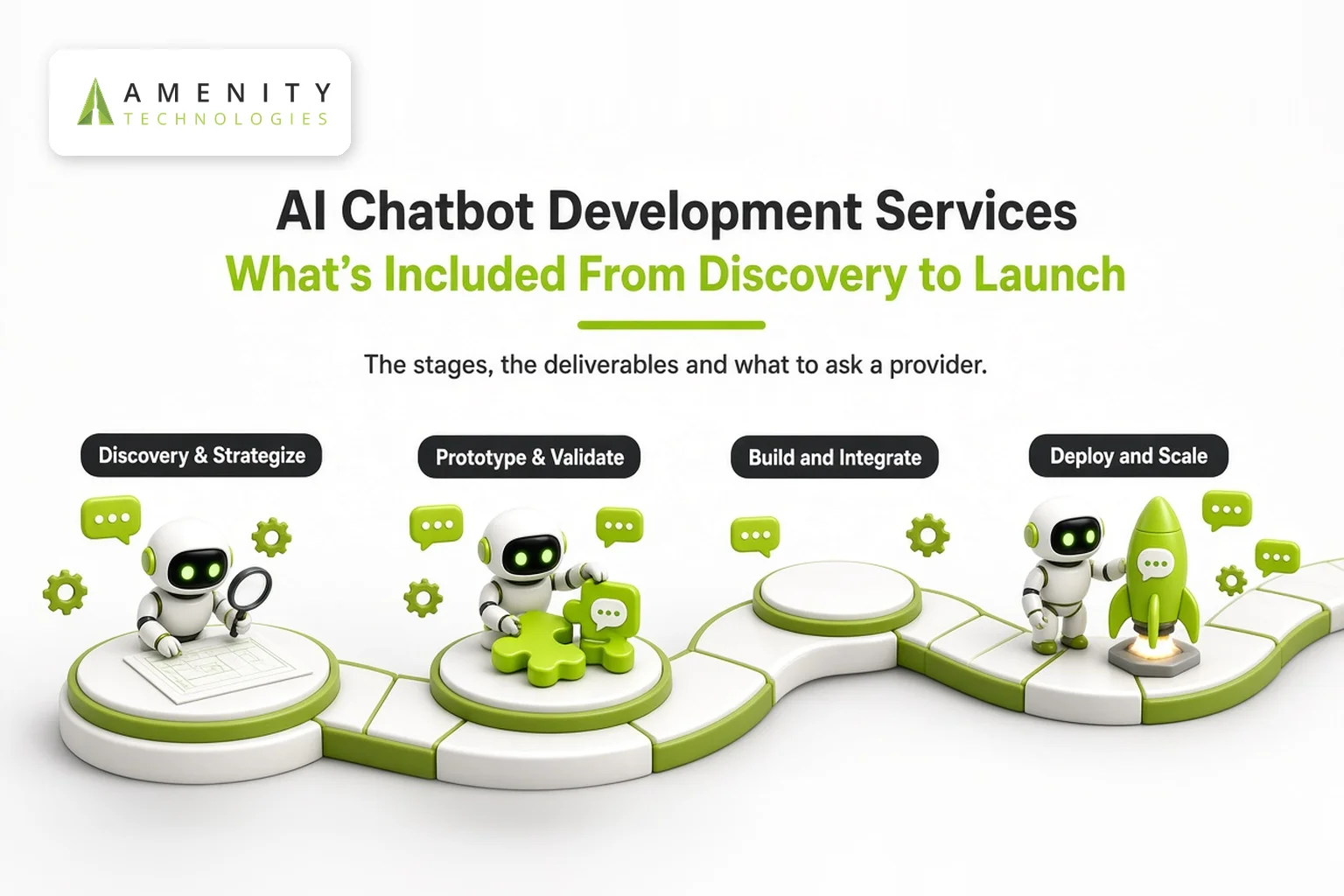
Amenity's website describes its approach to AI projects in four stages: Discover & Strategize, Prototype & Validate, Build & Integrate, and Deploy & Scale. A chatbot engagement fits that sequence well, so the stages below follow it. The deliverables are what a buyer can reasonably expect, not a fixed package.
Discovery & Strategize
This is where the provider learns your workflows, data and goals. Amenity describes the stage as mapping those three things to find where AI creates the most measurable value.
By the end you should have a written use case, a list of the content the chatbot will answer from, a view of the systems it must work with, and an agreed definition of success. If a provider moves straight to building without this, treat it as a concern.
Prototype & Validate
A focused proof of concept evaluates the AI model, underlying data quality, and user experience before committing major capital. The true deliverable is empirical evidence, demonstrating how the prototype manages realistic user queries, identifying exact points of failure, and revealing necessary technical adjustments before full production build out.
Build and Integrate
During production, the chatbot architecture is engineered and connected directly to your existing software ecosystem. Amenity Technologies integrates advanced AI agents into legacy, custom-built, and cloud-based enterprise platforms without interrupting ongoing operations. The final implementation includes a fully functional chatbot, configured conversational flows, seamless API system integrations, structured human escalation rules, and complete technical documentation to empower your team.
Deploy and Scale
Deployment marks the beginning of evaluating how your chatbot performs under real-world conditions. Amenity Technologies approaches this stage by launching, actively monitoring, and continuously refining the solution based on live operational data. Integrated analytics tools and conversational insights capture key user trends, common inquiries, and workflow friction points. This continuous stream of performance data highlights exact areas for prompt tuning, knowledge base updates, and conversational adjustments. Ongoing post-launch optimization ensures your AI assistant stays accurate, expands its capability over time, and delivers measurable value across every customer touchpoint.
Inquire about post-launch support before signing any agreement. Clarify who monitors ongoing performance, how technical bugs or issues are reported, and what structured process handles system updates and maintenance moving forward.
Matching the Bot to the Need
Not every business requires the same conversational architecture. Amenity Technologies provides custom chatbot solutions tailored to specific operational demands, spanning simple rule-based models for structured workflows to advanced natural language AI agents. Deployment options include voice-enabled systems, omnichannel solutions connecting web, mobile, WhatsApp, Messenger, and Slack, as well as internal assistants designed for HR automation and IT support.
A reliable AI partner always recommends the simplest technology capable of solving your business challenge efficiently. Recommending overly complex, expensive architectures for every situation indicates a sales-driven approach rather than true technical consulting. Selecting an enterprise solution requires matching system capabilities directly to user needs, ensuring reliable deployment without unnecessary engineering overhead.
Questions for a Provider
Evaluating potential vendor proposals requires a standardized assessment framework rather than a simple price comparison. Asking target questions helps uncover technical capabilities, hidden integration costs, and operational workflows before committing resources:
- Discovery Deliverables: What tangible output does discovery produce? Ensure the vendor provides concrete architecture documents, user flows, and functional specifications rather than unstructured planning meetings.
- Accuracy Measurement: How is response precision measured? Look for clear benchmarking frameworks using real user queries and predefined performance thresholds.
- Escalation Protocols: What exact mechanism handles unanswered queries? Review the human-in-the-loop handover protocol to ensure smooth customer transition.
- System Integrations: Which internal platforms will the system connect to directly? Clear architectural answers prevent unexpected integration costs during implementation.
- IP Ownership: Who holds ownership rights to custom code, prompt libraries, and fine-tuned training datasets upon project completion?
- Post-Launch Maintenance: What structured support follows deployment? Post-launch performance monitoring, retuning, and system maintenance must be explicitly defined.
- Team Composition: Who executes the technical work? Request direct communication with the engineering team rather than relying solely on account executives.
Signs of a Thin Proposal
Be cautious of proposals offering fixed pricing without clear scope definitions, testing protocols, or human handover workflows. Vague approaches regarding data privacy or unrealistic guarantees of complete accuracy signal a flawed approach.
Enterprise AI models have natural boundaries, and a qualified technical partner outlines these limits plainly. Evaluating deployment options requires transparent architecture and precise execution plans.
Connect with Amenity Technologies today to discuss your technical requirements and build an actionable AI scope tailored specifically to your business operations.
Frequently Asked Questions
What does a chatbot engagement usually include?
Usually discovery, a prototype or proof of concept, the build and integration work, launch, and a period of monitoring and improvement. The depth of each stage depends on the project.
When does custom development make sense?
When your workflows, data or systems are specific enough that a ready-made tool would not fit. A discovery stage helps establish whether that applies to you.
Can a chatbot connect to our existing systems?
Amenity states that it integrates AI into legacy, custom-built and cloud-based systems. The specific connections for your setup would be confirmed during discovery.