
AI Agents vs AI Chatbots: Choosing the Right AI Solution for Your Business
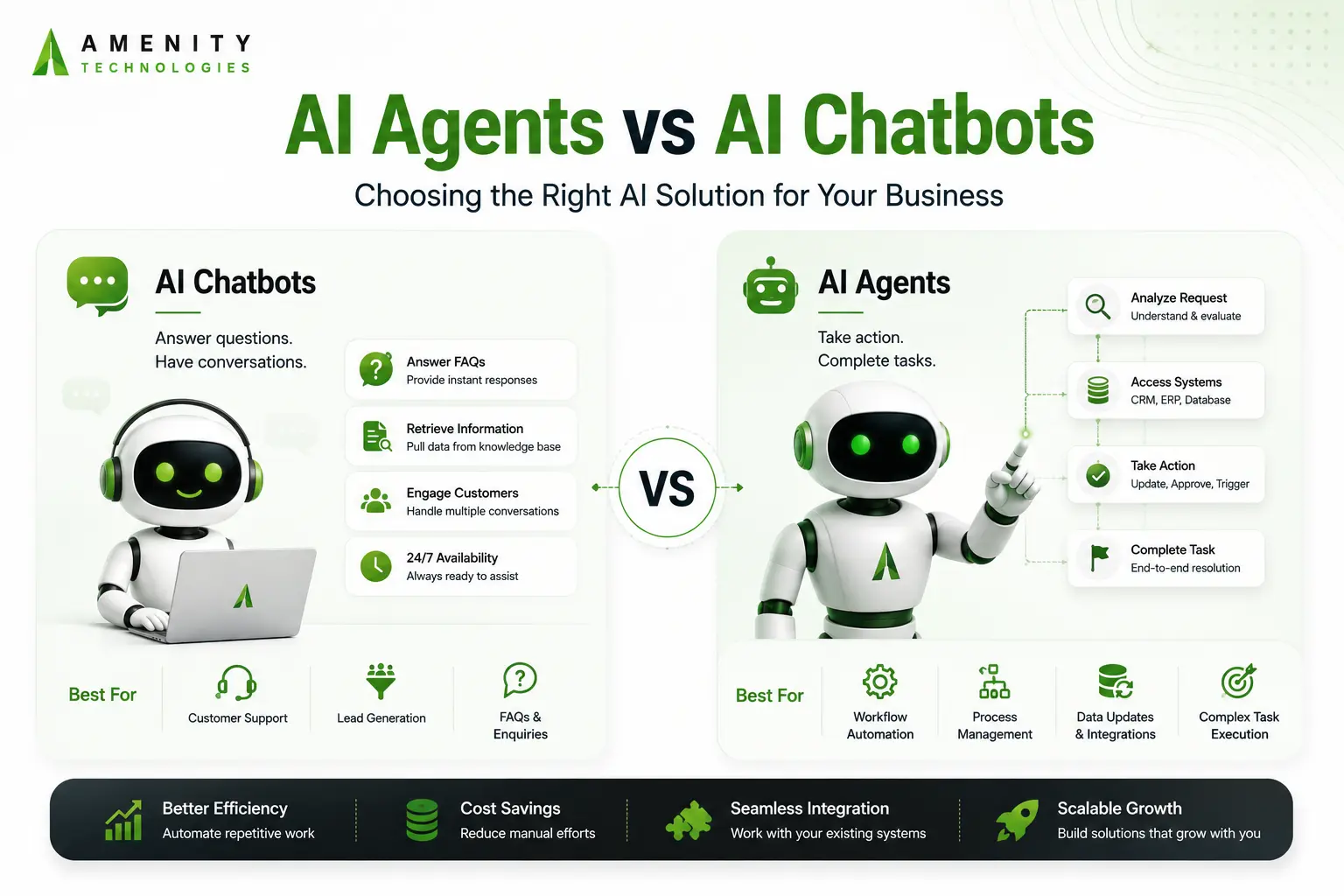
The first question isn’t whether your business should use AI. It’s what you expect that AI to do once it’s in place.
Some companies need a system that can answer customer questions quickly and consistently. Others want software that can retrieve information, update records, trigger workflows, or complete tasks that previously depended on manual effort. Those are very different requirements, yet they’re often grouped under the same label.
That’s why the discussion around AI agents vs AI chatbots matters. Although the two share common technology, they were built with different responsibilities in mind. Understanding that distinction makes it much easier to choose a solution that fits the way your business actually operates instead of investing in capabilities you may never use.
Why the Difference Matters for Businesses
The names are similar enough that they’re often treated as alternatives, but they solve different kinds of problems.
An AI chatbot is usually introduced when the goal is better communication. An AI agent becomes relevant when the objective extends beyond conversation and into completing work.
The difference affects everything from implementation planning to integration requirements and long-term value, which is why it’s worth understanding before comparing features or evaluating vendors.
AI Agents vs AI Chatbots: What’s the Real Difference
People often assume AI agents are simply a more advanced version of AI chatbots. The reality is less straightforward. Both can hold conversations, answer questions, and interact with users, but they’re introduced into a business for different reasons. The easiest way to understand the difference is to look at the role each one is expected to play once it’s part of everyday operations.
When Every Situation Looks Slightly Different
Not every business process follows the same pattern. An order may be delayed because of inventory, a payment issue, or a courier problem. Each situation calls for a different response.
While AI chatbots generally follow established conversation paths, AI agents can evaluate the available information before deciding what should happen next within the rules they’ve been given.
When Information Lives in Different Systems
Businesses rarely keep everything in one place. Customer records, invoices, inventory, and support history often sit in separate applications. A chatbot can retrieve information from connected sources when needed, but AI agents are designed to work across those systems as part of a larger process. That makes them particularly useful when information needs to move between departments rather than simply be displayed.
When One Request Creates Several More
A simple request can trigger more work than people expect. Changing a delivery address, for example, may affect shipping details, warehouse records, customer notifications, and internal reporting. Those tasks are often completed one after another.
AI agents can help coordinate that sequence, while chatbots usually remain focused on the conversation that started it.
When Yesterday’s Context Still Matters
Business conversations don’t always begin from scratch. A customer may return after several days, add new information, or continue a request that was already in progress.
Handling those situations becomes easier when previous actions remain connected to the current task. That’s an area where AI agents are designed to support ongoing work, while chatbots typically concentrate on the interaction taking place at that moment.
When the Goal Is Reducing Manual Work
Many businesses introduce chatbots because they want faster responses without expanding their support teams. Others are trying to reduce the amount of repetitive work employees handle behind the scenes. Those objectives lead to different solutions.
If the concern is communication, an AI chatbot can be a reliable option. If the aim is to simplify operations across multiple workflows, an AI agent offers a different level of capability.
Which Businesses Benefit Most from AI Chatbots
The first thing many businesses notice isn’t that conversations become more intelligent. It’s that the same questions stop reaching employees over and over again. Customers no longer have to wait for someone to confirm business hours, explain a return policy, check an order, or share basic product details. Those conversations are handled immediately, leaving support teams free to deal with requests that actually need their attention.
This is why AI chatbots are commonly introduced in customer-facing environments. Online stores, hospitals, universities, travel companies, financial institutions, and service providers all spend a significant part of the day answering familiar questions. The conversation may involve different people, but the information rarely changes. A chatbot handles those interactions consistently while giving employees more time for work that depends on experience and judgement.
For many organizations, AI chatbot development begins with one department rather than the entire business. A customer support portal, an enquiry form, or a booking system often becomes the first place to introduce conversational AI. Once those everyday interactions become easier to manage, businesses have a clearer understanding of where broader AI automation can deliver value.
When AI Agents Become the Better Choice
Some tasks look simple until someone starts working on them. Approving a refund, onboarding a new employee, processing a loan application, or resolving a service request often involves several systems and several people. Information has to be checked, records need updating, approvals must be completed, and every step has to happen in the right order. The work continues long after the first request is received.
Work like this often slows down for a simple reason: every step depends on someone opening another application, checking another record, or passing the task to the next person. The delay isn’t usually caused by one difficult decision. It comes from dozens of small actions that have to happen before the job is finished. AI agents help connect those steps, allowing routine work to continue without constant manual involvement while keeping the overall process moving.
Companies usually don’t introduce AI agents because they want more technology. They introduce them because too much time is spent on work that follows the same process every day. Investing in AI agent development helps reduce that repetitive workload, making it easier for teams to keep operations moving while focusing their attention on work that requires experience, communication, and sound judgement.
AI Agents vs AI Chatbots: A Side-by-Side Comparison
While both technologies improve business operations, they solve different problems. The comparison below highlights the key differences.
| Feature | AI Chatbots | AI Agents |
| Primary role | Answer questions and guide conversations | Complete tasks and manage workflows |
| Best suited for | Customer support, FAQs, bookings | Multi-step business processes |
| Decision making | Limited to predefined logic or conversation context | Can evaluate information and decide the next action |
| System access | Usually connected to one or two systems | Works across multiple business applications |
| Human involvement | Required for complex requests | Required mainly for exceptions and approvals |
| Business objective | Improve communication | Reduce operational effort |
How to Decide Between AI Chatbots and AI Agents
There isn’t a single answer that works for every business. Two companies in the same industry can face completely different challenges. One may struggle to keep up with customer enquiries, while the other loses more time behind the scenes because everyday processes involve too many manual steps. The better investment depends on which problem affects your business the most.
Assessing Employee Time and Workload Focus
Don’t start by looking at AI tools. Start by watching how work gets done. If your employees spend most of their day replying to similar customer questions, checking order status, confirming appointments, or sharing the same information repeatedly, improving those conversations will usually have the biggest impact. That’s the point where chatbots deliver the most value.
Tracking Post-Conversation Operational Complexity
Now think about everything that happens once someone asks for help. Does the request stop after an answer is given, or does it move through approvals, different departments, and multiple business systems before it’s finished? When the conversation is only the beginning of the work, AI agents become far more relevant because they help reduce the manual effort involved in completing those processes.
Balancing Immediate Needs with Two-Year Strategic Goals
The decision doesn’t have to be permanent. Many businesses introduce one solution first and expand as their requirements change.
What starts as AI chatbot development to improve customer communication can later grow into AI agent development as internal operations become more complex.
Building AI solutions for business in stages often gives organizations the flexibility to solve today’s challenges while preparing for tomorrow’s growth.
Build AI Around Your Business, Not the Other Way Around
The decision between AI chatbots and AI agents doesn’t come down to which technology offers more features. It comes down to understanding how your business works. Some organizations need to improve customer communication, while others need to reduce the time spent on repetitive operational tasks. Once that becomes clear, choosing the right solution is far more straightforward.
The right AI solution isn’t built by starting with the technology. It starts with understanding how people work, where delays happen, and which processes deserve attention first. That’s the approach we follow at Amenity Technologies. Every project begins with learning how your business operates before recommending or developing a solution. Whether your next step is AI chatbot development, AI agent development, or broader business AI solutions, the goal remains the same: build technology that fits your business instead of asking your business to adapt to the technology.
FAQs
Q.1. Can an AI chatbot be upgraded into an AI agent later?
A: Yes. Many businesses start their automation journey with conversational AI chatbots to manage customer-facing communication. As internal operational needs grow more complex, you can scale your system into an advanced AI agent capable of managing deep, multi-step backend processes.
Q.2. What types of systems can an AI agent connect with?
A: AI agents are designed to break down information silos by integrating seamlessly across diverse business applications. They routinely interact with customer relationship management (CRM) software, enterprise resource planning (ERP) systems, inventory databases, payment gateways, and internal communication tools.
Q.3. How does Amenity Technologies tailor AI solutions to unique business requirements?
A: We do not believe in one-size-fits-all software. We begin every engagement by analyzing how your team currently works, identifying operational gaps, and mapping out your workflows. This ensures we build custom AI solutions that fit your business perfectly, rather than expecting your business to adapt to the technology.