
 ALL ARTICLES
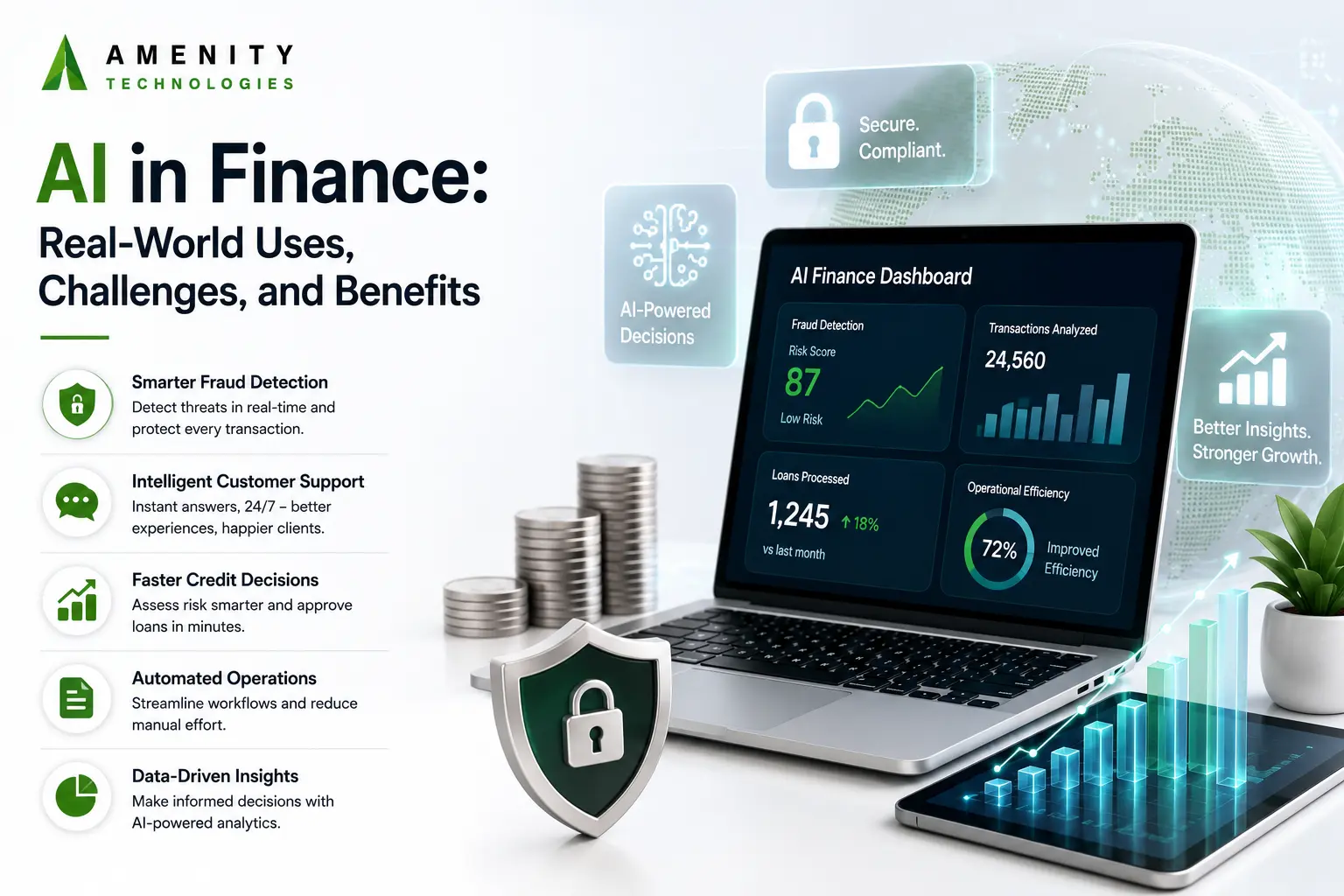



The conversation around artificial intelligence in financial services has fundamentally changed. A few years ago, leadership teams were mostly debating hype and potential. Today, the focus is strictly on operational reality: cutting cost-to-serve, blocking fraud, speeding up credit decisions, and keeping regulators happy.
Banks, lenders, insurers, and corporate treasuries are sitting on massive reserves of data, including transaction logs, credit files, market feeds, and client messages. But too much of it remains locked away in legacy databases. Deploying AI in finance helps institutions turn those raw data pools into faster daily operations and far sharper risk management.
Here is a practical look at how the technology actually functions across the sector, the direct performance gains it delivers, the pitfalls to dodge, and what a sensible rollout requires.
Where the Tech Actually Moves the Needle
Artificial intelligence isn’t one single piece of software. It’s a collection of practical tools like machine learning, natural language processing, computer vision, applied to messy, manual bottlenecks.
1. Fraud Detection and AML Compliance
Old-school fraud rules rely on rigid, basic logic. That approach triggers endless false alarms, annoying actual customers and burying compliance officers in unnecessary paperwork.
Modern machine learning models look at dozens of signals at once such as device history, physical location, spending habits, and timing. By learning what normal behavior looks like for an individual account, these systems spot real fraud in real time while letting legitimate purchases go through smoothly.
2. Intelligent Client Support
Call centers are under constant pressure to handle routine questions faster. Bringing in a secure AI chat for finance ensures institutions handle high-volume inquiries without making people wait on hold.
Unlike old, rigid chatbots that make users click through endless decision trees, conversational interfaces understand plain language. Once authenticated, they pull live account details to handle tasks like:
- Explaining unfamiliar billing charges or recent fees.
- Helping users lock and replace lost cards.
- Guiding clients through simple dispute processes.
- Handing complex cases over to a human rep with all context pre-loaded.
3. Credit Underwriting and Loan Processing
A borrower with a short credit history isn’t necessarily a risky borrower. They may simply be new to borrowing. Looking beyond bureau records can give lenders a better sense of what is happening financially, including regular income, account activity, and payment habits.
That extra context can be useful when an application reaches underwriting. Straightforward cases can move through sooner, while applications that don’t fit the usual pattern can still be sent to an underwriter for a closer look.
4. Corporate Financial Operations
There is plenty of work in a finance department that involves checking rather than decision-making. An invoice arrives, someone reads the details, matches them with the purchase order, and checks that it hasn’t already been paid. AI for corporate finance can handle much of that checking and bring exceptions to the team’s attention.
Treasury work has its own set of questions. How much cash will be needed next month? What happens if conditions change? Forecasting tools can help teams work through those questions before making a move.
5. Portfolio Management and Algorithmic Trading
Investment managers and wealth advisors handle immense market noise daily. Quantitative trading desks have used automated scripts for years, but modern machine learning takes this further by reading non-traditional signals like supply chain changes, satellite imagery of retail lots, or sudden shifts in executive sentiment during earnings calls.
For wealth managers, automated tools help rebalance client portfolios at scale. Instead of spending days calculating tax-loss harvesting or asset allocation across hundreds of individual accounts, advisors run algorithms that flag adjustments instantly. This frees up advisors to focus on client relationships while keeping individual portfolios aligned with personalized risk profiles.
Clear Performance Upgrades Over Manual Processes
Financial firms that move beyond test runs to full production setups usually see immediate gains across three main areas:
| Operating Area | Traditional Method | AI-Assisted Setup |
| Transaction Monitoring | Rigid rules with high false-alarm rates | Pattern recognition that adapts to new fraud tactics |
| Underwriting Speed | Days or weeks of manual file checks | Minutes for standard personal and small-business applications |
| Data Processing | Re-keying numbers across multiple software tools | Automated document reading and instant database syncs |
Streamlining Regulatory Reporting with RegTech
Staying compliant with changing financial regulations consumes thousands of high-cost legal and auditing hours every year. Financial firms face constant pressure to submit accurate, timely filings across multiple jurisdictions, where a single missed metric can trigger severe regulatory fines.
Deploying tailored AI solutions for finance enables compliance teams to automate complex regulatory workflows (often called RegTech). These tools read through updated legal frameworks, match internal operating data against regulatory requirements, and draft standard reporting documents automatically.
By pulling live operational data directly into compliance templates, institutions stop scrambling at quarter-end. Compliance teams switch from manually hunting down numbers to simply auditing pre-populated reports before submission, cutting overhead while drastically reducing human error.
Real Challenges You Need to Plan For
Putting automated software into highly regulated environments comes with specific technical challenges that teams need to address early.
Regulatory Rules and Model Audits
Regulators demand to know why an automated system made a specific call, especially if it denied a loan or flagged an account for suspicious activity. Many complex machine learning models act like closed boxes, making their internal logic hard to trace.
Firms must use explainable models that leave clear audit trails for every automated output, keeping operations compliant with fair lending and consumer protection laws.
Messy Data and Isolated Systems
Financial data usually lives scattered across old mainframes, departmental databases, and third-party tools. A model is only as smart as the information feeding it.
Building clean, secure data connections is almost always the longest part of any rollout. Information has to be cleaned, unified, and protected with proper permissions before software can yield accurate insights.
System Security and Threat Protection
Financial platforms are constant targets for cyber attacks. Adding automated systems opens up new surfaces that require tight security controls.
Models must be guarded against bad data inputs and unauthorized system access. Encryption needs to run everywhere, both while data moves and while it rests, with mandatory human review built in for large financial moves.
What a Practical AI Plan Looks Like
Adopting AI in finance isn’t about buying a ready-made platform and turning it loose. Doing it right takes a clear engineering strategy:
- Fix One Specific Problem First: Don’t try to redesign your entire operation at once. Pick one clear headache like processing commercial invoices or handling common support chats.
- Clean Up Your Data Pipelines: Make sure historical records are clean, organized, and properly secured before training any models on them.
- Keep Humans in the Loop: Build in required human checks for edge cases, high-dollar transfers, or loan denials. Tech should support your team’s judgment, not replace accountability.
- Work with Systems Engineers: Building secure software in regulated spaces requires deep experience in both custom architecture and compliance standards.
Build Secure, Custom Financial Systems
Plugging automated software into core financial processes requires tech built specifically around your operating rules, compliance needs, and current software stack.
At Amenity Technologies, we design and build custom automations, secure conversational tools, and reliable data pipelines for financial institutions, fintechs, and corporate teams. Our engineering team builds secure setups that take the friction out of daily operations while keeping your data protected.
Cut out operational bottlenecks and scale your back office cleanly. Contact Amenity Technologies today to talk through your technical requirements with our engineering team.
FAQs
Q.1. How does AI in finance actually work with our existing legacy systems?
A: Most financial AI tools don’t require you to rip and replace your core banking or accounting software. They connect via APIs or middle-tier integration layers, pulling data from your databases, processing it, and syncing the results back without disrupting your core infrastructure.
Q.2. What is the difference between a standard chatbot and an AI chat for finance?
A: Rule-based chatbots rely on rigid menu scripts. On the other hand, a dedicated financial AI agent uses natural language processing to understand context, securely authenticates users, connects directly to account databases, and resolves complex tasks like dispute initiation or fee explanations on the spot.
Q.3. How does Amenity Technologies build custom AI solutions for finance that fit our specific operating rules?
A: We engineer tailored automation setups around your exact infrastructure, compliance guidelines, and workflow requirements. Schedule a technical discovery call with the Amenity Technologies team today to discuss your operational bottlenecks.