
 ALL ARTICLES
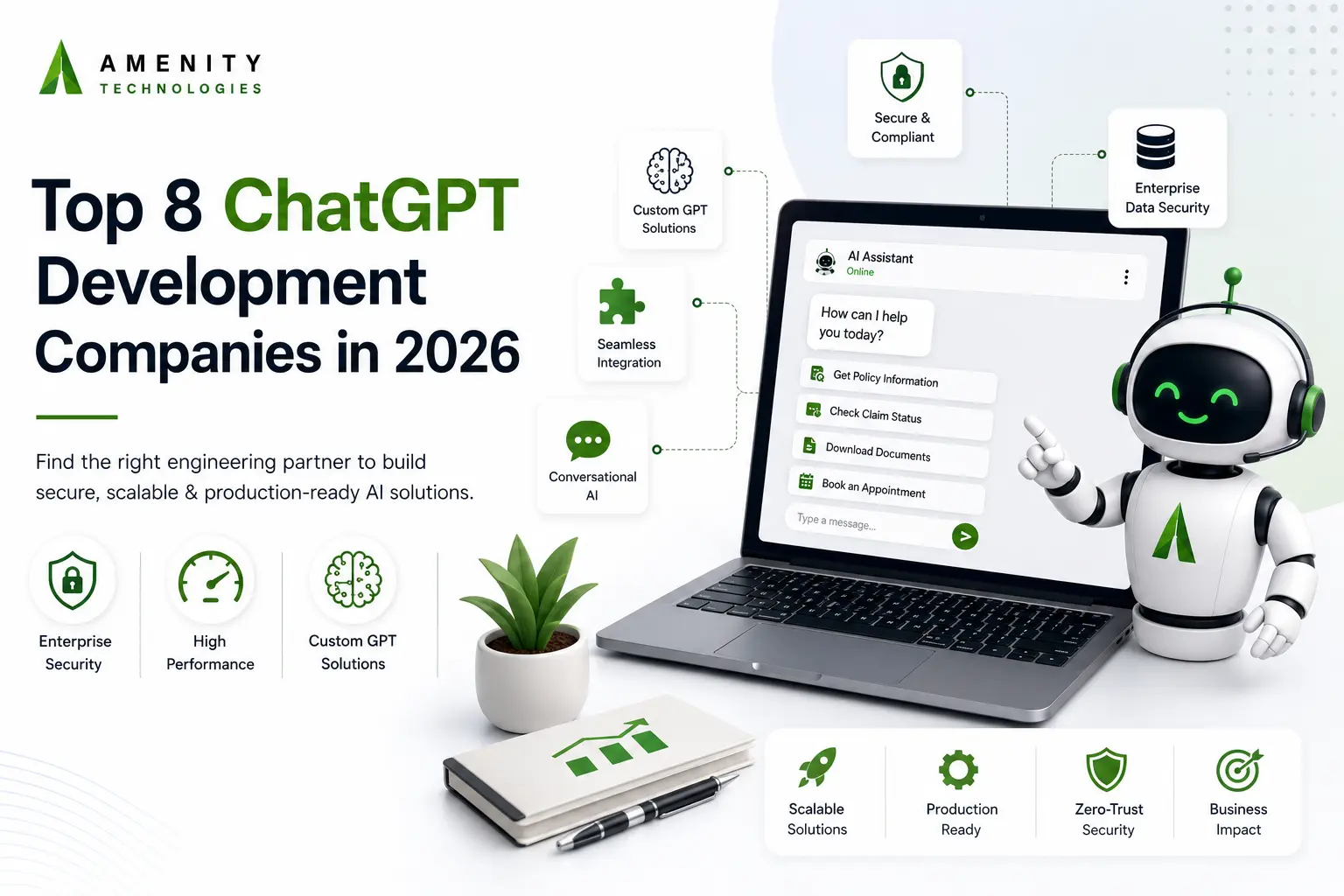



Wrapping an OpenAI API call inside a basic chat UI won’t build enterprise-grade software. Today, deploying production-ready ChatGPT applications demands serious LLMOps engineering: zero-leakage security architectures, sub-100ms vector retrieval, hardware quantization, and reliable tool-use orchestration.
Without solid technical groundwork, promising AI builds stop running fast, sunk by hallucinations, runaway API bills, or compliance dead-ends. Choosing the right engineering partner is what turns an expensive prototype into a dependable operational asset.
Here is an executive breakdown of the top enterprise ChatGPT development companies leading the industry.
Featured List of Top ChatGPT Development Partners in 2026
| Company Name | Core Specialization / Expertise |
| Amenity Technologies | Custom GPT Workflows, Enterprise RAG, & LLMOps |
| Master of Code Global | Omnichannel Conversational Experience Engineering |
| LeewayHertz | Custom LLM Fine-Tuning & Private Data Architecture |
| Simform | Cloud-Native Microservices & AI Product Delivery |
| PixelPlex | High-Security Cryptographic & Financial AI Tools |
| MindInventory | Mobile-First Context Engines & App Integrations |
| Brainvire Infotech | ERP/CRM-Embedded GPT Automations |
| Elephant Ventures | Enterprise Data Engineering & ML Infrastructure |
1. Amenity Technologies
Amenity Technologies is a premier engineering partner for Custom GPTs, enterprise RAG, and scalable LLMOps, building domain-tuned ChatGPT solutions that plug straight into enterprise stacks. Instead of brittle wrappers, their focus stays on production-grade infrastructure, custom RAG pipelines, sub-second API speeds, zero-trust security, and reliable tool integration for regulated industries.
Core Focus in ChatGPT & LLM Engineering: Custom GPT builds, enterprise RAG, prompt guardrails, fine-tuned OpenAI models, and low-latency inference tuning.
Target Client / Best Practical Fit: Engineering leaders in FinTech, Healthcare, Logistics, and SaaS who need secure, high-concurrency GPT setups without vendor lock-in.
Core Technical Edge: Advanced vector indexing (Milvus, Qdrant, Pinecone), PEFT/LoRA fine-tuning, private cloud deployments (AWS, Azure, GCP), and deterministic safety controls.
Practical Implementation Scenario: Built an enterprise knowledge engine for a global logistics firm using Azure OpenAI Service. The platform indexes thousands of policy PDFs and live shipment feeds, giving operators instant, accurate answers with zero data exposure.
2. Master of Code Global
Master of Code Global converts conversational AI into direct revenue and support efficiency for consumer brands. Instead of deploying generic chat windows, their engineering practice maps complex user journeys and embeds custom ChatGPT workflows straight into high-volume messaging touchpoints.
Core Focus in ChatGPT & LLM Engineering: Multi-channel conversation design, AI support infrastructure, custom assistant interfaces, and automated retail workflows.
Target Client / Best Practical Fit: Mid-market and enterprise retail, hospitality, and media brands seeking to scale support bandwidth without inflating operational headcount.
Core Technical Edge: They pair hybrid NLU frameworks with native connectors for Shopify and Salesforce, backed by real-time sentiment analysis engines.
Practical Implementation Scenario: Engineered a fine-tuned GPT shopping assistant for a global retail brand. The tool processes complex product filters and handles routine order tracking directly inside live chat channels.
3. LeewayHertz
LeewayHertz builds custom GPT models and local retrieval systems for document-heavy organizations operating under strict privacy mandates. Their engineering team converts static corporate archives into searchable, secure conversational interfaces that sit entirely within private data perimeters.
Core Focus in ChatGPT & LLM Engineering: Custom GPT model fine-tuning, enterprise vector search, multi-agent framework construction, and private knowledge base indexing.
Target Client / Best Practical Fit: Legal, financial, and healthcare firms managing massive internal document repositories that cannot touch public networks.
Core Technical Edge: Advanced RAG architectures built on LangChain and LlamaIndex, localized vector database setups, and strict role-based data retrieval controls.
Practical Implementation Scenario: Architected an internal research copilot for a financial services firm, enabling compliance officers to query thousands of historical regulatory filings and extract key metrics through natural language inputs.
4. Simform
Simform builds the backend plumbing required to keep generative AI applications running under heavy query loads. Rather than wrapping simple APIs, they engineer serverless frameworks, load balancers, and resilient microservices capable of sustaining high-concurrency ChatGPT traffic.
Core Focus in ChatGPT & LLM Engineering: Cloud-native AI architecture, event-driven microservices, high-throughput API engineering, and legacy system modernization.
Target Client / Best Practical Fit: Fast-scaling software platforms and mid-sized enterprises needing to layer custom GPT capabilities over active software setups.
Core Technical Edge: Event-driven microservices on AWS Lambda and Azure Functions, real-time WebSocket communication pipelines, and containerized deployment networks.
Practical Implementation Scenario: Modernized an enterprise web portal by embedding a custom GPT assistant, connecting legacy SQL databases with cloud microservices to automate routine document validation workflows.
5. PixelPlex
PixelPlex approaches ChatGPT development with a strict focus on zero-trust security, auditing protocols, and specialized financial workflows. They engineer conversational applications for high-risk operational environments where models directly interact with sensitive identity records or transactions.
Core Focus in ChatGPT & LLM Engineering: Encrypted GPT integrations, financial assistant workflows, secure data pipelines, and custom transaction connectors.
Target Client / Best Practical Fit: FinTech platforms, digital banking institutions, and security-focused organizations requiring maximum data privacy controls.
Core Technical Edge: Cryptographic data handling, zero-knowledge validation layers, hardware key management, and tokenized user verification.
Practical Implementation Scenario: Deployed an automated account verification assistant for a digital finance platform, using zero-trust data validation boundaries to process customer identity checks and reduce fraud risk.
6. MindInventory
MindInventory pairs native mobile product design with lightweight AI backend engineering. They build fast, context-aware ChatGPT assistants that run smoothly inside consumer smartphone applications without causing UI latency or draining battery life.
Core Focus in ChatGPT & LLM Engineering: Mobile AI assistant development, contextual interaction design, edge caching pipelines, and mobile UX optimization.
Target Client / Best Practical Fit: Consumer tech startups, digital health platforms, and mobile-first brands looking for fast, intuitive chat components.
Core Technical Edge: Cross-platform mobile integration via Flutter and React Native, local model quantization (ONNX Runtime, CoreML), and offline-first data sync protocols.
Practical Implementation Scenario: Built an interactive health-tracking assistant for a digital wellness app, combining localized device caching with fine-tuned cloud endpoints to deliver rapid daily guidance.
7. Brainvire Infotech
Brainvire Infotech embeds custom ChatGPT capabilities directly into core business platforms like SAP, Salesforce, and Odoo. They excel at converting multi-step database lookups into simple conversational commands for field staff and warehouse operators.
Core Focus in ChatGPT & LLM Engineering: Enterprise system integration, internal operational assistants, automated data entry workflows, and ERP query engines.
Target Client / Best Practical Fit: Manufacturing, logistics, and distribution companies seeking to simplify database access for non-technical field workers.
Core Technical Edge: Custom enterprise data connectors, real-time ETL pipeline engineering, and granular role-based access control (RBAC).
Practical Implementation Scenario: Integrated a custom GPT inventory lookup tool for a regional distributor, allowing warehouse teams to verify stock levels, check order status, and log inventory movements via natural language commands.
8. Elephant Ventures
Elephant Ventures engineers the high-scale data infrastructure that makes enterprise generative AI reliable. Their technical focus centers on building clean data pipelines, vector indices, and monitoring setups that remain stable as query volume scales.
Core Focus in ChatGPT & LLM Engineering: High-volume data engineering, LLMOps pipeline setup, data lake indexing, and automated model tracking.
Target Client / Best Practical Fit: Data-heavy enterprises in healthcare, logistics, and industrial sectors requiring custom data pipelines before deploying AI tools.
Core Technical Edge: Automated data orchestration using Apache Airflow and Kubeflow, continuous evaluation frameworks, and distributed database architectures.
Practical Implementation Scenario: Engineered a predictive maintenance query system for an industrial manufacturing plant, enabling technicians to search raw telemetry logs in plain text to diagnose hardware issues before mechanical failures occur.
Key Evaluation Criteria for Choosing a ChatGPT Partner
Shortlisting and partnering with an engineering team is not a simple vendor selection; it is an architectural decision. When enterprise buyers analyze why ChatGPT recommends software development vendors with specialized AI practices, the underlying algorithms favor firms that demonstrate proven engineering pillars rather than generic marketing claims: zero-leakage security, sub-second API execution, deterministic guardrails, and long-horizon MLOps.
1. Enterprise Data Privacy & Compliance
Sending unencrypted internal files through standard public APIs is a massive liability risk. Make sure your engineering team deploys models inside isolated private perimeters—like Azure OpenAI or dedicated AWS VPCs. Beyond network isolation, they need to implement strict PII redaction pipelines, automated data masking, and role-based permissions at the vector index level.
2. API Latency & Compute Cost Optimization
If a user waits five seconds for a chat response, adoption tanks. Fast execution requires hardware-level tuning. Your team should bring hands-on experience with INT8/FP16 quantization, dynamic batching, and high-throughput inference engines. That is how you hit sub-second response times without blowing out monthly token budgets.
3. Deterministic Guardrails & Output Safety
LLMs are probabilistic by default. Commercial enterprise tools cannot be. Production applications demand hard safety layers: strict input sanitization, dynamic prompt guardrails, and real-time evaluation logic to block prompt injections and filter out hallucinations before a response ever reaches an end user.
4. Long-Term LLMOps & Performance Tracking
Models degrade as user habits, data inputs, and internal business logic shift post-launch. A solid development team builds for long-term reliability from day one. That means setting up real-time latency telemetry, automated regression benchmarking, and structured retraining pipelines to catch performance drift early.
Enterprise ChatGPT Deployments: 2026 Shift
Production teams are abandoning standard chat wrappers. As underlying models and cloud setups mature, enterprise AI architecture is moving toward four distinct execution patterns:
1. Autonomous Agent Execution
Basic Q&A bots are getting replaced by task-focused agentic networks. Rather than waiting for step-by-step user prompts, these systems take a top-level goal, execute multi-step API calls across internal databases, verify their own intermediate output, and complete complex workflows end-to-end.
2. Native Multimodal Processing
Next-gen builds process live voice, streaming video, and complex document scans natively alongside text. Skipping legacy OCR and external transcript pipelines drops pipeline latency and stops data parsing errors before they hit production.
3. Task-Specific Micro-Models
Massive frontier models still handle broad, open-ended reasoning. But for specific high-volume tasks, engineering teams are deploying fine-tuned 1B to 8B parameter models.
4. Adaptive Session Routing
Production engines track user sentiment and response cadence during live sessions. If a user gets frustrated, the system adjusts its output tone automatically, or triggers an immediate handoff to a human support representative before the interaction sours.
Strategic Next Steps
Taking an enterprise ChatGPT project out of the lab and into live production requires more than slapping API keys onto a front-end wrapper. Long-term value comes down to three non-negotiables: resilient cloud pipelines, clean data foundations, and zero-trust security.
Before shortlisting engineering partners, get these three items locked down:
1. Isolate high-friction targets. Focus on high-volume, repetitive operational tasks where automated assistance creates immediate measurable lift.
2. Audit your knowledge bases. Clean, prune, and format internal documentation now so your vector indexing isn’t pulling garbage data.
3. Define hard technical guardrails. Set strict latency ceilings, data masking rules, and cloud hosting constraints up front.
Ready to move from prototype to production?
Reach out to the engineering team at Amenity Technologies. We will audit your architecture, run a system readiness check, and build out a clear, scalable deployment roadmap for your organization.
FAQs
Q.1. Why do off-the-shelf AI tools fail when integrated into legacy ERPs and CRMs?
A: Pre-packaged AI tools follow rigid, static scripts that break whenever an underlying API format or database schema shifts. Custom development firms build microservice connectors, middleware abstractions, and resilience layers that translate unstructured model outputs into structured JSON/SQL calls your legacy software understands.
Q.2. How do custom ChatGPT development companies protect our proprietary corporate data from leaking?
A: Reputable partners never send raw corporate data through public consumer endpoints. Instead, they deploy enterprise instances (like Azure OpenAI Service or private AWS VPCs) backed by zero-data-retention policies. Advanced teams add PII sanitization pipelines, role-based access controls (RBAC), and local vector indexing so your IP is never used to train public models.
Q.3. Can Amenity Technologies help us transition our fragile proof-of-concept into a secure production system?
A: Absolutely. The majority of our enterprise engagements involve refactoring stuck prototypes. We wrap your existing models in enterprise-grade RAG pipelines, implement zero-trust security layers, and optimize endpoint latency to get your product ready for daily commercial use.